


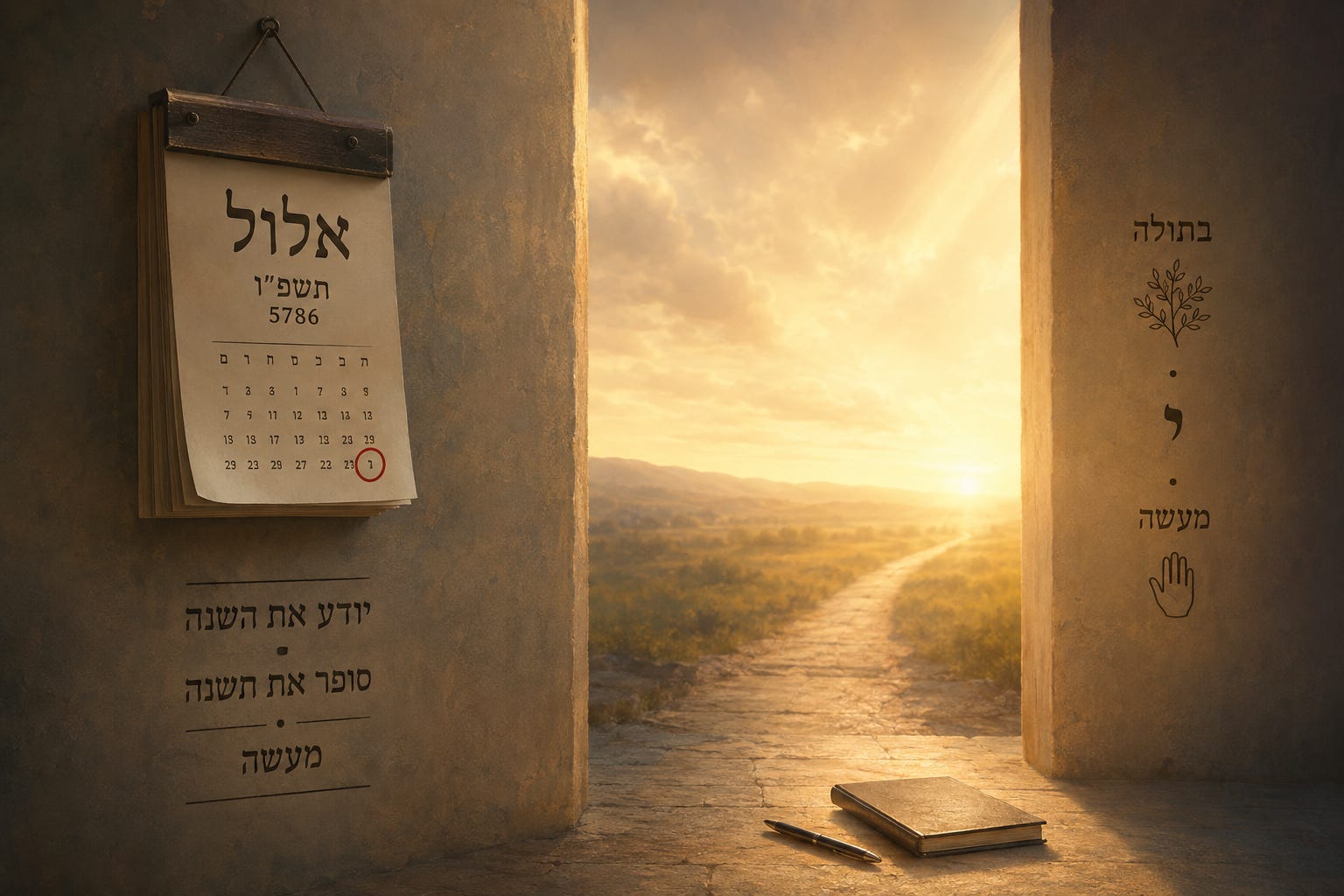
The year is ending. Every one of us knows it. We know how long it has been. We know, in some general way, how the year went — where it was hard, where it was good, and what we did not manage to do. None of this requires being told. The calendar supplies the number, and memory supplies the rest.
And none of it is yet תשובה (return).
✦
According to the נוסח (textual version) of ספר יצירה (Book of Formation) preserved by the Gra, creation is effected through letters, and each of the twelve months is joined to a letter, a מזל (constellation), an אבר (bodily limb), and a particular faculty. These are not merely four labels attached to the same month. They invite us to read them as one structure — the same character appearing in the sky, in the letter, in the limb, and in the כח (faculty) a Yid is given to work with during those weeks.
For אלול, the month standing at the end of the year, ספר יצירה gives the מזל of בתולה (Virgo), the letter י׳, the left hand, and the כח of מעשה (action). Not four observations that happen to coincide, but one formation seen from four בחינות (aspects). The limb already says what the faculty says: the month whose כח is doing is assigned a hand. And it is worth beginning from the faculty itself.
What a מעשה Is
The faculty of אלול is מעשה. That sounds like a push to get busy, but it means something much more precise.
Consider ספירת העומר (the counting of the days between פסח and שבועות). No one has ever been in doubt about which night is the thirty-third. The sequence is fixed, permanent, and known to a child. There is no information to be discovered and none that could go missing, and yet knowing the number does not discharge the חיוב (obligation).
You must count that night, in its order, as your own act. Even where שומע כעונה (hearing is treated as answering) allows a person to fulfill the count through hearing another, the hearing itself becomes his halachic act of speech. Nobody else’s counting creates his count for him. A night that passes uncounted has consequences precisely because an act was not performed, not because a fact was lost. The number was available the entire time, and its availability accomplished nothing.
A count is therefore not satisfied by the availability of its result. This is different from קידוש החודש (the sanctification of the month). בית דין (the rabbinical court) fixes the months for all of כלל ישראל (the Jewish people), and every Yid receives the established month without personally performing the act. What בית דין produces is a status, and that status can be established for everyone.
ספירת העומר does not work that way. The תורה says וּסְפַרְתֶּם לָכֶם. The count rests upon each person himself because there is no communal result that can simply be delivered to him. The personal act is the whole of it.
That gives us the distinction we need: a year whose number we merely know is an accounting. A year whose number changes what we do is a count.
✦
אלול is not the month in which we learn how the year went. That is the accounting, and the calendar has already provided it. I know it was a hard year. I know I am a year older. I know what I did and did not do. All of it is true, all of it is available, and all of it is as inert as knowing which night of the עומר it is.
אלול is the count. Like every count, it cannot be discharged by the availability of its result, nor can it be performed for us in the way בית דין establishes the month for everyone. There is no בית דין that can sit and declare us returned. The obligation rests upon the person himself, and there is nothing behind the act that some other means could deliver.
That is the whole of what the month asks. The remaining components tell us how.
בתולה
Why should the month of מעשה be represented by a בתולה?
A בתולה represents something whose first entry still lies ahead. Not innocence, and not a record without blemish. The past may already contain pain, failure, and חטא (sin). What cannot be restored is the firstness of what has already been entered. Read this way, we can begin to understand why בתולה belongs at the end of the year rather than its beginning.
אלול does not tell us that the year behind us can be made untouched. תשובה is not denial. It does not ask us to pretend that the חטא never happened, that the pain was never felt, or that the opportunities were never wasted. אלול tells us that although the past cannot be un-entered, the future has not yet been entered.
The previous year is complete. The coming year is still a בתולה. It has not yet been claimed by our habits, our failures, or our weaknesses. We carry the knowledge of what happened without being obligated to repeat it.
Nor is the past inert. ריש לקיש teaches that תשובה מאהבה (return out of love) reaches further back than תשובה מיראה (return out of fear). In יומא פ״ו ע״ב, he teaches that through תשובה מאהבה, זדונות נעשות כזכיות — deliberate sins become merits. They are not merely set aside. They are converted.
The claim was never that the past can be erased. It is that the past can become the material of something else. Its irreversibility is precisely what makes conversion the path that remains. תשובה does not make us people without a past. It makes us people whose past has become the foundation of a different future.
This adds another dimension to the position of אלול before the coming judgment. ראש השנה will be the day of דין (judgment), but אלול teaches us to approach Hashem before we are forced to stand before Him in judgment. It was on ראש חודש אלול that משה ascended for the third period of forty days. At their end, on יום הכיפורים, he returned with forgiveness, as described in פרקי דרבי אליעזר פרק מ״ו and brought in טור אורח חיים סימן תקפ״א.
The month was fixed as a time of seeking before the day of judgment arrived. During אלול, we seek Hashem on our own through אֲנִי לְדוֹדִי וְדוֹדִי לִי, from שיר השירים ו׳ ג׳, whose initial letters form the name of the month. I turn toward my Beloved, and my Beloved turns toward me. We do not wait until the King is seated in judgment. We come because we want the relationship, and not merely because we fear the consequences of its absence.
That gives the return of אלול the possibility of becoming a return of אהבה rather than only יראה — the very distinction that determines how far back תשובה can reach.
י׳
The letter of אלול is the י׳. It is the smallest of the letters, a concentrated point containing the beginning of everything that will later develop from it. It appears almost insignificant.
אלול is that point within the coming year. It stands at the end of the previous year and is already the seed of what follows. The form that ראש השנה and the year after it can take is determined by what is formed now. We cannot anoint Hashem as our King without first forming within ourselves the point from which that מלכות (kingship) can grow.
But a point is not yet a מעשה, and this month was given to action. A feeling of regret is not תשובה. A desire to change is not change. The point must expand into form.
That does not mean transforming everything at once. A י׳ is small. It may be one corrected habit, one commitment in learning, one improvement in תפילה (prayer), one repaired relationship, or one area in which we finally stop deceiving ourselves. But it must become מעשה. It must be something concrete enough to enter the coming year with us.
✦
The practical demand here is familiar enough, and that is exactly the danger. Familiar things get discussed rather than done, and אלול can disappear while we are still describing what we intend to do during it. Discussion is accounting. What is required is the count.
Take a few minutes each day. Examine the year that is ending, recognize the marks it has left, and choose the point from which the next one will begin. Give that point a form, a time, and a minimum that can actually be kept. Then begin it now.
That is the בתולה of אלול: not that the year behind us was untouched, but that the year before us still is. That is the י׳ of אלול: the small, pure point from which an entire form can emerge. And that is the מעשה of אלול: the responsibility to take that point and make it real, because there is no one to whom it can be handed.
The calendar can tell us how much time has passed. It cannot count the year for us.
May we be זוכה (worthy) to complete this year with אמת (truth), to enter the coming year with purity and purpose, and to merit a year of ברכה (blessing), growth, closeness, and great prosperity.