


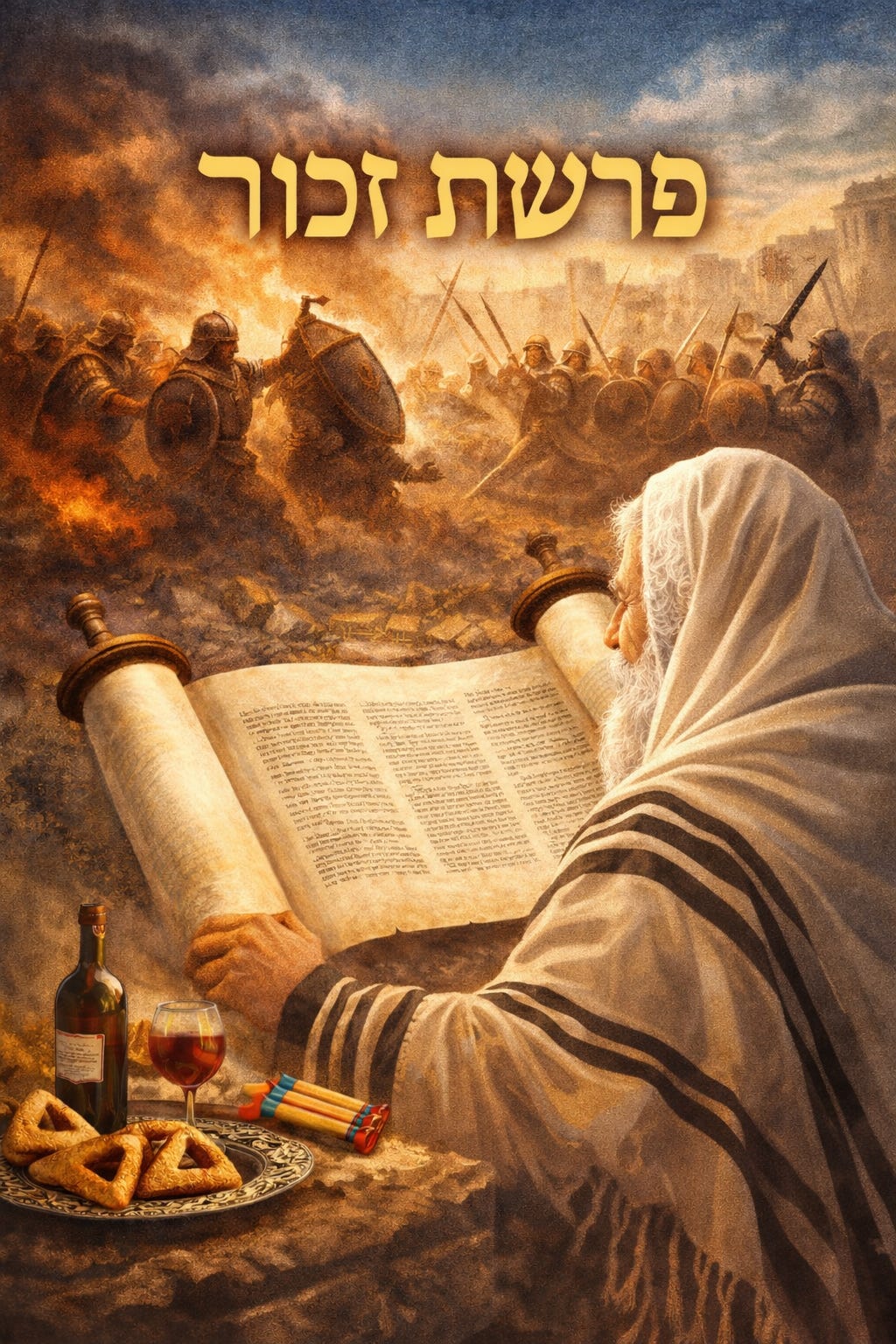
Every year when we reach פרשת זכור (Parashas Zachor), I find myself bothered—in a good way—by a famous move of the תרומת הדשן 108 (Terumas HaDeshen). He doesn’t just say “Zachor is important.” He goes further: he reads a well-known Gemara as if it is pointing directly to Zachor, and he builds a major practical conclusion on that.
The Gemara in ברכות (מז:) (Berachos) tells of ר’ אליעזר (Rabbi Eliezer) who came to shul, found only nine people, and freed his עבד (slave) to complete a minyan. The Gemara says the justification is מצוה דרבים (a mitzvah of the community). The simple assumption when we hear “we need ten right now” is that we’re dealing with the minyan-only parts of prayer—קדיש (Kaddish), קדושה (Kedushah), ברכו (Barchu), and the like. That is the natural reading of the sugya.
But the תרומת הדשן (Terumas HaDeshen) famously takes a different path. He says: the Gemara’s case can be understood as referring to the public reading of פרשת זכור (Parashas Zachor). In his teshuvah, he uses that to argue that Zachor is so weighty that people should travel from villages without a minyan to hear it with a minyan, and he even frames it as more urgent than ensuring a minyan for מגילה (Megillah).
That is exactly what bothered me: where did he get Zachor from? And why would Zachor be the right example of a “mitzvah of the community” that justifies an extreme step?
What helped me was realizing that the discussion changes once we separate two layers that we usually blend together: the Torah’s mitzvah-content, and the way Chazal staged that mitzvah inside Jewish communal life.
The Torah command at the heart of Zachor is זכירת עמלק (remembering Amalek). On a raw level, that mitzvah is about memory and speech—about ensuring the event and its meaning never become “ancient history.” But the Torah itself doesn’t spell out the exact performance format the way we do it: it doesn’t say “read it publicly from a scroll, on this Shabbos, with ten.” Those details come from the way Chazal and the Jewish community gave the mitzvah a concrete, national form.
And this is the key move—really, it’s the תרומת הדשן (Terumas HaDeshen)’s opinion once you read him carefully, he doesn’t say much but his words have to make sense with the gemara he quotes. A mitzvah can be Torah-level in its essence, and yet the “official” way it gets carried out can be shaped by rabbinic structure. In the case of Zachor, the practice became embedded as the fulfillment of the Torah obligation into קריאת התורה (public Torah reading). Once Zachor is placed inside that public institution, the question of “does it require ten?” becomes more precise. It’s no longer “did the Torah write ‘minyan’ into the mitzvah of remembering?” It becomes: once the mitzvah is expressed through public Torah reading, doesn’t it inherit the rules of that institution?
That’s exactly what happens. קריאת התורה (public Torah reading) isn’t just individuals reading a passage; it’s a ציבור (community) act, a communal institution. Chazal treat it as something that simply doesn’t take place in its formal sense without ten. So even if the underlying Torah mitzvah of remembering could theoretically exist in another form, the halachic Zachor that the community is charged with—Zachor as Chazal built it—lives inside a framework that is inherently minyan-dependent.
Now the תרומת הדשן (Terumas HaDeshen) reads much more smoothly. He doesn’t have to be saying, “the Torah itself requires a minyan for Zachor.” He can be saying: the communal enactment of Zachor is carried out through a public institution that is ten-dependent, and therefore it fits perfectly into the category of מצוה דרבים (a mitzvah of the community). So when the Gemara describes an extreme step taken to restore a communal mitzvah, Zachor is a very reasonable candidate—at least within the halachic framework Chazal created. The reasoning isn’t explicit, we must interpret and understand the meaning behind this perplex opinion.
This also illuminates a question that always lurks in the background: if Zachor is so central, why don’t we make a special ברכה (blessing) like “...על קריאת זכור”?
On one level, the technical answer is simple: since Zachor is carried out as Torah reading, it comes with the standard Torah-reading blessings. But it feels like there’s more to it, and here too the תרומת הדשן (Terumas HaDeshen)’s framework helps.
Zachor isn’t a “pleasant” mitzvah. It is tied to tragedy, hatred, and the painful necessity of confrontation. The mitzvah of מחיית עמלק (erasing Amalek) is not a goal we celebrate; it is a grim demand of a world in which such evil exists. There’s an instinct in halachah that not everything deserves its own standalone blessing—especially acts that exist because of a broken reality or a result of something negative (נותר). A unique blessing “on Zachor” could sound like we are blessing the very fact that Amalek exists as a subject in our lives.
And yet the opposite extreme also doesn’t work. If Zachor were done with no blessing at all, it could feel casual, almost like a historical reading—precisely the opposite of what the Torah wants. So the solution is elegant: we don’t bless “Amalek,” but we do bless the Torah. We place Zachor into the most dignified public vessel we have—public Torah reading with its blessings—so it gets maximum seriousness without turning its subject into a standalone object of blessing. In short: we bless the Torah, not Amalek, but we insist the confrontation with Amalek be carried out with Torah weight.
At this point it pays to bring in a classic angle that adds real gravity. The ספר החינוך (Sefer HaChinuch) famously frames Zachor in close relationship with war. He links the mitzvah of remembering to the national mission of erasing Amalek—meaning, Zachor is not merely “remember a story,” but “keep alive the posture and commitment that leads to action.” Whether one accepts all the Chinuch’s conclusions (and the מנחת חינוך (Minchas Chinuch) famously pushes back on some implications, especially regarding women), the Chinuch’s framing does something important: it makes Zachor unmistakably a national mitzvah, not a private inspiration.
That war-correlation helps explain why Chazal would naturally stage the mitzvah as a public act. War is not fought by lone individuals; it’s fought by a people. If Zachor is the spiritual and moral engine of a national mission, it makes perfect sense that it is performed in a ציבור (community) setting, through the communal institution of Torah reading. Zachor isn’t merely a memory; it’s a national stance.
Now the hashkafic piece clicks even more. Purim is the story of a nation almost wiped out (by Haman who was indeed from Amalek!). But the danger after salvation is not only physical. A people can survive and then “cool off” as the language of the Torah is “אשר קרך בדרך”—lose intensity, drift, secularize, and make covenant feel optional. That is precisely how many understand Amalek on the inner plane: the force of ליצנות (scoffing) and ספק (doubt/uncertainty) (עמלק is the gematria of ספק)—the voice that says, “Relax. Don’t be so serious. Forget the details.”
But Jewish life is built on דקדוק (precision). Those “details” aren’t fussy technicalities; they are the language of loyalty. Amalek attacks that loyalty not only through violence, but through ridicule and spiritual cooling. And that’s why Chazal placed Zachor right before Purim, and why the תרומת הדשן (Terumas HaDeshen) was so emphatic about treating it as a communal obligation. Right before we celebrate survival, the ציבור (community) stands up and declares—formally, publicly, through Torah reading—that we will not cool off into casualness. We will not let scoffing make mitzvos feel small. We will not let “forget the details” become our philosophy.
And that brings me back to what originally bothered me. The discomfort was the sense that someone was inventing a Torah-level minyan requirement for Zachor. The more satisfying read is subtler—and it is essentially the תרומת הדשן (Terumas HaDeshen)’s own framework: the Torah commands memory; Chazal embed that memory into the communal institution of Torah reading; and once that happens, the mitzvah takes on the communal “shape” of that institution—minyan, structure, blessings, dignity. The absence of a unique blessing now fits too: we do not “bless Amalek,” but we insist that the fight against Amalek—externally in history and internally in spirit—be carried out with Torah seriousness.
And here’s the מוסר (ethical takeaway). The Torah doesn’t ask us only to remember our need to destroy Amalek as a nation. It asks us to wipe out the Amalek mentality inside ourselves: the pull toward ספק (doubt/uncertainty), the reflex of ליצנות (scoffing), the voice that says, “Don’t be so serious—forget the details.” The only way to do that is to live a Torah-true life where mitzvos matter, where the small things matter, where we don’t negotiate away commitment.
If we remove ספק (doubt/uncertainty) and replace it with אמונה (faith), if we refuse to be scoffers and instead live with יראת שמים (fear of Heaven), then we can walk into Purim differently. We can embrace the שמחה (joy) of Purim not as noise or escape, but as a deep, clean joy—a joy that comes from meaning. We become capable of being מקבל תורה בשמחה ובאהבה (accepting the Torah with joy and love), and doing it with a real smile.
May we all be זוכה (merit) to destroy our own personal Amalek in our lives, and may it bring משיח צדקנו (our righteous Messiah) במהרה בימינו (speedily in our days).