

There was a time I messed up an interaction with another person. I didn’t speak kindly to a peer and was too sharp and was rude. I meant well, but I did the wrong thing; I upset him. I remember feeling so frustrated with myself that I had this thought: Why can’t I just lock myself away for a few years, learn תורה (Torah), work on my מידות (character traits), and leave all this behind? Why do I need all this friction with people?
And the more I think about it, the opening of our פרשה (section) seems to be answering exactly that question.
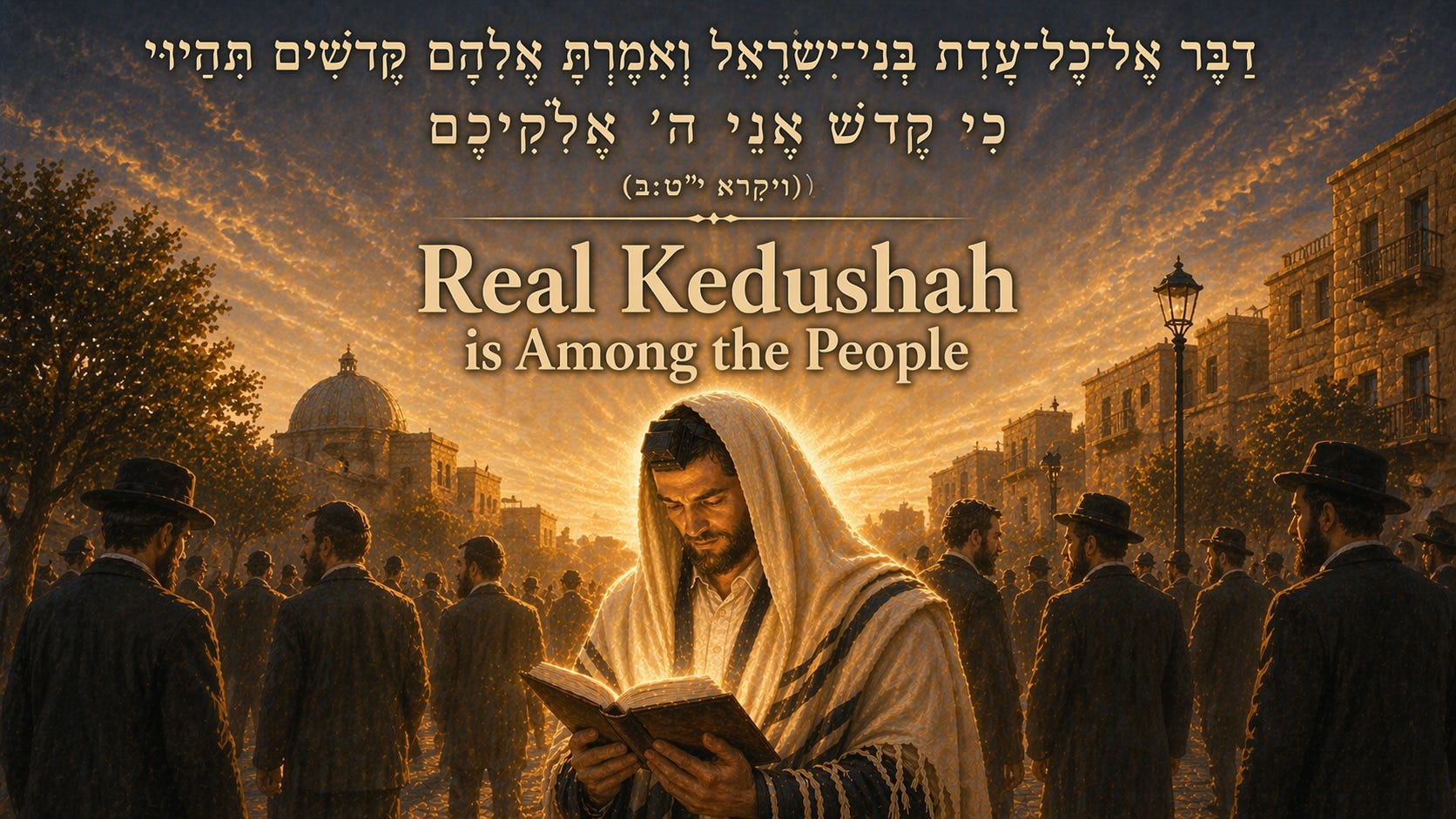
“דבר אל כל עדת בני ישראל ואמרת אליהם קדושים תהיו כי קדוש אני ה׳ אלקיכם”
If holiness meant escape, the תורה should have said: Pull away. Go inward. Separate. Become less involved, less exposed, less entangled. But instead, the mitzvah of קדושה (holiness) is given specifically in the framework of כל עדת בני ישראל — the whole עדה (congregation). Be holy, yes. But be holy inside the world of other Yidden.
That itself is strange. The כלי יקר notices the word עדה and ties it to דבר שבקדושה (matter of sanctity requiring a quorum), to the world of ציבור (community), of ten. But then when you look at the mitzvos in the parshah, they are mostly not communal mitzvos at all. They are mitzvos of the יחיד (individual): parents, Shabbos, speech, money, revenge, honesty, עריות (forbidden sexual relations), love your fellow. So why is the whole thing framed through the language of עדה?
At first glance, the answer might be simple: There is no holy ציבור without holy individuals. If each person is coarse, dishonest, indulgent, and self-serving, then the ציבור they form will not somehow become holy on its own. The holiness of the many depends on the holiness of the one.
But I think the תורה is saying something deeper.
The danger in קדושים תהיו is not only that a person will ignore it. The danger is also that he will misunderstand it. He will hear “Be holy,” and imagine that holiness means distance. Withdrawal. Escape. Less life. Fewer people. Less mess. He will think that if ordinary life is complicated, then maybe the holiest thing would be to leave it behind.
That is exactly why the תורה says “דבר אל כל עדת בני ישראל.” The mitzvah itself comes with a built-in boundary. Holiness is not meant to turn a person into a spiritual exile. It is not meant to remove him from the עם (people). It is meant to teach him how to live a higher life within the עם.
And that is where Rashi and Ramban become so important.
Rashi says, “הוו פרושים מן העריות ומן העבירה.” Holiness begins with restraint. A person cannot be holy if every desire gets indulged, if every impulse gets obeyed, if there is no גבול (boundary) anywhere. Kedushah means not living at the mercy of instinct. And Rashi’s language is exact. עריות are included in עבירה, of course, but he singles them out because this is the central battlefield. Holiness is particularly tested where physical desire is strongest.
But Ramban says something even deeper: Without this mitzvah, a person can become a “נבל ברשות התורה” — low, vulgar, indulgent, and still technically within the rules of תורה. That phrase is so incisive because it means that permission is not enough. מותר (permitted) is not yet קדוש. Legal is not yet elevated. A person can live inside the formal boundaries of halachah (Jewish law) and still be spiritually unaccomplished.
Being careful with mitzvos is the baseline. A person must know the lines and keep within the lines. But it is when a person embraces קדושה that he truly begins to become someone who walks with Hashem. קדושה begins where a person no longer asks only how not to fall, but how to live higher.
That, I think, is the real heart of the mitzvah. קדושה is more than permission. It is elevation. It is when a person asks not only, “Am I allowed?” but also, “Who am I becoming through this?” The opposite of קדושה is not only עבירה (sin / transgression). It is also settling for a life that is technically acceptable and spiritually unimpressive.
But maybe there is something even more profound in the פסוק itself. The תורה does not just say קדושים תהיו. It adds: “כי קדוש אני ה׳ אלקיכם.” And that itself needs understanding. Why give a reason? A mitzvah is a mitzvah. Why not just say: Be holy?
Maybe the answer is that here the reason is part of the mitzvah. Without “כי קדוש אני,” we would fill in the word קדושה with our own imagination. One person would think it means chumros (stringencies). Another would think it means complete withdrawal from physical life and possessions. Another would think it means mystical intensity. Another would think it means private spiritual extremism. So the תורה tells us: Your holiness is not self-defined. כי קדוש אני. The model is Me.
That sounds very close to והלכת בדרכיו (and you shall walk in His ways), but it is not exactly the same. והלכת בדרכיו is focused בעיקר on מידות (character traits). Just as He is רחום (merciful), be רחום. Just as He is חנון (gracious), be חנון. That is imitation of Hashem in the realm of character.
But קדושים תהיו seems more specifically directed to man as a physical being. Its battlefield is גשמיות (physicality): appetite, indulgence, desire, comfort, consumption, the danger of being swallowed even by what is permitted. So the two are clearly linked, but they are not identical. In both cases we are emulating Hashem. But with respect to קדושה, Hashem is not just a model of conduct. He is the שורש הקדושה (root / source of holiness). He is the source from which holiness itself flows. So “כי קדוש אני” means: Your holiness has to be rooted in Mine. Not self-invented holiness. Not whatever feels lofty to you. Real holiness, drawn from the One who is its source.
And maybe that is also part of why this parshah comes after אחרי מות.
נדב ואביהוא were drawn to closeness. They wanted more than the ordinary. But they brought אש זרה אשר לא צוה אותם — a fire of holiness on their own terms, not within the framework Hashem had given. And that is exactly what קדושים פרשת comes to answer. Holiness is not self-authored. It is not seized. It is not something a person inserts into the world because it feels lofty. It is received. It is shaped by ציווי, by גבול, by Torah, by the form Hashem gave it. אחרי מות shows the danger of untethered קדושה. קדושים פרשת teaches the path of true קדושה.
And maybe that also points to something very primal about man himself. אדם הראשון was not created merely to avoid sin. He was created to live in a world illuminated by a deeper light, where גשמיות itself did not have to hide the presence of Hashem. He was שייך to real קדושה. He had the possibility of living in a world where the physical itself could be capable of revealing something higher. And he lost that.
Since then, the עבודה of man is not only to avoid falling lower. It is to repair that loss. Not to remain at the level of the fall, content with the bare minimum, content with “at least I didn’t violate.” קדושים תהיו כי קדוש אני means: Do not be satisfied with technical permission. Reach back toward the holiness for which man was originally made. Embrace the קדושה that אדם הראשון could have lived in and that we are still trying to recover.
But that repair does not happen through isolation. Already at the beginning of creation the תורה says: “לא טוב היות האדם לבדו.” In fact, אדם הראשון was given חוה, because man’s completion was never meant to happen alone. So too our return to קדושה is not through fleeing life, but through sanctifying life with others — through marriage, family, responsibility, and ultimately בתוך (within) כל עדת בני ישראל.
But once you say we must continually strive higher, a new danger opens up. If holiness means going beyond the minimum, how do you know where to stop? Maybe a person should keep separating more and more? Why not become Rashbi? Why not retreat from ordinary life altogether?
That is why the framework of עדה matters so much. Because the תורה wants more than just avoidance of עבירה, but it also does not want disappearance from life. Even someone like a נזיר, who takes on more than the תורה required, is still called a חוטא (sinner). That means something very important: More separation is not automatically more holiness. There is such a thing as too far. There is a kind of withdrawal that stops serving תורה and starts shrinking life.
So the goal is not simply to run from the חול (ordinary / mundane). The goal is to be מקדש the חול — to sanctify ordinary life.
That is the Torah’s vision of קדושה.
Not a cave.
Not bread and water forever.
Not escaping people.
Not leaving behind the burdens and gifts of being human.
But taking life itself and raising it.
Eating, but with dignity and ברכות (blessings).
Marriage, but with קדושה.
Business, but with honesty.
Speech, but with care.
Family, friendship, work, responsibility, children, community — all the ordinary places of life becoming places where Hashem is served.
And this is where something my mashgiach, HaRav Beryl Weisbord שליט״א, once told me that has stayed with me. When I was frustrated with myself and said, “Why can’t I just lock myself away for a few years and work on myself like Rashbi?” the answer I got back was simple:
If Hashem wanted that, He would have made the world so.
If isolation were the ideal path for us, that is how Hashem would have built our עבודת ה׳ (service of Hashem). But He didn’t. He built a world of people. A world of ציבור. A world of family, marriage, children, neighbors, misunderstandings, obligations, repair, and return. Which means that the place where He wants most of us to become holy is not outside of life, but inside of it.
That is not a compromise. That is the plan.
So yes, a person should want more. He should raise the bar. He should refuse to become a נבל ברשות התורה. He should push himself beyond what is merely comfortable, beyond what is merely permitted. But he should do that in a way that elevates the ציבור rather than leaving it behind. Let him become the rav, the tzaddik (righteous person), the one who lifts the room. But not by becoming so separate that he is no longer part of the room.
Maybe that is the deepest meaning of the opening of the פרשה:
“דבר אל כל עדת בני ישראל ואמרת אליהם קדושים תהיו”
Your holiness is not meant to sever you from the people. It is meant to deepen your place within them. The measure of קדושה is not how far you can get from ordinary life, but how high ordinary life can be lifted by your own personal עבודה (service).
So the mitzvah is more demanding than we think, because it does not let us hide inside technical permission.
And it is more human than we think, because it does not ask us to become angels. As we know, an angel has a single foot; he does not “walk” in the conventional sake. We are people. We walk, we grow, we struggle, we are real. That is why the Torah was given to us, and not to the angels.
It asks us to become holy human beings.
To live among other people.
To carry the beauty and burden of ordinary life.
To show up for the ציבור.
To build a home.
To raise children.
To repair what we break.
To be inspired, to get inspired, and to inspire others.
May we be זוכה to hear the call of קדושים תהיו in the way the תורה meant it to be heard: not as a push to run away from life, and not as an excuse to settle for what is merely permitted, but as a demand to become greater within life itself. May we strive for real קדושה — attainable קדושה, honest קדושה, קדושה with real goals, among real people, in the midst of real life. May our קדושה be rooted not in our imagination, but in the Ribbono Shel Olam, who is the שורש הקדושה. And may our pursuit of holiness never come at the expense of those around us. Rather, may it refine us without making us harsh, elevate us without making us distant, and expand us without making us act smaller toward others. May we be זוכה not to settle for the bare minimum, but to embrace the קדושה for which man was originally created — and to recover it not alone, but together, בתוך כל עדת בני ישראל. And may our קדושה lift us upward while also lifting the people around us, so that through us there is more אמת (truth), more warmth, more growth, and more מקום for the שכינה (Divine Presence) within כל עדת בני ישראל. Through that effort may we usher in משיח צדיקנו.