

We know that the תורה is not a history book.
The very first Rashi in בראשית asks why the תורה begins with the story of creation. If the תורה is a book of mitzvos, it should have begun with the first mitzvah given to כלל ישראל (the Jewish people):
החדש הזה לכם
So already from the beginning of תורה, we know that when the תורה tells us “history,” it is not simply recording what happened. It is teaching us something eternal.
That makes the Ramban’s הקדמה (introduction) to ספר במדבר (the Book of Bamidbar) very striking.
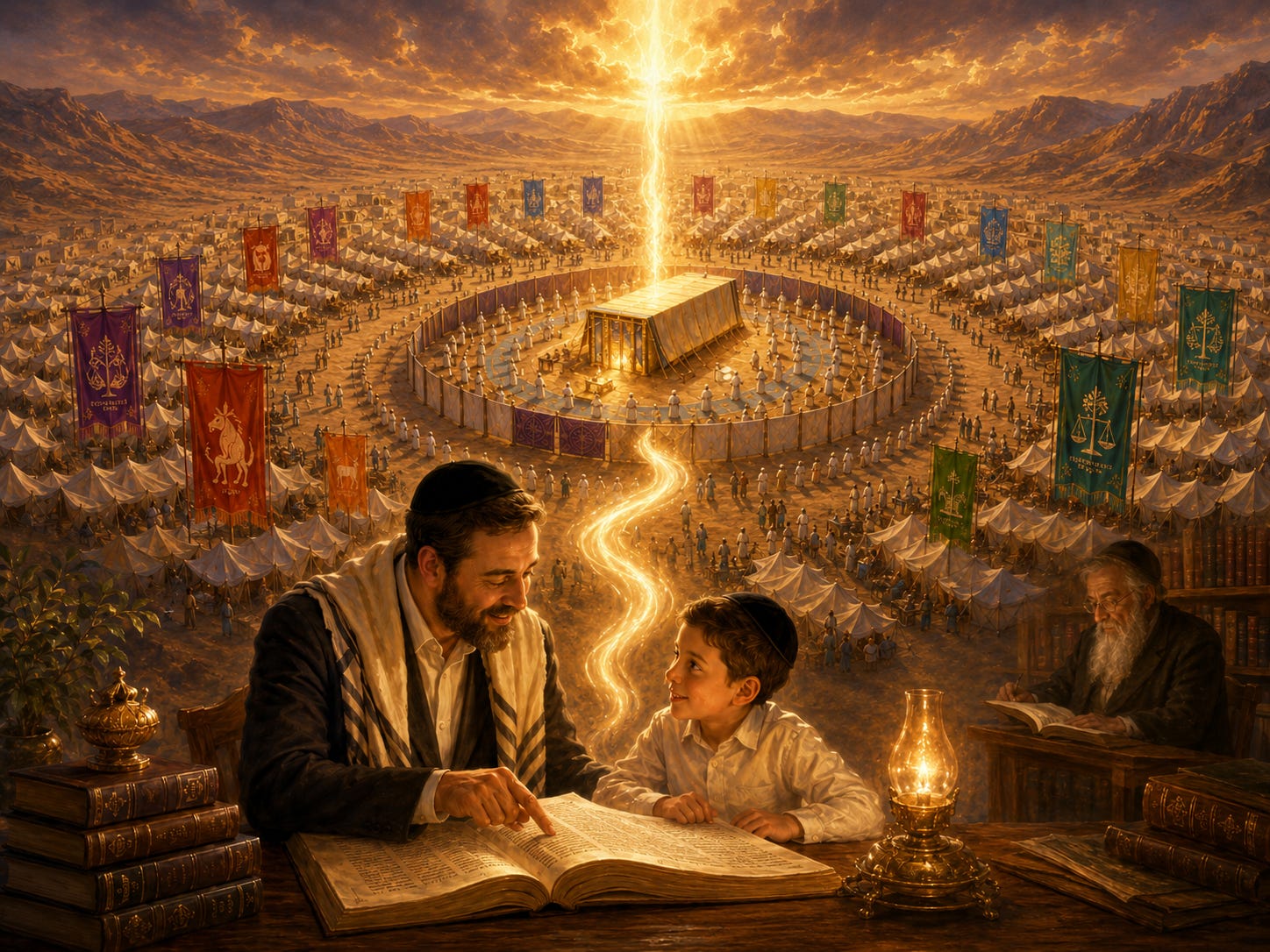
The Ramban seems to say that much of ספר במדבר is about things that were only for that time: the way כלל ישראל camped in the מדבר (wilderness), the way they traveled, the דגלים (flags/banners), the arrangement around the משכן (Mishkan), and the role of שבט לוי (the tribe of Levi).
But if the תורה is not a history book, why do we need an entire ספר devoted to the temporary arrangement of כלל ישראל in the מדבר?
Perhaps the answer begins with the first Rashi in our parsha.
Rashi says that Hashem counts כלל ישראל again and again because of חיבה (dearness/love). They are precious to Him, so He counts them.
That is already a different way of reading ספר במדבר. Not just the book of how they camped — the book of how Hashem looked at כלל ישראל with love and arranged them around Him.
Counting is not usually the language of ברכה (blessing). חז״ל (our Sages) say:
אין הברכה מצויה אלא בדבר הסמוי מן העין
ברכה is only found in something hidden from the eye.
The גמרא (Gemara) teaches that before a person measures his grain, he can daven that Hashem should send ברכה into it. But after he already measured it, to daven that it should increase is a תפלת שוא (a vain prayer). As long as it remains uncounted, there is room for more ברכה. Once it is counted, it becomes fixed.
And this is not only true with possessions. The גמרא (כב יומא) is explicit: counting בני ישראל directly is a לא תעשה (negative commandment). The source is the opening pasuk of the הפטרה (Haftorah) we read every year for
פרשת במדבר . (הושע ב:א):
והיה מספר בני ישראל כחול הים אשר לא ימד ולא יספר
The number of בני ישראל will be like the sand of the sea — that cannot be measured and cannot be counted.
R’ Elazar holds that this is one איסור (prohibition). Rav Nachman bar Yitzchak holds it is two: לא ימד and לא יספר are each a separate violation.
Think about that. The very words that forbid counting are the opening of the הפטרה for the parsha that is filled with counting. This is clearly not a coincidence; this was made to show us the tension and want us to feel it. Hashem counts — but no one else may.
That is why even in the בית המקדש, when the כהנים drew lots for the עבודה, they counted fingers — but not people. We count Yidden with a פסוק (verse), with coins, with anything but a direct number on a human head.
Why?
Because we do not want to reduce a Yid to a statistic, to a unit, to something trivial or mundane. A Yid is not “number seven” in a room. A Yid is not inventory. A Yid is a soul, a world, a חלק אלוק ממעל (a portion from Above). Human counting can flatten. It can make something holy into something ordinary.
If counting can limit ברכה, and if we are so careful not to count Yidden directly, why does Hashem count כלל ישראל again and again?
The answer must be that Hashem’s count is not like our count.
When we count, we can reduce. When Hashem counts, He reveals חיבה.
Hashem does not reduce a Yid to a number. He reveals that this Yid counts.
It is like when a child gets a new toy. He looks it over, puts it away, and then comes back to check it again. Not because he forgot what he has. Because he loves it. It is precious to him.
כביכול (so to speak), Hashem counts כלל ישראל because they are precious.
But immediately, the תורה says something very surprising:
אך את מטה לוי לא תפקד ואת ראשם לא תשא בתוך בני ישראל
Do not count the tribe of לוי. Do not lift their heads among בני ישראל.
It does not merely say that לוי was not counted. It sounds active. Almost like a לא תעשה (negative commandment): do not count them.
Why not?
Are they not part of כלל ישראל?
And if counting expresses חיבה, why is לוי left out?
The answer is that לוי is not left out because they are less beloved. They are left out because they are קודש (holy).
The rest of כלל ישראל is counted from twenty years old:
מבן עשרים שנה ומעלה כל יוצא צבא בישראל
This is not a count of every soul in כלל ישראל. It is a count of the מחנה (camp) in its public, national strength. At thirteen, a boy is already obligated in mitzvos. But twenty represents a fuller stage of maturity and responsibility. These are the men who can stand as יוצאי צבא, those who go out to the army. They carry the burden of the nation in the world.
That is not a small thing. כלל ישראל needs that. כלל ישראל needs people who build homes, fight wars, settle the land, raise families, create society, and live Torah in the physical world.
That is the גשמיות (material/physical responsibility) of כלל ישראל.
But לוי’s contribution is different.
לוי is not counted as יוצאי צבא because לוי’s contribution is רוחניות (spirituality). לוי belongs to the משכן. He surrounds the משכן. He guards the משכן. He creates the boundary of קדושה (holiness) around the center of the מחנה. The תורה says that if a זר (outsider/non-Levi) comes close, he dies.
The rest of כלל ישראל carries the camp. לוי guards the meaning of the camp.
So לוי is not excluded from כלל ישראל. לוי is isolated because לוי is holy. Counting defines. If לוי would be counted with everyone else, לוי would be defined by the ordinary count of בני ישראל. But לוי is not ordinary. לוי is קודש.
And then the תורה does count לוי — but only in relation to the משכן.
לוי is not uncounted. לוי is counted differently.
The rest of כלל ישראל stands with their דגלים around the center. לוי belongs to the center itself.
Why does the תורה make such a big deal about the דגלים? What is the beauty of flags? Is it just pageantry?
It seems not.
The דגלים show us a layer of כלל ישראל that we no longer really have. Today we have ספרדים, חסידים, מתנגדים — different קהילות (communities), different מנהגים (customs). But that is not the same thing as שבטים.
A שבט had its own flag, its own place, its own land, its own identity. The land itself was divided by שבט. כלל ישראלwas not meant to be a blurred mass of people. It was meant to be one nation made up of distinct holy parts.
We see how seriously the תורה treats this from the incident with בנות צלפחד. Their inheritance question was not only about land. The תורה was concerned that נחלה (inheritance) might pass from one שבט into another. The boundaries of the שבטים had to be protected. Each שבט had its own rooted identity, its own מידה (spiritual quality) to reveal within כלל ישראל.
And the גמרא at the end of תענית says that ט”ו באב was one of the greatest days for כלל ישראל — because on that day, the שבטים were allowed to marry across tribal lines. That only makes sense if the boundaries between שבטים were real to begin with. First, each שבט had to have its identity. Then the שבטים could be joined. The joy was not that the differences never mattered. The joy was that after the identities had been established, the שבטים could join together.
The דגל was the color of that identity in the מדבר. The נחלה was that identity planted in the land.
And yet — look around today. The other שבטים have blended into the broader כלל ישראל. We no longer know who is Reuven, who is Shimon, who is Zevulun. But לוי remained. כהונה (priesthood) remained.
Why?
Because לוי was never defined by land like the other שבטים. לוי had no regular נחלה. Rather, לוי was defined by קדושה, by עבודה (service), by תורה, by specific halachos. The visible tribe that endured is the tribe that reminds us that כלל ישראל must always have a center of רוחניות. The דגלים may no longer be visible. But the קדושה of לוי still is. It is not coincidental that the שבט without land is the only שבט whose identity has endured the test of time.
Then the parsha turns to לוי even more directly. The תורה says:
הקרב את מטה לוי
Bring the tribe of לוי close.
לוי is not merely counted. לוי is brought close. And more than once, the תורה says:
והיו לי הלוים
The לויים are Mine. They have no regular נחלה like the other שבטים. They are not defined by ordinary national life. They are devoted to Hashem.
But the Rambam at the end of (הלכות שמיטה ויובל (יג:יב tells us who לוי really is:
ולמה לא זכה לוי בנחלת ארץ ישראל ובביזתה עם אחיו? מפני שהובדל לעבוד את ה׳ לשרתו ולהורות דרכיו הישרים ומשפטיו הצדיקים לרבים
Why did לוי not receive a portion in ארץ ישראל like his brothers? Because he was set apart to serve Hashem — and to teach His ways and His judgments to the masses.
לוי has two functions, not one. עבודה and הוראה (teaching). They serve Hashem at the center, and they bring Hashem’s תורה outward to כלל ישראל.
That is who לוי is.
And now the תורה tells us something crucial: לוי stands in place of the בכור (firstborn).
Hashem says:
ואני הנה לקחתי את הלוים מתוך בני ישראל תחת כל בכור פטר רחם מבני ישראל והיו לי הלוים
The לויים are taken from within בני ישראל “in place of every בכור.”
And immediately the next פסוק explains why:
כי לי כל בכור ביום הכתי כל בכור בארץ מצרים הקדשתי לי כל בכור בישראל מאדם עד בהמה לי יהיו אני ה׳
Every בכור belongs to Hashem because on the day Hashem struck the בכורי מצרים, He sanctified the בכורים of ישראל, מאדם עד בהמה — from man to animal.
לוי is the replacement for the בכור. The בכור came from every home.
Originally, the בכור was the כהן of the family. The source of קדושה was not isolated in one שבט. It existed inside every family.
Every home had a בכור. Every home had its own representative of עבודה. Every family had a direct link to Hashem’s service.
This did not begin after חטא העגל (the sin of the Golden Calf). Already by מכת בכורות and at the end of פרשת בא, the בכור is sanctified. Hashem says that the בכורים belong to Him — מאדם עד בהמה.
That phrase is important. By man, the בכור was connected to service. But by animal, the animal itself becomes sanctified. So בכורה is not only a job. It means the first emergence of life, strength, family, blessing, and productivity belongs to Hashem. The family looks at its first child, its first strength, its future — and the תורה says: the first belongs to Hashem.
But after חטא העגל, that changes. And the תורה wants us to understand why it was specifically לוי.
It is brought down in our mesorah that שבט לוי was not part of the שעיבוד (enslavement) in מצרים. While the rest of כלל ישראל was being crushed by labor, שבט לוי remained set apart, holding on to the מסורה (tradition) of אברהם, יצחק, and יעקב.
So when משה came down from the mountain and saw the עגל, he called out:
מי לה׳ אלי
Whoever is for Hashem, come to me.
And the תורה says:
ויאספו אליו כל בני לוי
All of שבט לוי gathered to him. Only שבט לוי. At the moment of the nation’s deepest spiritual failure, one שבט as a whole stood with Hashem.
And immediately, משה says to לוי:
מלאו ידכם היום לה׳
מלאו ידכם is the language of being inducted into priestly service. Right there, in פרשת כי תשא, שבט לוי is being inaugurated as the new keepers of עבודה.
So the עבודה did not transfer to לוי arbitrarily. It moved to the שבט that had remained קדוש when it mattered most. The role of the family בכור found its true home in the שבט that had carried קדושה through.
לוי is not just a special group replacing everyone else. לוי is the concentrated form of what used to exist inside each family.
The בכור was family-based קדושה. It is שבט לוי that is the tribe based on total devotion.
And this may explain why לוי is counted from one month old.
The תורה counts לוי:
מבן חודש ומעלה
From one month and up.
That must connect to the בכור. As we know, פדיון הבן (redemption of the firstborn son) is done after thirty days, on the thirty-first day. That is when the בכור becomes established as the בכור who must be redeemed.
So the one-month-old לוי stands in place of the one-month-old בכור.
The תורה is lining them up. The בכור of each home once represented that home’s link to עבודה. Now Hashem says: I am taking לוי instead. והיו לי הלוים — the לויים are Mine.
כלל ישראל is counted from twenty, when a man can carry the גשמיות responsibility of the nation. לוי is counted from one month, because לוי is not being counted for physical capacity. לוי is being counted for קדושה. He belongs to Hashem from the beginning.
If that role moved from the family to לוי, what remains in the family today?
Remember: לוי inherited two things from the בכור. עבודה and הוראה. The בכור of each family had been the family’s link to קדושה in both directions — bringing service upward and being the spiritual anchor of the home, inwards. When that role concentrated in לוי, both pieces went with it.
Today we have neither משכן nor בית המקדש. The עבודה of לוי waits for the גאולה (redemption).
But the הוראה cannot wait.
תורה has to keep being transmitted, in every generation, without a pause. The teaching function that לוי used to carry for the whole nation has to come back somewhere.
It comes back to the home.
The Rambam in הלכות תלמוד תורה (laws of Torah study) teaches that a father must teach his son. There is also an obligation to teach others — but one’s own son comes first.
At first, that sounds obvious. Do we need to be taught that our own child comes first?
Maybe yes.
Because our love for another Yid is supposed to be so real that another person’s child is also our responsibility. A Yid cannot say, “That is not my child, so I do not care.” We are each responsible for כלל ישראל.
But the תורה teaches us ordered love.
First your own child. Then someone else’s child. First the family. Then the broader nation.
Not because we care only about our family. And not because כלל ישראל is only an abstraction. But because קדושה has structure.
That is exactly what ספר במדבר is teaching us.
There is the family. There is the בכור. There is the שבט. There is the דגל. There is לוי. There are כהנים. There is the משכן. And all of כלל ישראל is arranged around Hashem.
Originally, the family’s link to קדושה was the בכור. After חטא העגל, that role moved to לוי — both the עבודה and the תורה.
So today, when we do not have the עבודה in the משכן, the family’s link to קדושה returns through תלמוד תורה. A father teaching his son. A rebbe teaching his talmid. The home becoming the first place where תורה is given over.
The בכור once brought the family into עבודה. It is לוי that brought כלל ישראל into עבודה and תורה. Today, the father and the rebbe bring the child into תורה.
And the Rambam himself, only one perek after he describes לוי’s separation, writes (הלכות שמיטה ויובל יג:יג):
ולא שבט לוי בלבד אלא כל איש ואיש מכל באי העולם אשר נדבה רוחו אותו והבינו מדעו להבדל לעמוד לפני ה׳ לשרתו ולעבדו… הרי זה נתקדש קדש קדשים
Not שבט לוי alone. Every single person, from anyone in the world, whose spirit moves him to set himself apart to stand before Hashem and serve Him — that person becomes נתקדש קדש קדשים.
That is exactly the language the Rambam used for לוי — now applied to anyone who chooses it.
Being a father who teaches תורה in his home is not a consolation prize for not being a לוי. He is performing the inheritance of לוי. The home with תורה in it is the place where the לוי’s function of הוראה lives today. It becomes our own personal מקדש.
That is why ספר במדבר matters forever.
The מחנה itself was temporary. The דגלים are no longer visible. We no longer know our שבטים in that way. לוי no longer surrounds the משכן in the מדבר.
But the structure is eternal.
Ordered love. First the family. Then the שבט. Then the nation. Each part holy in its place, each part standing around the center.
Hashem’s love does not erase structure. It creates structure.
That is the תורה of ספר במדבר. And that is the תורה of every Yiddishe home.
And it is no accident that we live all of this during ספירת העומר. Hashem counts כלל ישראל in the מדבר, and we ourselves count from Pesach toward Shavuos. The count is not meant to reduce us. It is meant to refine us. From the קרבן העומר of שעורים, animal food, toward the שתי הלחם of חטים, the food of אדם — we count our way toward becoming people ready to receive תורה. Hashem counts us with חיבה, and we count ourselves toward responsibility.
May we be zoche to take this תורה with us.
May we learn to count our blessings the way Hashem counts כלל ישראל — out of חיבה. Not to reduce, but to reveal. Not to inventory what we have, but to recognize how precious it is. To look at our families, our children, our lives, and see the brachos Hashem has placed in front of us.
May we see the potential in every Yid — and in ourselves. May we see the beauty in the individuality of each נשמה (soul) the way the תורה sees the beauty of each שבט with its own דגל and its own מידה. And at the same time, may we see the beauty of כלל ישראל as one nation, one מחנה.
We are like droplets of water. Each droplet keeps its own shape, its own clarity, its own integrity. And all the droplets together form one ocean. The ocean does not erase the droplet. The droplet does not lose itself in the ocean. That is what כלל ישראל is.
And may we be zoche, in these very days of ספירה, to make that climb — from בהמה toward אדם, from the raw beginnings of who we are toward the refined קדושה we are meant to be. May the homes we build, and the תורה we teach inside them, carry us day by day to הר סיני — counted, beloved, ready — to receive the תורה anew, as if it were given today.
May Hashem give us the eyes to see our brachos, and the hearts to honor them. And may we be zoche to see, very soon, the day when the משכן stands again, when the לוי serves at the center, when every שבט is restored to its place — and all of כלל ישראל, distinct and one, droplets and ocean, stands as אדם before Hashem.