

The parshah begins with the מנורה (Menorah), then moves from one subject to another: the לויים (Leviim), פסח שני (Second Pesach), the ענן (cloud), the חצוצרות (trumpets), the traveling of the ארון (Ark), the נון הפוכין (inverted nuns), the complaint for בשר (meat), the שבעים זקנים (seventy elders), אלדד ומידד, and finally מרים speaking about משה.
At first, it can feel like a series of separate episodes.
But perhaps that itself is the point. בהעלותך is the parshah where קדושה (holiness) begins to travel. It is no longer enough for קדושה to stand in one place, clear and concentrated. It has to move through a מחנה (camp), through a ציבור (community), through people with different roles, different levels, and different struggles.
It is one thing to receive קדושה. It is another thing to carry it.
By הר סיני it is קדושה that is revealed in its highest form. In ויקרא, that קדושה is given a fixed place: the משכן, the מזבח (altar), the קרבנות (offerings), the כהנים (Kohanim), and the world of טומאה וטהרה (impurity and purity). But in במדבר, and especially in בהעלותך, that קדושה has to enter the road. It must live inside a people who are not standing still.
That may be why the parshah begins with light.
Hashem tells אהרן to light the מנורה. This is not just an opening detail. It may be the answer before the problems appear.
The מנורה is not for Hashem. Hashem does not need light. The light is for כלל ישראל (the Jewish people). We need light because the world seems dark and complicated. We need light because people do not always understand their place. We need light because the רצון ה׳ (will of Hashem) has to become visible inside a human camp.
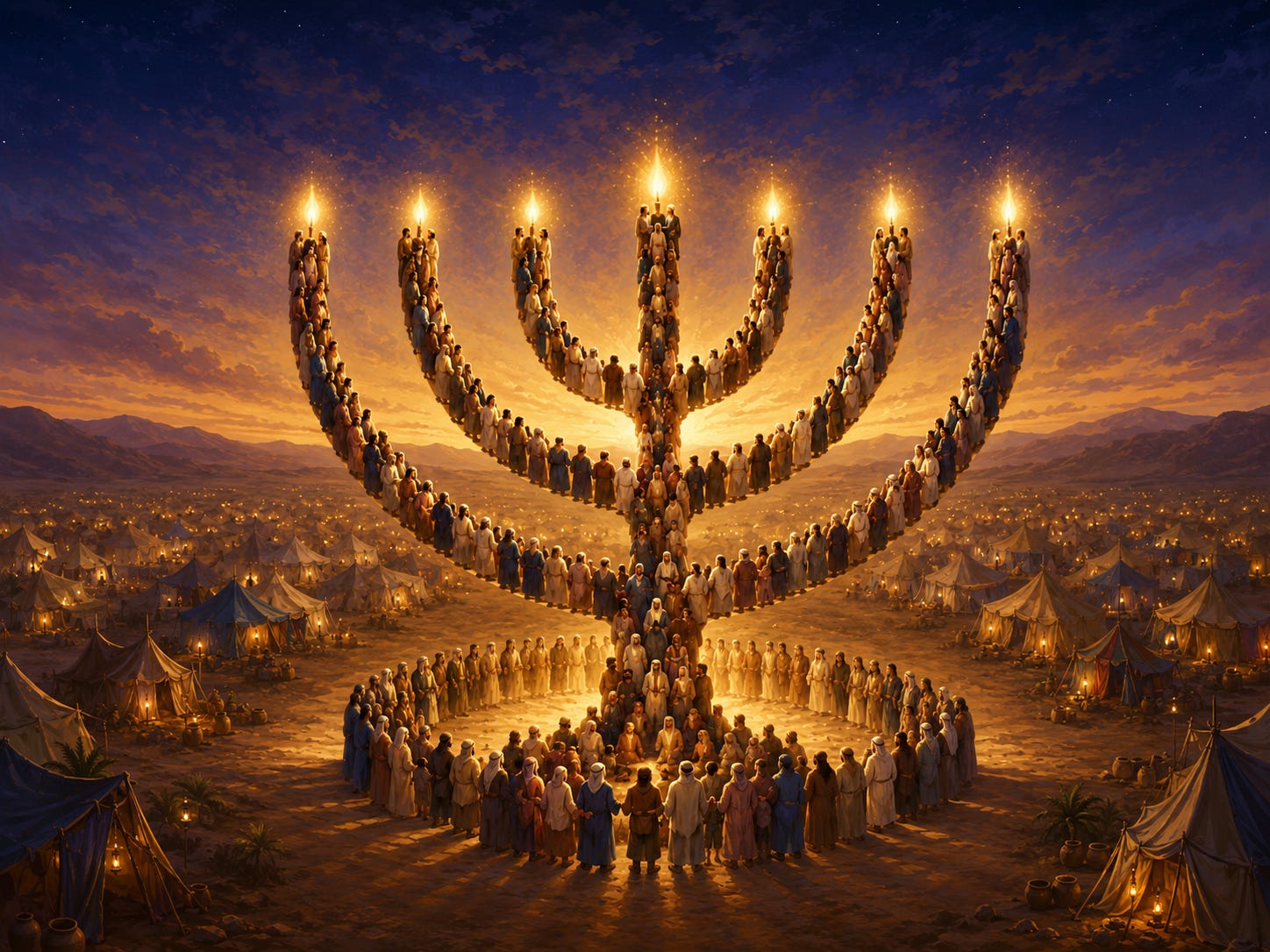
That may be why the מנורה is made מקשה אחת — one hammered piece. It has branches, cups, flowers, and lights, but it comes from one piece of gold. Many parts, one source. Many branches, one light.
This becomes the quiet question of the parshah: how can a singular רצון ה׳ enter a world of many people, many roles, and many struggles without becoming fragmented? How can the light of Torah reach each person where he is, without becoming something less than Torah? How is that great light wielded?
The Torah is not given only to the יחיד (individual) standing at the highest מדרגה (level). It is given to כלל ישראל. That means קדושה must be able to live inside a ציבור, and a ציבור is never made of one type of person. It contains many levels, many roles, many limitations, and many unfinished people.
If Torah were only for משה רבינו, one pure line of revelation would be enough. But Torah is for כלל ישראל, so the one רצון ה׳ must become a מקשה אחת: aמנורה , one piece, but many branches. Not fragmentation, and not sameness. One קדושה, carried through many vessels.
One מקשה. Many branches.
One Torah. Seventy faces.
One משה. Seventy זקנים.
This begins with the לויים.
The בכור (firstborn) was not a side figure in כלל ישראל. From the night of יציאת מצרים (the Exodus from Egypt), the בכורים carried a special קדושה. Hashem struck the firstborns of מצרים and saved the firstborns of ישראל. The בכור belonged to Hashem.
But after the חטא העגל (sin of the calf), that role shifts. The לויים are taken in their place. Yet look carefully at the way the Torah says it:
ואקח את הלוים תחת כל בכור בבני ישראל
“I took the לויים in place of every firstborn among בני ישראל.”
Hashem does not stop to explain the failure of the בכורים. He does not say, “because the בכורים lost their place.” He does not embarrass them. He does not turn their displacement into a public humiliation. He simply states the תיקון (repair). The לויים are taken תחת כל בכור. The original קדושה is not ignored; it is counted, redeemed, and transferred.
That itself is a lesson in holy speech. Hashem can correct without shaming. He can reorganize without turning a person or a group into the story of their failure. He does not put down. He picks up.
This is restraint. The Torah tells us the תיקון without rehearsing the embarrassment. Not every true thing must be said, and not every failure must be made into someone’s identity.
That becomes important later, when מרים speaks about משה. Lashon hara is not about falsehood; that is מוציא שם רע. Lashon hara is specifically something true but denigrating. Sometimes it is about exposing what did not need to be exposed. Through the בכורים, Hashem models guarded speech: create the תיקון, but do not add unnecessary shame. Through מרים, we see what happens when speech loses that restraint.
The לויים themselves also teach this structure of place.
The כהן (Kohen) performs the inner עבודה (service). The לוי does not do the actual מזבח service. But the לוי guards, carries, sings, and surrounds the עבודה. He makes the עבודה possible inside the מחנה.
That does not make the לוי an “extra.” It shows us that Torah is not built only from the most visible roles. The מזבח needs a world around it. קדושה needs boundaries, carriers, singers, guards, and a מחנה that knows how to move.
In that sense, early במדבר is the “לוי-translation” of ויקרא. Through ויקרא, we learn קדושה in place: קרבנות, כהנים, טומאה וטהרה, and the fixed center of the משכן. Through במדבר, we begin to learn a different question: how does that קדושה travel? How does the קדושה of ויקרא enter a camp, a journey, a nation, a road?
That is the role of לוי. Not the inner עבודה of the כהן, but the carrying of קדושה through motion.
This is why, as Rashi explains, אהרן’s חלישות הדעת should not be read as petty jealousy. אהרן הכהן was not simply feeling left out because the נשיאים (leaders) brought gifts. The נשיאים were bringing the offerings of the חנוכת המשכן (inauguration of the Mishkan), accompanied by open displays of Divine favor and miraculous dedication. One might have thought that these dramatic moments were the highest expression of the משכן’s holiness.
Hashem’s answer is the מנורה. Through it, He teaches that the greatness of the משכן is not only in its inauguration but in its continuation. The miracles and offerings consecrate the משכן, but afterward it must be tended, illuminated, guarded, and served day after day. The work of the כהנים and לויים is not secondary to the dedication; it is what allows the קדושה of the משכן to remain present within כלל ישראל. The enduring light of the מנורה reveals a deeper kind of greatness than a single moment of celebration.
אהרן does not provide the same קרבנות as the נשיאים. He provides light. His role is not to copy their service, but to illuminate the place of all service. The one who feels an absence becomes the one who shows how every branch has its place.
The same theme appears again through פסח שני.
The טמאים miss the קרבן פסח, but they do not simply walk away. They ask, למה נגרע. Why should we lose our place? This is not a complaint or a demand. It is a longing for belonging in עבודת ה׳.
Hashem answers by creating פסח שני. Most missed מצוות (commandments) do not receive a second date. But Pesach is different. Pesach is the founding moment of כלל ישראל. To be excluded from it is to be excluded from the national act of belonging. So the Torah gives a doorway back.
But פסח שני is not only a second chance for the individual. It also reveals one of the deepest messages of the parshah: Torah is not given only to the יחיד who is on the highest מדרגה. It is given to כלל ישראל.
חז״ל learn from “איש איש” that איש נדחה לפסח שני ואין ציבור נדחין לפסח שני — an individual who is טמא is delayed to פסח שני, but a ציבור is not delayed to פסח שני. When the ציבור is טמא, the קרבן פסח is brought in טומאה.
This is not a small technical detail. It means that the ציבור has its own Torah reality. The עבודה of כלל ישראל is not simply the sum of many private spiritual states. If every יחיד had to be perfectly ready before the ציבור could move, כלל ישראל could never move. Torah is given to a nation, and a nation includes many levels, many limitations, and many unfinished people.
פסח שני therefore teaches both sides. The יחיד who misses the ציבור’s moment is not abandoned; he is given a path back. But the ציבור itself is not held back in the same way. The Torah makes room for the יחיד, but it moves through the כלל.
Again, the parshah is not erasing loss. It is illuminating the path of return.
Then the nation prepares to travel. The ענן lifts. The חצוצרות are made. The ארון is ready to move.
The חצוצרות are not just musical instruments. They are the sound of סדר (order) in transition. They tell כלל ישראל when to gather, when to travel, when to go to war, and how to be remembered before Hashem. A nation traveling with קדושה cannot move through chaos. It needs ordered signals.
The חצוצרות are also distinct from the שופר (shofar). They are linked, and at times even stand together, but they are not the same כלי (vessel). The שופר comes from nature. It is the primal cry of the איל of יצחק (ram of Yitzchak), of מלכות ה׳ (Hashem’s kingship), of יובל (Jubilee), of משיח (Moshiach), of return to the root. The חצוצרות are forged silver, מקשה, shaped instruments of the מחנה. The שופר is the קול (voice/sound) of creation returning to its King. The חצוצרות are the קול of a nation arranging its daily movement under that King.
That difference matters. The same note can sound different when it comes from a different כלי. A תקיעה from a שופר and a תקיעה from the חצוצרות may resemble each other, but their nature is not the same. The כלי gives the קול its identity.
This too belongs to the parshah’s larger rule: similarity is not sameness. A לוי stands near the כהן, but he is not the כהן. Through מרים and אהרן, we see that נבואה can exist at many levels, while משה remains unique. Through אלדד ומידד, we see that others can receive רוח without threatening משה. The שופר and the חצוצרות may stand together, but each has its place.
The חצוצרות also touch the world of מלחמה (war). In war, the Torah commands כלל ישראל to sound the חצוצרות and be remembered before Hashem. Perhaps we can suggest that is a תיקון for the world of חרב (sword), the world of raw force. עשו is told, ועל חרבך תחיה — by your sword you shall live. יעקב is identified with קול: הקול קול יעקב. The חצוצרות take the battlefield, the place that can so easily become a world purely of force, and bring it under קול directed to Hashem. They are forged like instruments of power, but the Torah makes them instruments of זכרון לפני ה׳ (remembrance before Hashem).
Before the parshah shows us fallen sound — complaint, crying, and lashon hara — it first shows us holy sound. Sound is meant to gather, direct, and bring the מחנה before Hashem.
And right as the journey begins, the נון הפוכין appear.
Those two פסוקים are the very פסוקים we say when taking out and returning the ספר תורה (Torah scroll).
When the Torah goes out, we say:
קומה ה׳ ויפוצו אויביך — arise, Hashem, and let Your enemies scatter.
When the Torah returns, we say:
שובה ה׳ רבבות אלפי ישראל — return, Hashem, to the tens of thousands of Israel.
חז״ל say these פסוקים make a separation between פורענות and פורענות. That means the Torah places the movement of the ארון between one danger and another. The separator is not empty space. It is Torah itself.
Torah is the שמירה (protection).
Every time we lein, we reenact this. Taking out the Torah is not merely beginning the reading. The Torah is going out into the מחנה. The רצון ה׳ is being revealed, learned, and shared. That is קומה. Torah goes outward and pushes back confusion, harm, and the forces that pull a person away from קדושה.
Returning the Torah is not merely putting it away. That is שובה. We ask that what was revealed should return inward with us. The Torah should be protected inside our homes, our minds, our choices, and our lives, as we are taught it is a שמירה. We do not only hear Torah. We have to safeguard it, preserve it, and carry it back into the ordinary places of life. Just as we say ובמצותיך תרדוף נפשי at the end of שמונה עשרה, we ask that our souls pursue Hashem’s mitzvos and be guarded by them. Torah is not only something we learn; it is something that protects us as we carry it through the world.
This is the constant of the parshah. When there is instability, the Torah remains the center and endures. The ארון travels between dangers. The Torah comes out as שמירה and returns as השראת השכינה (resting of the Divine Presence) among כלל ישראל.
But then the parshah turns.
The people cry for בשר.
The Torah introduces the complaint with the words, והאספסף אשר בקרבו התאוו תאוה. Some learn that the אספסוף refers to the ערב רב, the mixed multitude that joined כלל ישראל when they left מצרים. If so, the תאוה did not begin as the pure voice of כלל ישראל at all. It began with an outside element living within the מחנה.
But once that desire is voiced, בני ישראל are drawn into the crying as well. That is important. The Torah is not presenting כלל ישראל as wicked people who simply wanted a steak. It is showing how a lower desire can enter the מחנה and awaken a struggle that already exists in the human נפש.
The issue is not only food. The Torah calls it תאוה before it even tells us the menu. Something in the נפש is unsettled. Something is pushing back against the מן and the life it demands.
They cry, מי יאכילנו בשר — who will feed us meat? But then they list the foods they remember from מצרים: fish, cucumbers, melons, leeks, onions, and garlic. That itself is strange. Most of the foods are not בשר in the usual sense. They are not making one clear request. They are expressing a restless נפש that knows it does not want what is in front of it.
It is like a child who does not really know what he wants for dinner. He only knows he does not want this. Offer a food, he rejects it. Offer another, he rejects that too. The issue is not the specific food. The issue is the inner state of refusal.
תאוות הנפש often works that way. It cannot clearly name what will satisfy it, because nothing will truly satisfy it. It only knows how to reject the discipline of the present. The different foods are different expressions of the same restless desire: sweetness, sharpness, earthiness, pungency, variety, sensation. Their common denominator is not that they are all meat. Their common denominator is that they are not מן. They represent a way of being nourished from below, instead of receiving life from שמים (Shamayim).
The מן was a different kind of nourishment. It was not only food; it was a test. The Torah says (שמות טז ד): למען אנסנו הילך בתורתי אם לא — Hashem gave the מן in order to test whether they would walk in His Torah. Every day they had to receive life from שמים. They could not hoard. They could not control tomorrow. They had to gather what Hashem gave and trust that tomorrow would come from Him too.
The מן trained a person to live with ביטחון (trust in Hashem). It fed the body through the נשמה (soul).
But the Chizkuni makes the food list even more striking. They do not simply ask for meat and then list random foods. The foods they remember are the parts of a full סעודה (meal): fish, the foods eaten with it, the items cooked with meat to enhance its flavor, and garlic used as a dip or accompaniment. In other words, they are not asking for one bite of meat. They are longing for the whole experience of eating: courses, flavor, preparation, condiments, and the richness of a table.
That could easily become תאוה, but it also has a holy root.
The Rokeach gives a remarkable רמז (hint) in the strange counting of days. The Torah does not simply say that they will eat meat for a long time. It counts: one day, two days, five days, ten days, twenty days. The Rokeach connects this counting to the days of the year when there is an obligation to eat meat, including שבת and the ימים טובים. He specifies that the total number of days equals all of the days of שבת and ימים טובים (minus שבת חול המועד).
This changes the way we read the complaint. The Torah is not saying that בשר is simply low. There is a proper, obligated place for בשר in a Torah life. The מן was higher nourishment, but there remains a physical form of eating that has its own place in עבודת ה׳.
Their mistake was not that they sensed some value in בשר or in a full סעודה. Their mistake was that instead of waiting for that physicality to be given its place within קדושה, they demanded it now, as תאוה. They wanted the סעודה of שבת and יום טוב in the mindset of a mundane physical life.
Torah is not against taste or beauty. We have מלח (salt) on the קרבנות, wine, oil, bread, song, בגדי כהונה (priestly garments), and קטורת (incense). Torah is not colorless. The issue is not whether life has spice. The issue is whether the spice serves the meal or becomes the meal.
When variety becomes the purpose of life, a person is never satisfied. תאוה promises fulfillment, but it does not deliver. The Torah says the meat was still between their teeth when the punishment came. That is a frightening image. The thing they craved was literally still in their mouths, and already it had become death. תאוה can be between a person’s teeth and still leave him hungry.
That may also explain the strange sequence of days on the level of מוסר (ethical teaching). The numbers show how desire expands. A person thinks one taste will be enough. Then two. Then five. Then ten. Then twenty. Finally, the craving becomes a whole cycle of life.
But the numbers also hint to the תיקון. It is תאוה that must be met with סדר. The מן trained כלל ישראל in daily order: gather today, do not hoard, receive the double portion before שבת, live with measure. תאוה wants to become endless. סדר gives the person back his framework.
The practical fight against תאוה is usually not won in one dramatic moment. It is won by constant guarding, repeated boundaries, and preserving the סדר even when the נפש wants to break out. תאוה must be countered and guarded, because if it is not placed within סדר, it becomes the סדר. It begins as a desire for meat, but soon it becomes a way of seeing life.
That is why the place is called קברות התאוה — the graves of desire. Not the graves of meat. Not the graves of complaint. The graves of תאוה. What had to be buried there was the false idea that desire can be the source of life. תאוה is not erased from the human being, but it must be buried as a master before it can return as a servant of קדושה.
This is משה’s challenge.
He says, מאין לי בשר — from where do I have meat? On the surface, it sounds logistical. But משה is asking something deeper. My role is to bring Torah from שמים. My role is פה אל פה. How do I carry a nation that received Torah but still has an unrefined נפש? How do I lead people who are not always holding by the מדרגה of מן?
משה is relatable in the deepest way. He loves כלל ישראל, carries them, davens for them, and gives himself for them. But his role is not to become the therapist of every lower craving in the מחנה. He is the נביא (prophet), the פה (mouth) of Torah, the central bearer of דבר ה׳ (word of Hashem). He is the one through whom Hashem speaks פה אל פה.
And משה is also one יחיד, even if he is the greatest יחיד. He is ענו מכל האדם and פה אל פה with Hashem. But כלל ישראל is a ציבור. A ציבור has many bodies, homes, levels, struggles, memories, meals, and ways of receiving Torah. The challenge is not that משה is lacking. The challenge is that Torah must reach the nation as a nation.
This is the same theme that emerged through פסח שני. Torah is not given only to the greatest יחיד. It is given to כלל ישראל. And משה can receive Torah at its highest level, but Torah cannot remain only in the world of משה. It has to enter the world of a ציבור — people with homes, meals, children, moods, memories, cravings, questions, and very different capacities.
Hashem’s answer is the שבעים זקנים.
משה must remain משה. But the nation needs many human vessels. One Torah must reach many kinds of people, many levels, many struggles. There must be “someone for everyone,” not to dilute Torah, but to carry משה’s רוח into the lived reality of the people.
That is the depth of seventy. The שבעים זקנים are not merely administrative helpers. They are seventy vessels through which משה’s רוח can reach the מחנה. This connects to שבעים פנים לתורה — seventy faces of Torah. Not seventy Torahs, but seventy faces of one Torah. Different people, temperaments, struggles, questions, and levels need different points of access. Torah remains one, but it reaches the ציבור through many faces.
One מקשה. Many branches.
One Torah. Seventy faces.
One משה. Seventy זקנים.
This parallels פסח שני from the other side. Through פסח שני, we see that the יחיד who missed the ציבור’s moment needs a path back into the כלל. Through the שבעים זקנים, we see that even the greatest יחיד is not meant to carry the entire ציבור alone. Torah must enter a structure of ציבור.
That is why אלדד ומידד are so important. They prophesy in the camp, and יהושע worries for משה’s honor. משה answers, המקנא אתה לי — are you jealous for me? משה is not threatened. He wants רוח ה׳ to spread, saying, ומי יתן כל עם ה׳ נביאים — if only all of Hashem’s people would be prophets.
This is the proper philosophy. Another person’s greatness does not diminish mine. If my place is truly from Hashem, then your place is not a threat. The more people find their place in קדושה, the more complete the מחנה becomes.
But immediately afterward, the Torah protects משה’s uniqueness through the story of מרים.
The parshah has already shown us the danger of the mouth. First the mouth cries out for meat. Then the meat is still between their teeth. Now the mouth speaks about משה.
But מרים’s mistake is not only that she spoke. It is that she misread משה’s place. She and אהרן say, הרק אך במשה דבר ה׳ הלא גם בנו דבר — did Hashem speak only with משה? Did He not also speak with us?
In one sense, the question sounds spiritual. They too had נבואה. They too were great. But the Torah immediately answers that משה is not simply one נביא among others. Hashem says, פה אל פה אדבר בו — mouth to mouth I speak with him.
משה is the פה of Torah in its clearest form. His greatness is not only that he receives more נבואה, but that there is less of “משה” blocking the דבר ה׳. That is why the Torah places here the testimony: והאיש משה ענו מאד מכל האדם אשר על פני האדמה.
משה’s ענווה (humility) is not a side virtue. It is what makes him the vessel of פה אל פה.
This becomes the answer to the whole failure of speech. תאוה says: my desire is central. Comparison says: my standing is central. Lashon hara speaks from a self that has become too present. משה is the opposite. He does not need to defend his place, because his place is not built on self-assertion. His פה can carry the דבר ה׳ because his self does not tinge it.
That is why this episode belongs at the end of the parshah. After the שבעים זקנים receive משה’s רוח, one might think משה’s uniqueness has been compromised. Through אלדד ומידד, we see that משה is not jealous when others receive רוח. Through מרים, we see the other side: many can receive רוח, but משה remains פה אל פה. There are many vessels, but one central mouth of Torah. It is a prism — many colors, but one light shines through it.
The parshah therefore gives both truths. Torah must spread through many vessels. But the source remains pure. There are many branches, but one מקשה.
Looking back, the parshah was never a random collection of episodes. Through the לויים, displaced קדושה is reorganized without shame. Through פסח שני, the יחיד is given a path back into the כלל. Through the חצוצרות, the ציבור learns how to move with סדר. Through the מן and בשר, the body itself is drawn into the question of קדושה. Through the שבעים זקנים,
משה’s רוח reaches the many levels of the מחנה. Through אלדד ומידד, we see that more vessels do not threaten the source. Through מרים, we learn that even while רוח spreads, משה remains unique.
These are not separate stories. They are all parts of one question: how does one Torah travel through an entire people?
That is the answer to the parshah. Not force. Not appetite. Not comparison. Not accusation. Not even structure by itself. כי אם ברוחי. The light of the מנורה comes from רוח ה׳.
This is why the מנורה stands at the beginning.
The parshah is not only telling us that people fail. It is teaching us how Hashem carries us through failure. He gives us Torah as שמירה, the מנורה as light, משה as the pure פה of the דבר ה׳, the זקנים as vessels for the people, the לויים as carriers and guardians, the חצוצרות as ordered sound for the road, and פסח שני as a doorway back.
There are no extras in the Torah’s world. There are many roles, many levels, many struggles, and many ways to be carried. The work is to bring every branch back to the one light.
It is one thing to stand at הר סיני. It is another thing to carry הר סיני through the desert. בהעלותך teaches that Hashem gives us what we need for that journey: one Torah, one מנורה, one קדושה — and many branches through which that light can reach every corner of the מחנה. May we be זוכה to see that light and recognize its uniqueness and how it shines through each one of us.