

The Torah’s vision of קדושה (holiness) is not a person who escapes the body, escapes marriage, or escapes ordinary life. The Torah’s vision of קדושה is a person who can take life itself — with its body, food, family, beauty, pain, and desire — and hold it in the right balance.
That may be the key to understanding the קדושה of the כהן (priest).
The Torah tells us:
וְקִדַּשְׁתּוֹ כִּי אֶת לֶחֶם אֱלֹקֶיךָ הוּא מַקְרִיב קָדֹשׁ יִהְיֶה לָּךְ כִּי קָדוֹשׁ אֲנִי ה׳ מְקַדִּשְׁכֶם
“You shall sanctify him, because he offers the bread of your God; he shall be holy to you, because I, ה׳ who sanctifies you, am holy.”
– ויקרא כא:ח
The כהן is קדוש because he brings the לחם אלקיך (bread of your God). He takes the most basic physical part of life — food, body, need — and raises it before ׳ה.
So the question is not, “Why does the כהן have restrictions?” The Torah already tells us why he is elevated. The question is: Why does the קדושה of כהונה (priesthood) take this shape? Why is this the way the Torah elevates him? Why does his קדושה express itself specifically through טומאה (impurity), marriage, mourning, hair, beard, and the dignity of the body?
There is another point that makes this sharper.
Right before קדושים תהיו (you shall be holy), the Torah speaks at length about עריות (forbidden relationships). פרשת אחרי מות closes with the sexual boundaries that protect the בית (home), the family, and the dignity of the human being. So when the Torah opens the next פרשה and says:
קְדֹשִׁים תִּהְיוּ
“You shall be holy.”
– ויקרא יט:ב
the simple context is not floating in the air. It is coming right after the פרשה of עריות. Be holy — meaning, first of all, guard this area. Guard desire. Guard the בית. Guard the sexual boundaries that preserve צורת האדם (the dignified human form).
The רמב״ן takes this further. Since the Torah has already spoken about עריות and forbidden foods, קדושים תהיו teaches that קדושה is not only avoiding what is forbidden. It is פרישות even within the permitted, so that the physical does not become uncontrolled. It begins with desire, food, and the places where a person can most easily go beyond his שיעור (proper measure).
That gives us a beautiful contrast.
By כלל ישראל (the Jewish people), קדושים תהיו comes first in the context of עריות. The Torah is teaching the whole nation: If you want to be holy, begin by guarding desire. The בית needs גבולות (boundaries). Human dignity depends on knowing where desire does and does not belong.
But by the כהן, the Torah expands the idea. His קדושה is not only in the area of עריות. The Torah says:
וְקִדַּשְׁתּוֹ כִּי אֶת לֶחֶם אֱלֹקֶיךָ הוּא מַקְרִיב
“You shall sanctify him, because he offers the bread of your God.”
– ויקרא כא:ח
The כהן brings the physical world before ׳ה. Therefore, his קדושה touches every part of physical life: food, body, death, mourning, marriage, hair, beard, and human dignity. The same קדושה that every Yid needs around desire becomes, by the כהן, a broader קדושה around the entire physical world.
So the progression is very clear.
First, the Torah teaches קדושה of desire: guard עריות, guard the בית, guard the places where human beings are most vulnerable.
Then, by the כהן, the Torah teaches קדושה of physical life: If you are the one who brings לחם אלקיך, then every part of the physical has to be held with שיעור.
It seems that the answer is that the כהן is not holy because he escapes human life. He is holy because he elevates human life. He brings לחם, and therefore his own life must show what the physical looks like with קדושה.
The Torah is not against the body. It is not against food, marriage, beauty, grief, or ordinary human life. But all of these need שיעור. They need גבול, balance, and צורה (form). When the physical is left wild, a person can fall below צורת האדם. The כהן is the one who exemplifies what it means for human life to remain dignified, measured, and whole.
This contrast becomes clearer when we compare the כהן to the נזיר (Nazirite).
On the simple level, they overlap in two major areas: טומאה and wine. The נזיר is forbidden to become טמא למת (impure through contact with the dead), and he may not drink wine. The כהן is also guarded from טומאת מת, and while wine is not forbidden to him in general, he may not drink wine when entering the עבודה (service of God).
So both are קדוש through guarded distance from death and wine. But there is a significant difference. The נזיר withdraws completely, because his קדושה is a temporary פרישות. The כהן does not withdraw from life. He enters life, family, food, and עבודה — but with שיעור. His restriction is not escaping from the physical; it is the making the physical fit for service.
That is why the כהן is guarded from death. Death is the deepest break in חיים (life). A כהן cannot casually enter טומאת מת, because his whole עבודה is connected to life, blessing, שלום (peace), and continuity.
But the Torah does not make the regular כהן inhuman. He is allowed to become טמא for his close relatives. He remains a son, a husband, a father, a brother. His קדושה separates him, but it does not detach him from normal human bonds. That itself is the balance. The כהן is elevated, but he is still a person. His קדושה does not erase בית; it refines בית.
A regular כהן is also forbidden to marry a חללה (a woman with invalidated כהונה status) or a זונה (a woman prohibited to a כהן because of certain forbidden relationships). Those fit more immediately: The כהן’s בית has to be guarded from relationships that are already halachically marked as incompatible with כהונה. But the prohibition of marrying a גרושה (divorcee) needs more thought. A גרושה may be a wonderful, refined person. So what is it about the status of גרושה that does not fit the בית of a כהן?
A גרושה means there was once a בית, and the שלום did not hold. The only way forward was separation. That does not mean she is lesser, חס ושלום. It means that the status of גרושה carries the mark of a previous בית that did not remain whole. A regular כהן, who is a man of שלום, cannot build his בית on that earlier break in שלום.
The כהן גדול (High Priest) takes this further. The Torah says:
וְעַל כָּל נַפְשֹׁת מֵת לֹא יָבֹא לְאָבִיו וּלְאִמּוֹ לֹא יִטַּמָּא
“He shall not come near any dead person; even for his father and mother he shall not become impure.”
– ויקרא כא:יא
He cannot become טמא even for his father and mother. He may not allow his hair to become פרוע (loosened or unkempt), as the Torah says:
אֶת רֹאשׁוֹ לֹא יִפְרָע וּבְגָדָיו לֹא יִפְרֹם
“He shall not let his head become disheveled, and he shall not tear his garments.”
– ויקרא כא:י
He also cannot marry a גרושה, and he cannot marry even an אלמנה (widow). The Torah says:
וְהוּא אִשָּׁה בִבְתוּלֶיהָ יִקָּח. אַלְמָנָה וּגְרוּשָׁה וַחֲלָלָה זֹנָה אֶת אֵלֶּה לֹא יִקָּח
“He shall marry a woman in her virgin state. A widow, a divorcee, a חללה, or a זונה — these he shall not marry.”
– ויקרא כא:יג–יד
This is very telling.
An אלמנה is different from a גרושה. There may have been perfect שלום in that marriage. Nothing went wrong between husband and wife. But death came in and interrupted that בית. There is a pain of death connected to that earlier marriage. The כהן גדול, who cannot enter death even for his parents, cannot build his בית on a previous story of loss.
So a regular כהן is guarded from a marriage that begins with the mark of broken שלום. The כהן גדול is guarded even from a marriage that begins with the mark of death.
But this is the crucial point: Even the כהן גדול is not celibate. Judaism does not see the highest קדושה as escaping marriage. On יום הכיפורים (Yom Kippur), the כהן גדול cannot perform his עבודה without a wife. The Torah says:
וְכִפֶּר בַּעֲדוֹ וּבְעַד בֵּיתוֹ
“He shall atone for himself and for his household.”
– ויקרא טז:ו
חז״ל (our Sages) teach: ביתו זו אשתו — “his household” means his wife.
So the כהן גדול is not above marriage. On the contrary, he cannot perform his עבודה on יום הכיפורים without a wife. But because of the nature of his עבודה, he must avoid a marriage that begins with the mark of earlier pain — whether the pain of a בית where שלום could not hold, or the pain of a בית interrupted by death. His קדושה does not demand the absence of בית. It demands a בית that can fully reflect חיים, שלום, and שלימות.
This same idea appears in the laws of mourning. The Torah says by כהנים:
לֹא יִקְרְחוּ קָרְחָה בְּרֹאשָׁם וּפְאַת זְקָנָם לֹא יְגַלֵּחוּ וּבִבְשָׂרָם לֹא יִשְׂרְטוּ שָׂרָטֶת
“They shall not make a bald patch on their heads, they shall not shave the edge of their beard, and they shall not cut their flesh.”
– ויקרא כא:ה
The first and third are clearly mourning gestures. A person in grief may want to tear at himself, cut himself, make the body itself express the shock of death. The Torah says no. Grief is real, but it cannot become self-destruction.
The middle law, וּפְאַת זְקָנָם לֹא יְגַלֵּחוּ, is not necessarily a mourning law in the same simple way. The prohibition of destroying the beard has its own place in Torah. But the fact that it is positioned here, between קרחה and שריטה, is very telling. In this פרשה, the Torah is speaking about the כהן’s body and face remaining dignified even around death. The beard is part of הדרת פנים, the human dignity of the face. So even if the law is broader than mourning, its placement here teaches that the כהן must not allow death, grief, or disfigurement to erase the dignity of the human form.
This is also how אבילות (mourning) works. In mourning, we do not shave. Normal פאר is interrupted. A person is not expected to look fully restored and socially polished immediately after a loss. But the mourner may not cut his body or deform himself. אבילות allows the interruption of beauty, but not the destruction of צורת האדם.
That is a deep part of the Torah’s response to pain. Death throws a person out of normal life. The Torah does not tell a person to pretend everything is fine. There is אנינות (the immediate stage before burial), then שבעה (seven days of mourning), then שלושים (thirty days), and for a parent, י״ב חודש (twelve months). The pain is provided stages. It is allowed to be real, but it is also given form.
The Torah teaches us how to forget gradually and respectfully. Not to erase, and not to betray the memory. We have a יארצייט. We say קדיש (the mourner’s prayer). We learn, give צדקה (charity), and commemorate. We never fully forget. But we do move forward. We reintegrate the loss into life. We grow around the pain.
That is שיעור. Pain is not denied, but it is not allowed to consume the person forever.
And maybe this is the deeper word for what death does to a person. רעש. Disturbance. The ground shakes. Life was moving in one rhythm, and suddenly that rhythm breaks. רעש is what happens when force has no שיעור in time — when something arrives without warning and shakes the form of a person’s life.
The world has two natural responses to רעש. We silence it, or we ignore it. We push the shaking away and pretend life is the same. Or the opposite — we let the רעש swallow us, and we never come back from it.
The Torah, together with the structure that חז״ל built around it, does neither.
What we call אבילות today is not only what is written in the חומש. It is the Torah and the careful work of דורות of חכמים who took the raw reality of loss and gave it שיעור. אנינות, שבעה, שלושים, י״ב חודש, יארצייט, קדיש — these stages are the result of Torah and מסורה together, shaping how a Yid carries רעש. The shaking is real. It is allowed to be real. But it is given form, given stages, given a way to slowly become part of life again. We do not silence the רעש. We do not let it consume us. We adapt. We grow around it. We carry it with כבוד.
That is the כהן’s whole עבודה around death, and it is the מסורה’s gift to every Yid who comes after him. Not a person who pretends רעש does not exist. A person — a people — who show that even רעש can be held with שיעור, and that even when life shakes, צורת האדם can remain.
This may also explain why these laws are repeated specifically by כהנים even though they apply more broadly to all ישראל. קרחה (baldness in mourning) and שריטה (cutting the body) are taught elsewhere by all of כלל ישראל, and פאת הזקן (the corner of the beard) is also taught elsewhere. But here they are repeated regarding כהנים because the כהן is the concentrated example of guarded human dignity around death. He must not only avoid certain contact with death; even his body’s reaction to death must remain measured.
Now this brings us to hair.
Hair keeps appearing in the Torah exactly where the boundary between raw physical force and human dignity is being tested. Hair is strange. It grows from the body, but it is also at the edge of the body. It has something animalistic about it. Animals have hair and fur. It is raw growth. And yet, when elevated, hair can become dignity, wisdom, beauty, and even קדושה.
Before developing this further, I want to be clear that I am not making a technical דקדוק (grammar) claim that all the following words share the same שורש (root). That is not the point.
This is an approach I developed in my own learning — noticing how words that share the same letters, even across different שורשים, can still be connected in meaning — and my great Rebbe, HaRav Nochum Lansky שליט״א, reviewed it and agreed that this is a legitimate way to understand depth in לשון הקודש (the Holy Tongue).
Every letter in לשון הקודש carries a מחשבה (thought). Every letter has a certain כח (power). When letters come together, they create a field of meaning. The order of the letters, the נקודות (vowels), and the exact form of the word all change the direction and the perception. They tell you how that כח is being expressed. But the letters themselves are not random. They tell us something.
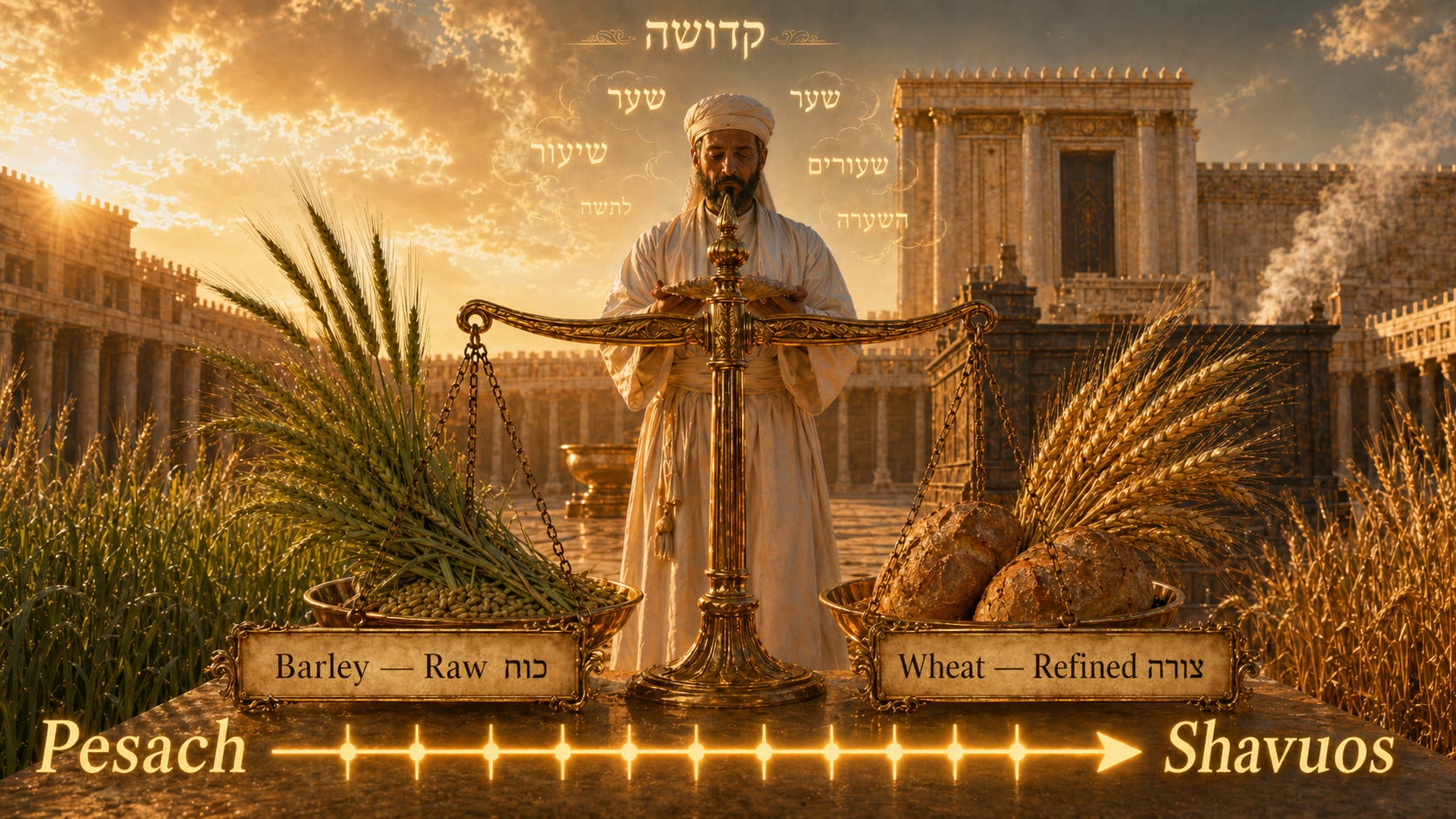
So when we look at words built from these same letters — שֵׂעָר, שַׁעַר, שיעור, שעורים, עשר, עשיר, רשע, and עשו איש שעיר — I am not saying they are all the same word. I am saying they are all touching the same inner world: raw force, measure, boundary, fullness, and what happens when that force is either elevated or left unmeasured.
שֵׂעָר (hair) — raw growth at the edge of the body.
שַׁעַר (gate) — the boundary between inside and outside.
שיעור — measure, the boundary that gives something form.
שעורים (barley) — animal food.
עשר (ten) — a number of completion, fullness with צורה.
עשיר (rich person) — a person with abundance, and abundance needs שיעור.
רשע (wicked person) — what happens when raw force refuses גבול.
רעש (disturbance) - when things break form and are not balanced
All of these circle around the same idea: גבול, measure, form, and what happens when form is either guarded or lost.
This opens up the connection to סוטה (suspected adulteress) and נזיר. They are not in these פרשיות (Torah portions), but they clearly share the same language.
By סוטה, the Torah says:
וּפָרַע אֶת רֹאשׁ הָאִשָּׁה
“He shall uncover or loosen the woman’s hair.”
– במדבר ה:יח
The סוטה is a case where שלום in the בית has become unstable. The boundary of marriage may have been broken. So her hair is uncovered. The private dignity of the בית is disturbed publicly. And her קרבן (offering) is מנחת שעורים (a barley offering). If the human relationship of marriage falls into unmeasured desire, the קרבן reflects that fall.
And who handles the סוטה? The כהן. The man of שלום. He brings the case into the מקדש (Sanctuary) to clarify whether שלום can be restored or whether the break must be exposed.
Then immediately after סוטה comes the נזיר. There, חז״ל say that one who sees the סוטה in her disgrace should separate from wine. Why? Because he has seen what happens when desire breaks its measure. He has seen what can happen when wine, תאוה (desire), and loosened boundaries enter the בית.
So the נזיר accepts a stricter שיעור. He does not drink wine. He does not become טמא. He does not cut his hair. The Torah says:
קָדֹשׁ יִהְיֶה גַּדֵּל פֶּרַע שְׂעַר רֹאשׁוֹ
“He shall be holy; he shall let the hair of his head grow wild.”
— במדבר ו:ה
But we have to be careful. The נזיר is not the final ideal. חז״ל say he is called a חוטא (sinner). He is not called a רשע; he is not breaking boundaries like עשו. Just the opposite — he is accepting extra boundaries. But he is also not the perfect model of קדושה.
His קדושה comes through withdrawal, and withdrawal has a price. He takes things that the Torah permitted — wine, ordinary grooming, normal life — and steps away from them. Sometimes that is necessary. Sometimes a person sees a סוטה and realizes he needs stronger boundaries. But the goal is not to remain forever in withdrawal. The goal is to use that פרישות to restore balance and then return to life with a healthier שיעור.
In other words:
עשו has no שיעור.
נזיר imposes extra שיעור.
כהן shows the proper שיעור.
Here we also have to be careful with the word פרע. I am not saying that פרע appears only in these places. It does not. But there are several key places where the Torah uses the language of פרע around hair and human dignity, and they form a striking pattern.
By סוטה:
וּפָרַע אֶת רֹאשׁ הָאִשָּׁה
פרע as exposure and disorder, because the boundary may have broken.
By נזיר:
גַּדֵּל פֶּרַע שְׂעַר רֹאשׁוֹ
פרע as holy wildness, raw hair held within restraint.
By כהן גדול:
אֶת רֹאשׁוֹ לֹא יִפְרָע
No פרע at all, because he represents complete order and dignity.
And by מצורע (one afflicted with צרעת — a spiritual skin affliction), the Torah says:
בְּגָדָיו יִהְיוּ פְרֻמִים וְרֹאשׁוֹ יִהְיֶה פָרוּעַ
“His garments shall be torn, and his head shall be disheveled.”
– ויקרא יג:מה
That fits the picture very strongly. The מצורע is a person whose place in the מחנה (camp) has broken down. He is sent outside. His speech damaged relationship, and now his clothing and hair express that dispossessed, dislocated state. His head is פרוע because his social and spiritual צורה has become disordered.
So the language of פרע gives us different states of disturbed or guarded human form.
By סוטה, פרע exposes a possible break in the בית.
By מצורע, פרע expresses being outside the מחנה.
By נזיר, פרע is taken and elevated through restraint, but in a way that carries the cost of stepping away from normal life.
By the כהן גדול, פרע is not allowed at all.
That contrast is powerful. The same hair-state can mean disgrace, dislocation, temporary קדושה, or forbidden disorder — depending on whether it is attached to סוטה, מצורע, נזיר, or כהן גדול.
This also helps us understand יפת תואר (beautiful captive woman). There too, the Torah deals with desire at a dangerous moment. A man is at war, in a state of violence, victory, adrenaline, and loosened boundaries. He sees beauty, and he desires. The Torah does not pretend desire does not exist. But it also does not allow immediate surrender to desire.
The Torah says:
וְגִלְּחָה אֶת רֹאשָׁהּ
“She shall shave her head.”
– דברים כא:יב
She shaves her head. She mourns. She removes the garments of captivity. Time passes.
The Torah slows the man down. It interrupts the fantasy. It forces desire to pass through delay, mourning, and process. This is another form of שיעור. The Torah’s response to dangerous desire is not denial. It is measured delay.
Now we can return to the time of year.
These פרשיות are generally read during ספירת העומר (counting of the Omer). This is the time between פסח (Passover) and שבועות (Shavuos), and the movement of this time is from שעורים to חיטים (wheat). The עומר offering is from barley, animal food. The שתי הלחם (two loaves) of שבועות are from wheat, human food.
That is the עבודה of ספירה. We move from animal force to human form. From raw impulse to תורה. From physical energy to measured קדושה.
But the Torah does not say that שעורים are evil. The עומר itself is brought from שעורים. The סוטה’s מנחה is from שעורים. The lower, animal side of man can enter the מקדש. It can be elevated. The problem is not that man has animal force. The problem is when that force has no שיעור.
This is where עשו enters as the negative image. The Torah describes the birth of עשו:
וַיֵּצֵא הָרִאשׁוֹן אַדְמוֹנִי כֻּלּוֹ כְּאַדֶּרֶת שֵׂעָר
“The first one came out red, entirely like a cloak of hair.”
– בראשית כה:כה
Later, יעקב says:
הֵן עֵשָׂו אָחִי אִישׁ שָׂעִר וְאָנֹכִי אִישׁ חָלָק
“My brother עשו is a hairy man, and I am a smooth man.”
– בראשית כז:יא
עשו is the man of raw force, field, appetite, immediacy. He is שֵׂעָר without שיעור.
And he sells the בכורה (firstborn right) for עדשים (lentils). This is a small point, but it sharpens the contrast. שעורים are low, animal food, but they can still enter the world of עבודה. In contrast, עדשים, by עשו, represent appetite beneath that world — the immediate hunger for which a person can trade away קדושה.
This is where רשע fits. If the raw שֵׂעָר side of man is given שיעור, it can become קדושה. If it refuses שיעור, it becomes רשע. That is עשו: raw force without גבול, appetite strong enough to sell the בכורה.
The נזיר is the opposite in one way. He also has hair, but his hair is governed by restraint. His שער is given שיעור, and therefore it becomes קדוש. But again, even that is not the final ideal. It is a corrective. It is extra שיעור because something has gone off balance.
This is also the meaning of אחרי מות (after the death), which is also read in this season. The פרשה begins after the death of נדב ואביהוא. Death throws everything out of normal balance. But the Torah’s response is not chaos. It is the most measured עבודה possible: the כהן גדול entering the קודש הקדשים (Holy of Holies) only with exact boundaries, exact בגדים (garments), exact קרבנות, and exact timing.
After death comes measured עבודה. After pain comes סדר (order). After shock comes שיעור.
That is the whole sugya. The Torah is teaching us how קדושה deals with the places where human life can lose form: death, desire, mourning, wine, beauty, marriage, body, speech, and food.
The כהן preserves human wholeness.
The נזיר restores human wholeness when it is threatened, though not without cost.
The מצורע shows what happens when speech damages relationship and the person is pushed outside the מחנה.
The כהן גדול shows the highest version: not escape from life, but a perfected בית.
And ספירת העומר gives the seasonal frame: from שעורים to חיטים, from animal force to Torah-shaped humanity.
Maybe if there were one word for this פרשה, or for this whole תקופה (period) of ספירה, it would be balance.
Not balance in the weak sense. Not compromise. Not mediocrity. Balance means שיעור. It means knowing where each כח belongs. It means every part of a person has a place, but it cannot take over the whole person.
Grief has a place, but it cannot destroy the person.
Desire has a place, but it cannot rule the person.
Beauty has a place, but it cannot become fantasy.
Marriage and בית are holy, but they need שלום.
The body is not rejected, but it cannot be left wild.
Even pain is not erased, but it must be carried in a way that lets a person live again.
That is the קדושה of the כהן. He brings the לחם אלקיך. He takes the physical world and shows that it can become holy. Not by running away from it, and not by giving in to it, but by giving it its proper שיעור.
And that is the עבודה of ספירה. We count one day and then another day. We do not jump to שבועות. We grow gradually. We take the animal side of ourselves — the rawness, the hunger, the pain, the pull of desire, the confusion — and we bring it into order.
The Torah is not asking us to become angels. It is asking us to become people who can carry קדושה.
A person without גבולות becomes like עשו — שעיר איש, strong, hungry, immediate, able to sell the בכורה for a bowl of food. But a person who gives his כוחות (strengths) a שיעור can take that same raw energy and make it holy. That is the נזיר, when needed. That is the כהן, in its proper form. That is the path from שעורים to חיטים.
And this is not just a nice thought. It is one of the most basic foundations of עבודת ה׳.
The רמב״ם, in the first perek of הלכות דעות (the laws of character traits), explains that a person is supposed to train himself to walk the middle path. Not too extreme in one direction, and not too extreme in the other. The goal is not numbness. It is not to have no feelings, no strength, no anger, no desire, no ambition. The goal is that each כח should be in its proper place, at its proper time, with its proper שיעור.
I mention this to my children often. If a child is about to run into the street, it is appropriate to yell. Not every raised voice is a failure. There are moments when strong emotion is exactly what is needed. But that cannot become the way a person lives. Generally, a person has to be in control. The emotion has to serve the moment; the moment cannot become a servant to the emotion.
That is the עבודה of a lifetime.
Yiddishkeit does not tell us to crush our כוחות. It teaches us to guide them. Anger can protect. Desire can build a בית. Wealth can become צדקה. Beauty can become dignity. Pain can become growth. Speech can create connection. But every כח needs its שיעור. Without שיעור, even a good כח can take a person out of balance.
That is why this is such hard work. Balance is not a small middah. It is the lifelong work of becoming a person whose inner world is ordered enough to carry קדושה.
Of course, each of these ideas could be its own piece. כהונה, נזירות, סוטה, מצורע, יפת תואר, אבילות, ספירה, שער, שיעור — each one deserves to be developed at much greater length. It is a daunting task to touch on such חשוב ideas briefly without oversimplifying them. But perhaps the common thread is clear: This תקופה is about finding balance.
So the מוסר (lesson) is very simple, but very demanding.
We each have places where we lose balance. Some people lose it in anger. Some in desire. Some in food. Some in grief. Some in ambition. Some in the need to be seen. Some in the way they speak. The work is not to pretend those כוחות are not there. The work is to train them, slowly, over a lifetime, until they serve קדושה.
That is how a person finds his way to קדושה.
Not by escaping life.
Not by being swallowed by life.
But by learning how to live life with balance.
And maybe this is the ברכה (blessing) we should leave with.
We should be זוכה (merit) to accept the challenges that הקב״ה gives us with dignity. Not because they are easy. Not because the pain is small. Pain is real. Loss is real. Confusion is real. There are moments in life where a person feels completely shaken, and it is not our job to explain it away with nice words.
But the Torah teaches us not to waste pain.
אבילות does not deny the tears. It catches them. It gives them a place. It gives pain a סדר, a שיעור, a way to slowly become part of life without destroying life.
And that is true in every challenge. When a person is inside a hard moment and can stop, even for a second, and say, “This is the pain. This is the place where ה׳ is asking something from me. This is a moment for עליה,” that itself can begin to change him.
Not because he understands why it happened. Very often we do not understand. And sometimes asking “why do bad things happen to good people” does not help us live better in that moment. But we can ask a different question: “What can I become from this? What dignity can I hold on to? What גבול, what שיעור, what קדושה can I find here?”
That is not minimizing the pain. It is the opposite. It is saying the pain matters too much to be wasted.
We should be זוכה during these days of ספירה to take every experience — the sweet ones and the hard ones, the clarity and the confusion, the tears and the growth — and bring them closer to ה׳. We should be זוכה to find our balance, to carry our pain with dignity, to grow from what we go through, and to take our לחם, our ordinary human life, and make it לחם אלקיך.
And we should be זוכה that all the tears of כלל ישראל should become tears of עליה, of healing, of closeness, and of true נחמה.