

Why a Basket?
The mitzvah of ביכורים is among the most familiar passages in the Torah. Its פסוקים form the central account of יציאת מצרים that we expound upon at the ליל הסדר. Yet because the words are so familiar, we can easily overlook the most basic question in the entire פרשה.
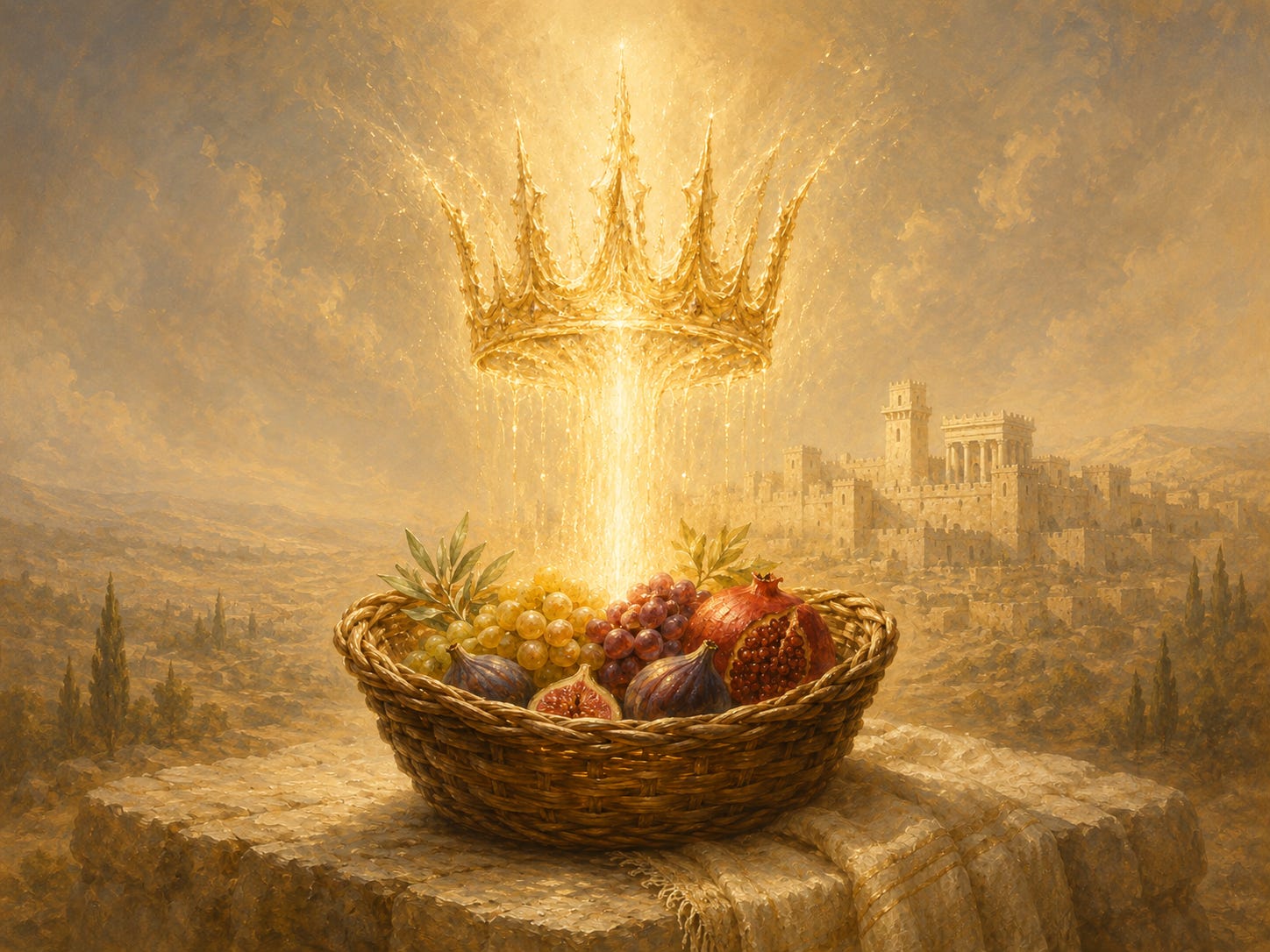
Why does ביכורים require a basket?
The Torah does not merely command the farmer to bring the first fruit of his land. It says:
וְלָקַחְתָּ מֵרֵאשִׁית כָּל פְּרִי הָאֲדָמָה אֲשֶׁר תָּבִיא מֵאַרְצְךָ אֲשֶׁר ה׳ אֱלֹקיךָ נֹתֵן לָךְ וְשַׂמְתָּ בַטֶּנֶא
“You shall take from the first of every fruit of the ground that you bring from your land, which Hashem your God gives you, and you shall place it into a basket.”
דברים כ״ו:ב׳
The basket is then emphasized a second time:
וְלָקַח הַכֹּהֵן הַטֶּנֶא מִיָּדֶךָ וְהִנִּיחוֹ לִפְנֵי מִזְבַּח ה׳ אֱלֹקיךָ
“The כהן shall take the basket from your hand and place it before the altar of Hashem your God.”
דברים כ״ו:ד׳
The כהן does not merely remove the fruit. He takes הטנא מידך. The כלי (vessel) itself must leave the farmer’s hand and be placed before Hashem — whether or not it is later returned to him.
The basket is not incidental packaging. It is the central image of the mitzvah.
The כלי That Receives
מלכות (the sefirah of kingship) is the בחינה (aspect) of the receiving כלי. It is the נוקבא (the feminine, receiving principle), the recipient of the שפע (divine flow) descending from above. לית לה מגרמה כלום — it possesses nothing that originates independently from itself. Yet the כלי is not insignificant. The שפע can only enter the lower world when there is a כלי capable of receiving, containing, and revealing it.
The טנא is that כלי.
The basket does not create the fruit. Yet it gathers the fruit, contains it, and allows it to be brought into the בית המקדש. Its greatness lies not in being the source of what fills it, but in receiving that שפע correctly.
That is also the עבודה of the farmer. He has worked. He has plowed, planted, protected, and harvested. The Torah does not deny his labor. Yet his land, his strength, the rain, the growth, and the fruit itself were all received from Hashem. The danger is that because the ברכה passed through his effort, the כלי begins to imagine that it is the מקור (the source).
ביכורים restores the proper relationship between the שפע and the כלי. The farmer takes the fruit, places it into the טנא, and gives the טנא itself from his hand. He declares:
וְעַתָּה הִנֵּה הֵבֵאתִי אֶת רֵאשִׁית פְּרִי הָאֲדָמָה אֲשֶׁר נָתַתָּה לִּי ה׳
“And now, behold, I have brought the first of the fruit of the ground that You have given me, Hashem.”
דברים כ״ו:י׳
He does not say, “which I produced.” He says:
אשר נתתה לי ה׳
He gives Hashem not only the fruit that entered his possession, but the very כלי through which he experiences possession.
What לבן Claimed
This may explain why the declaration begins in such a surprising place:
אֲרַמִּי אֹבֵד אָבִי
Why must a farmer bringing fruit from ארץ ישראל suddenly speak about לבן?
In truth, לבן was a thief and a liar, but the root of his corruption was deeper than individual acts of dishonesty. Much of the prosperity he now claimed as his had come through יעקב’s labor, yet לבן declared:
הַבָּנוֹת בְּנֹתַי וְהַבָּנִים בָּנַי וְהַצֹּאן צֹאנִי וְכֹל אֲשֶׁר אַתָּה רֹאֶה לִי הוּא
“The daughters are my daughters, the children are my children, the flock is my flock, and everything you see is mine.”
בראשית ל״א:מ״ג
The כלי believed itself to be the מקור.
The farmer bringing ביכורים stands with fruit that he has a far more legitimate claim to call his own. It grew in his field, through his own effort. Yet the farmer answers:
אשר נתתה לי ה׳
And לבן says: Everything you see is mine.
The Yid says: Everything you see was given to me.
The Torah is not teaching that man owns nothing. The farmer repeatedly calls the land and produce his own. Rather, there is ownership that acknowledges its Source, and there is ownership that denies it. The farmer can possess his produce precisely because he knows that he first received it.
רב and כל
The contrast between יעקב and עשו sharpens this further. When the brothers met, עשו said:
יֶשׁ לִי רָב
“I have much.”
בראשית ל״ג:ט׳
Then יעקב answered:
יֶשׁ לִי כֹל
“I have everything.”
בראשית ל״ג:י״א
Here עשו experiences possession as quantity: רב. He has much, but “much” has no natural end. יעקב experiences what Hashem has apportioned to him as completeness: כל. He has what is his, and therefore nothing essential is lacking.
That same distinction appears in our פרשה.
At ביכורים the Torah says:
וְשָׂמַחְתָּ בְכָל הַטּוֹב אֲשֶׁר נָתַן לְךָ ה׳ אֱלֹקיךָ
“You shall rejoice in all the good that Hashem your God has given you.”
דברים כ״ו:י״א
Yet at the root of the קללות the Torah says:
תַּחַת אֲשֶׁר לֹא עָבַדְתָּ אֶת ה׳ אֱלֹקיךָ בְּשִׂמְחָה וּבְטוּב לֵבָב מֵרֹב כֹּל
“Because you did not serve Hashem your God with joy and goodness of heart, from an abundance of everything.”
דברים כ״ח:מ״ז
They had abundance without end. That is מרב כל. Yet that abundance did not become כל הטוב.
They possessed עשו’s רב, but had lost יעקב’s understanding of כל.
The טנא transforms רב into כל. Unbounded abundance enters a defined כלי and is understood as a complete gift. The farmer does not merely see how much has grown. He sees:
כל הטוב אשר נתן לך ה׳
The Hidden ס׳
The בעל הטורים points out that טנא has the numerical value of sixty, corresponding to the שיעור (the required measure) of ביכורים, which is אחד מששים, one-sixtieth. He then notes something remarkable: the letter ס׳ does not appear anywhere in the פרשה of ביכורים.
The טנא equals ס׳, yet the ס׳ is hidden.
The form of the ס׳ itself may deepen that רמז. The letter is closed on every side, a מקיף (encompassing enclosure), surrounding and protecting what lies within it. That is exactly what the טנא does physically. It takes the exposed fruit and places it within a guarded כלי. Before the fruit becomes part of the farmer’s ordinary possessions, it is surrounded by קדושה, gratitude, and the recognition of אשר נתתה לי ה׳.
The טנא protects the שפע. It prevents the ברכה from becoming the source of arrogance and false ownership.
What חז״ל Do With Sixty
Sixty appears elsewhere in Torah, and it appears in the same role.
When an איסור (forbidden matter) falls into a permitted mixture, the Torah does not say that the איסור has ceased to exist. It is still there. What changes is the שם (the halachic name) of what lies before us: the mixture is called by the name of what makes up its majority, and therefore the Torah permits the אכילה. Nothing was annihilated. Something was renamed.
Where the איסור imparts taste, the question is not majority at all, since טעם כעיקר treats the taste itself as the forbidden matter. But where the Torah does work by majority, two parts against one already suffice. Yet we do not permit the mixture until there are sixty parts of היתר (permitted matter) against the איסור. The גמרא learns the measure from זרוע בשלה, the cooked foreleg of the ram of a נזיר, which is given to the כהן and forbidden to a ישראל, and which is nevertheless cooked together with the entire animal and permitted within it.
Why sixty, when the Torah asks only for רוב?
As תוספות explain, the point at which the taste of the איסור ceases is not fixed. Sometimes it ceases well before sixty. The boundary cannot be located in any given case. So חז״ל set their measure far beyond wherever that boundary might lie.
They did not draw the line. They built a wall at a distance from it.
That is a מקיף. It does not touch the איסור. It surrounds it.
Whether this sixty is מדרבנן or מדאורייתא is a מחלוקת ראשונים (a dispute among the early authorities). Most hold that the לימוד from זרוע בשלה is an אסמכתא, a supporting allusion, rather than a true source, and that the measure itself is מדרבנן, while רש״י holds that it is מדאורייתא.
Both שיטות serve us, and each says something the other does not.
If the sixty is מדרבנן, then חז״ל have built a סייג (a protective fence). A Yid could look at that and say: they have made my food אסור. The Torah permitted it at רוב, and they took it from me. He would not be wrong to think that something was taken. But he would be wrong about what was truly happening: they were standing between him and a line he could not see.
And if the sixty is מדאורייתא, then we are holding a Torah measure that appears nowhere in the Torah. It is reached only through דרשה (exegetical derivation). It lives in the mouth of תורה שבעל פה (the Oral Torah) and nowhere else.
One שיטה shows us what חז״ל are doing. The other shows us where it lives.
Yet there is a second sixty, and it is closer to home.
The משנה we say each morning teaches אלו דברים שאין להם שיעור (these are the things that have no fixed measure), and it lists פאה, and it lists ביכורים. Yet the very next משנה states אין פוחתין לפאה מששים, and then adds ואף על פי שאמרו אין לפאה שיעור. There is no שיעור — and do not give less than one-sixtieth.
ביכורים follow the same pattern. מדאורייתא there is no שיעור at all. The Torah says ולקחת מראשית, and never says how much ראשית. The אחד מששים is מדברי סופרים (established by the Sages). Upward the mitzvah remains open; a person who wishes to make his entire field ביכורים may do so.
חז״ל did not give the mitzvah a ceiling. They gave it a floor.
אין להם שיעור sounds like freedom. It is a חיוב with nothing underneath it. If no amount is ever definitively enough, then nothing a person brings is ever fully given. Every basket might be insufficient. There is no such thing as bringing extra, because there is no line above which extra begins.
A person cannot rejoice in the mitzvah if he is not certain he has discharged his obligation.
This is the defect of רב itself. עשו said יש לי רב, and רב has no natural end. A mitzvah without a שיעור sits in exactly that position. Always more. Never complete.
חז״ל gave the mitzvah a כל.
Once there is a floor, the farmer knows when he has brought ביכורים. Everything he adds beyond it, he adds because he chooses to. The obligation becomes bounded, and therefore it becomes his, and therefore he can bring it בשמחה.
The כלי bounds the fruit. The שיעור bounds the חיוב. Neither one creates anything. Both make שמחה possible.
That is what חז״ל did with sixty, twice. In ביטול (nullification in a mixture), the sixty restricts. In ביכורים, the sixty releases. In both, a Yid is protected from a boundary he could not locate himself.
And notice who bears the cost. The man whose mixture already stood at רוב did not need sixty. The learned farmer who could read the פסוקים himself did not need to be prompted. Each of them lost something real, and each loss protects somebody else.
כל ישראל ערבים זה בזה
None of this is written. The Torah commands and rarely measures. It says אכילה, and חז״ל say כזית (an olive’s volume). It says שתיה, and חז״ל say רביעית (a quarter-log). The שיעורין are הלכה למשה מסיני (a law transmitted orally to Moshe at Sinai). The measure never appears on the page, because the measure was never given to the page.
The ס׳ is not merely hidden. It is hidden in the way that every שיעור is hidden.
A מקיף also does something to what lies within it.
As we saw, the איסור inside sixty parts of היתר is not destroyed. It is renamed.
The fruit placed into the טנא is not changed either. It is the same fruit. It is renamed. It was the farmer’s produce. Inside the כלי it becomes ראשית.
The כלי creates nothing. Yet whatever enters it receives its name from it.
לית לה מגרמה כלום
This may be why לבן’s failure was not merely theft. לבן was a כלי that gave the wrong name to everything that passed through it. The same שפע that reached him through יעקב, we see that his corruption is the desire to change and control even names, as we see by his צאן he calls it צאני.
Standing Where He Cannot Stand
Yet the hidden ס׳ also appears in another form:
סוֹמֵךְ ה׳ לְכָל הַנֹּפְלִים
“Hashem supports all who are falling.”
תהלים קמ״ה:י״ד
That כח is revealed within the mitzvah itself.
מקרא ביכורים (the declaration recited over the first fruits) is one of the recitations that must be said specifically in לשון הקודש. Originally, a person who knew how to read recited the passage himself, while one who could not read repeated it after another. Those who could not read became embarrassed and began refraining from bringing their ביכורים. In response, חז״ל instituted שיהו מקרין את מי שיודע ואת מי שאינו יודע — that they would prompt both the person who knew and the person who did not know.
חז״ל did not merely provide assistance after the weaker person had fallen. They changed the entire form of the mitzvah so that his weakness would no longer be exposed. Even the learned farmer could no longer display that he could recite independently. He also had to receive the words and repeat them.
They created a מקיף around the vulnerable person so that he would not fall.
That is סומך נופלים. Not reaching down to a person after he has fallen. Standing where he cannot stand, so that the question of falling never reaches him.
The ס׳ is absent from the written פרשה because a שיעור belongs to תורה שבעל פה, and תורה שבעל פה does not live on a page. It lives in כלל ישראל. It is חז״ל who become סומך נופלים, surrounding the person who cannot stand independently and preserving his place within the mitzvah.
The טנא surrounds the fruit so that the שפע will not become corrupted.
כלל ישראל surrounds the vulnerable Yid so that embarrassment will not drive him away.
The same ס׳ protects both.
This also reveals why מקרא ביכורים cannot simply be expressed in the farmer’s own words. The fruit may grow in his individual field, but the words through which he understands that fruit belong to כלל ישראל.
The declaration does not begin with his field. It begins with יעקב, with לבן, and with מצרים itself:
אֲרַמִּי אֹבֵד אָבִי
וַיֵּרֶד מִצְרַיְמָה
וַיָּרֵעוּ אֹתָנוּ הַמִּצְרִים
וַנִּצְעַק אֶל ה׳
וַיּוֹצִיאֵנוּ ה׳ מִמִּצְרַיִם
וַיְבִאֵנוּ אֶל הַמָּקוֹם הַזֶּה
דברים כ״ו:ה׳–ט׳
Only then can the individual say:
ועתה הנה הבאתי
He can say הבאתי only after recognizing ויביאנו. His private fruit is the latest expression of a national story that began long before he existed.
The fruit enters the physical טנא. His understanding of the fruit enters the כלי of Torah and מסורה (the received transmission).
The Missing תגין
There is a striking רמז brought in the name of the גר״א. The word טנא alludes to טנת״א, an acronym for four elements: טעמים (cantillation), נקודות (vowel points), תגין (letter-crowns), and אותיות (letters). These are the elements through which the words of Torah are written, read, and expressed.
Yet טנא has three letters, and טנת״א names four elements. The ת is absent, and with it the תגין.
That absence is not a small difficulty. טנת״א is not a loose acronym assembled for the occasion; it is established terminology, and each of its four elements occupies a fixed place within it. A רמז that points the word טנא toward that scheme cannot be stated without the gap becoming clearly visible. Anyone who says it has already seen it.
And the גר״א says it.
That is what turns the difficulty into the question. If the missing element disqualified the רמז, the רמז would not have been transmitted. Since it was transmitted, the absence is not a failure of the רמז but its content. The question is no longer whether טנא may be read as טנת״א. The question is why the basket holds three and not four.
*I had noticed this רמז independently and set it aside precisely because of the missing ת. Finding it brought in the name of the גר״א is what turned the objection into the question, and the explanation that follows is my own.*
תגין are not merely compared to crowns. They are the actual crowns written above the letters of the Torah. The גמרא describes Hashem as קושר כתרים לאותיות, tying crowns to the letters. רבי עקיבא would derive piles of הלכות from each crown, yet those very teachings ultimately return to הלכה למשה מסיני.
The greatest חידוש of תורה שבעל פה does not sever itself from מסורה. Its crown is precisely that it uncovers what was received.
What is missing from the טנא is therefore the crown resting upon the Torah it contains.
The Torah concludes the mitzvah:
ושמחת בכל הטוב אשר נתן לך ה׳
The בעל הטורים notes that הטוב has the numerical value of twenty-two, corresponding to the twenty-two letters of Torah. חז״ל teach:
אין טוב אלא תורה
This is not an external רמז attached to the mitzvah. It reveals what ultimately fills the טנא.
The farmer physically brings fruit. Yet physical abundance does not carry its own interpretation. It can become לבן’s כל אשר אתה רואה לי הוא, or עשו’s יש לי רב. The fruit becomes טוב only when it enters the twenty-two letters of Torah, and is understood as אשר נתתה לי ה׳.
The טנא is the receiving כלי of מלכות. The כ״ב letters of הטוב give the contents of that כלי their meaning.
Yet the letters still require their crowns.
Perhaps the תגין are absent from the טנא because a crown cannot be contained within the basket. It must be placed above the letters through the עבודה performed with them.
That crown is revealed through תורה שבעל פה in its purest form: מסורה.
The farmer may know the פסוקים perfectly, yet he receives them from another and repeats them. The words do not become his private possession. They are handed to him by כלל ישראל. His תורה שבכתב (the Written Torah) enters his mouth through the living transmission of תורה שבעל פה.
The letters are present. The מסורה places the תגין upon them.
When the learned farmer gives up the distinction of reciting independently so that another Yid will not be embarrassed, the Torah itself is crowned. The crown is formed through humility, transmission, and the recognition that no individual owns its words.
Through crowning Torah, the farmer crowns Hashem, the נותן התורה and the true Source of everything within his basket.
He takes his ראשית and gives it to the true ראש. He places before Hashem both the fruit, and the כלי that contains it. He acknowledges Hashem’s מלכות over his field, his labor, his Torah, and his success.
The טנא contains the טעמים, the נקודות, and the אותיות.
The מסורה supplies the תגין.
The כ״ב letters of הטוב are crowned, and through them Hashem is crowned over the world.
Perhaps the hidden ס׳ and the missing תגין are not two absences at all, but one absence appearing twice.
The written Torah does not supply the שיעור, and the written Torah does not supply the crown. Neither can be produced by the letters out of themselves. Both reach the world only through תורה שבעל פה.
The ס׳ surrounds the טנא and protects what lies within it. The תגין rest above the letters and crown them.
What the page withholds from below and what the page withholds from above, the מסורה supplies.
Neither anomaly is my own. The ס׳ is noted by the בעל הטורים and the ת by the גר״א, and neither of them tells us what the absence means. Only the joining is mine, and that is the only kind of crown a חידוש may wear: it uncovers what was already received.
Before the Mouth Speaks
This is why the פסוקים of ביכורים become the center of מגיד on the ליל הסדר. Before we begin telling the story, we declare כל דכפין ייתי וייכל, and then כל דצריך ייתי ויפסח.
Before the פה speaks, the ס׳ must surround. Before we recount Hashem’s redemption, the person who cannot provide for himself must be brought inside.
This is the same כח revealed in מקרא ביכורים. No Yid may be shamed out of the mitzvah, and no Yid may remain outside the table.
A teaching printed in the name of the גר״א explains the unusual language:
הלילה הזה
Night represents the feminine, receptive בחינה, yet ליל פסח is filled with mitzvos and גילוי. The receptive כלי itself becomes the setting through which Hashem’s revelation appears.
That is the טנא. It does not create the fruit, but when it receives correctly, it becomes the means through which Hashem’s מלכות is revealed within the world.
מחשבה Becomes שמחה
The עבודה begins at פסח with speech and redemption. The season of bringing and reciting ביכורים begins at שבועות, the day of מתן תורה. The fruit of ארץ ישראל enters a כלי defined by the letters of Torah.
This is why מקרא ביכורים is bound to a specific period of שמחה. From שבועות until סוכות, the farmer brings and recites. Once that agricultural זמן שמחה has passed, he may still bring for a time, but he no longer recites מקרא ביכורים.
Why should the recitation of פסוקים depend upon שמחה? The history remains true throughout the year.
Because מקרא ביכורים is not merely a statement of historical facts. It is the expression of the מחשבה through which the farmer experiences the ברכה before him.
My Rebbe taught that בשמחה contains the same letters as מחשבה.
And שמחה begins in מחשבה. The emotion with which a person performs his עבודה is rooted in the way he understands his life.
That may be why ביכורים begins at the first moment the fruit appears. The farmer does not wait until the harvest is complete. When he sees the first fig or pomegranate beginning to ripen, he ties a גמי (a reed used to tie) around it and says:
הרי אלו ביכורים
At the ראשית, he establishes the מחשבה that will define everything that follows.
If the first מחשבה is “This is mine,” then even unbounded abundance will never produce true שמחה. The more the person receives, the more he must protect, control, and accumulate. Quantity has no end.
But if the first מחשבה is אשר נתתה לי ה׳, then the harvest can become כל הטוב. It is complete because it is the portion Hashem has given.
The initial מחשבה becomes the later בשמחה.
Two Mountains
The continuation of the פרשה now becomes essential. Upon entering ארץ ישראל, six שבטים stood upon הר גריזים and six upon הר עיבל. Between them stood the ארון, the כהנים, and the לויים. Torah and עבודה stood at the center.
Before כלל ישראל could disperse into its fields, homes, and individual inheritances, this picture had to be established. The root of national שפע is not the field, the army, or the individual שבט. Torah and עבודה must remain at the center.
Yet why were two mountains necessary? Why did the לויים turn back and forth, first toward the ברכה and then toward the קללה? Why did the entire nation answer אמן?
In fact, חז״ל teach that each ארור was preceded by its corresponding ברכה. The לויים turned toward הר גריזים and pronounced the ברכה, and all answered אמן. They then turned toward הר עיבל and pronounced the קללה, and all again answered אמן.
The people on one mountain did not accept only the ברכה while those on the other accepted only the קללה. Every Yid accepted both.
The formation did not change when the voice turned from גריזים to עיבל. The same ארון, the כהנים, and the לויים remained at the center. The same nation remained bound to the same Torah.
The Torah explicitly records the אמן following the ארורים. Perhaps that is because this is the אמן that requires the greatest strength. It is easy to answer אמן to visible ברכה. It is far more difficult to answer אמן when the words describe דין.
This does not mean rejoicing in suffering as suffering. It means recognizing that Hashem’s דין is not outside His מלכות. The same Hashem Who gives the fruit is the Hashem before Whom we stand when the outcome is not what we desired.
ביכורים teaches us to say אשר נתתה לי ה׳ when the fruit is visible and good.
הר גריזים and הר עיבל demand that Torah and עבודה remain our center even when the voice turns toward עיבל.
Whole Stones
The extraordinary command concerning the stones may be the culmination of this entire movement.
According to the view that the Torah was written upon the same stones used to construct the מזבח, these stones served a double purpose. The Torah was written and explained upon them, and those stones became the place upon which כלל ישראל brought עולות and שלמים, ate, and rejoiced before Hashem.
These were not two unrelated uses of the same stones. They formed one continuous movement:
מחשבה to עבודה to שמחה
First, the Torah had to be written upon the stones. That established the מחשבה through which ארץ ישראל must be received. Before the nation could fully possess the land, its physical stones had to bear the words of Torah. As the רמב״ן explains:
בעבור התורה באת שמה
We did not first acquire the land, and only later subject it to Torah. We entered the land for the sake of Torah. Its foundation had to carry that truth from the outset.
Yet the Torah was not written upon an intellectual monument standing beside the מזבח. According to this view, it was written upon the stones of the מזבח itself.
The מחשבה of Torah had to become עבודה.
Only then does the Torah command:
וְזָבַחְתָּ שְׁלָמִים וְאָכַלְתָּ שָּׁם וְשָׂמַחְתָּ לִפְנֵי ה׳ אֱלֹקיךָ
“You shall slaughter peace offerings, eat there, and rejoice before Hashem your God.”
דברים כ״ז:ז׳
The Torah written upon the stones is the מחשבה. The קרבנות offered upon them are the עבודה through which that מחשבה enters life. The result is בשמחה.
The stones must be:
אֲבָנִים שְׁלֵמוֹת
Whole stones, without imperfection.
Perhaps this reflects the שלמות of the Torah being accepted. We do not enter the land with a Torah cut into the portions that suit us, or reshaped according to our preferences. The complete Torah must precede the life we will build upon the land.
The רמב״ן brings an extraordinary tradition from ספר תאגי (an early work on the letter-crowns) that the Torah was written upon those stones בתאגיה וזיוניה, with its crowns and ornamental strokes. We do not know the precise form of this inscription in הלכה. It was written upon stone, not parchment, and in seventy languages. We cannot assume that it possessed every דין of an ordinary ספר תורה.
Yet according to that מסורה, even the actual crowns upon the letters were present.
The individual עבודה of the טנא now reaches its national culmination.
The טנא contains the טעמים, the נקודות, and the אותיות, while its תגין are supplied through מסורה and המלכה (the coronation of Hashem as King). Then, upon entering the land, the crowned Torah itself is written upon the whole stones of עבודה. The letters of הטוב are joined to the מזבח, and the result is:
ושמחת לפני ה׳ אלקיך
The Torah is crowned not when it remains only written or understood, but when it becomes עבודה performed בשמחה.
The Sword Stops at the Altar
This also explains why no ברזל may be raised upon those stones.
The parallel prohibition in פרשת יתרו says:
כִּי חַרְבְּךָ הֵנַפְתָּ עָלֶיהָ וַתְּחַלְלֶהָ
“For you have raised your sword upon it and profaned it.”
שמות כ׳:כ״ב
Even when the iron is being used as a tool for construction, the Torah calls it חרבך. Its essential identity is the sword.
כלל ישראל is entering ארץ ישראל to wage מלחמת מצוה (a war commanded by the Torah). The war is commanded, necessary, and holy in its purpose. Yet even a holy war must not be confused with Torah or עבודה.
War is a means through which כלל ישראל survives, removes evil, and takes possession of the land Hashem promised. But the חרב remains an instrument that shortens life. It cannot become the source of קדושה, nor can military victory be mistaken for the reason we were given the land.
The Torah therefore draws a boundary.
The sword may bring us to the mountain, but it cannot build the place upon which we serve Hashem.
It may secure the land, but it cannot sanctify it.
It may protect Torah, but it is not Torah.
It may make עבודה possible, but it is not עבודה.
It may be a necessary means of Jewish survival, but it cannot become the substance or purpose of Jewish life.
The land is sanctified when its stones bear Torah, when those stones become the place of עבודה, and when that עבודה culminates in שמחה.
Even מלחמת מצוה may be necessary, but it must never be confused with the mission it enables. The instrument of conquest must stop before the stones of the מזבח.
The land will not ultimately be ours because we wielded ברזל more effectively than those who opposed us. It is ours because Hashem gave it to us for Torah, עבודה, and the revelation of His מלכות.
The חרב may allow us to say that we survived.
Only the Torah allows us to say why.
The prohibition of ברזל therefore belongs directly to ביכורים. The farmer worked the land; the nation fought for the land. Neither labor nor warfare is denied. Yet both must ultimately declare:
אשר נתתה לי ה׳
Human effort is real, but it is not the מקור.
The כלי must not imagine itself to be the Source.
This is also why the Torah is written באר היטב (clearly explained), understood by חז״ל as being in seventy languages. The Torah was not written only for those standing upon the mountains, all of whom shared לשון הקודש. At the moment of conquest, the sword is removed from the stones and the Torah is made comprehensible to the nations.
Force may be necessary, but it cannot be the final explanation.
The sword is removed, and the word is explained.
The inner ברית of כלל ישראל must be accepted in לשון הקודש. Yet the אמת of Torah is not tribal possession. It is written and explained so that the world can know the divine דין beneath the events taking place in the land.
The stones on הר עיבל now no longer appear as an interruption in the פרשה. They are where the inner meaning of the טנא becomes fully visible.
The individual farmer brings fruit inside a כלי, and gives that fruit meaning through Torah.
The nation writes Torah upon the whole stones of the land.
The farmer brings his ראשית to the מזבח.
The nation makes the crowned Torah itself part of the stones of the מזבח.
The farmer declares אשר נתתה לי ה׳.
The nation demonstrates that neither its land nor its military victory can be understood apart from Hashem.
The מחשבה of Torah becomes עבודה.
The עבודה culminates in שמחה.
Crowning the King
This is the completion of המלכה; to crown Hashem only when we receive visible ברכה is not yet complete קבלת מלכות. The true test is whether Hashem remains King when the voice turns toward הר עיבל, when Torah demands surrender, and when the outcome does not resemble the fruit we hoped to harvest.
Yet the Torah demands more than reluctant submission. It demands:
עִבְדוּ אֶת ה׳ בְּשִׂמְחָה
The קללות do not come merely because כלל ישראל failed to obey. The Torah identifies the deeper failure:
תחת אשר לא עבדת את ה׳ אלקיך בשמחה ובטוב לבב מרב כל
They had the רב, but the שפע had not entered the proper כלי. The abundance had not become כל הטוב. It did not produce joyful עבודה because its source and purpose were no longer clear.
The failure of שמחה began as a failure of מחשבה.
The season of ביכורים therefore moves toward ראש השנה. As the farmer brings the ראשית of his field, he is already performing the central עבודה of ראש השנה. He is taking what appears to be his and returning it to the true ראש. He is supplying the missing תגין and placing the crown upon the letters of Torah and upon Hashem.
The עיקר שמחה is the שמחה of המלכה.
A person may submit to a king because he has no alternative. But that is not the fullness of קבלת מלכות. The deepest המלכה is to rejoice that Hashem is King — to know that the world has a true Source, that what enters our basket was given with purpose, and that our lives do not rest upon our own limited power.
The season culminates at סוכות, when the entire harvest has been gathered. The small ראשית has become the whole ingathering, and what stood at the start of the season as רב must now be received as כל. At precisely that moment, the Torah commands the greatest joy of all: ושמחת בחגך, and then והיית אך שמח.
My Rebbe, HaRav Nochum Lansky שליט״א, related in the name of his Rebbe, Rav Ruderman זצ״ל, that the ninety-eight כבשים offered during סוכות correspond to the ninety-eight קללות of משנה תורה (the book of דברים). Rav Ruderman explained that the שמחה of the עבודה of סוכות must surpass the קללות.
This is not merely one numerical force opposing another. The עבודה of סוכות attacks the root of the קללות themselves.
The קללות came because מרב כל failed to become עבודת ה׳ בשמחה. The עבודה of סוכות takes that same gathered abundance and transforms it into זמן שמחתנו.
The ninety-eight כבשים are offered through a שמחה powerful enough to consume the ninety-eight קללות at their source.
סוכות is therefore the culmination of ביכורים. The first fruit marked at the beginning of the harvest has now become the completed ingathering. The טנא has taught the farmer how to receive the entirety of his שפע.
The כ״ב letters of הטוב have transformed the physical harvest into Torah, עבודה, and שמחה. The מסורה of תורה שבעל פה has supplied their תגין. Upon the stones of הר עיבל, the crowned Torah has entered the מזבח itself. Through that crown, Hashem is ממליך over the complete abundance of the year.
Our Own ביכורים
Perhaps among our most precious ביכורים today are our חידושי תורה.
They are the fruits that emerge from our יגיעה (toil in learning). We ask, struggle, gather sources, and work until an idea begins to ripen. Because the חידוש emerges through our own mind and labor, it can feel more fully ours than almost anything else we produce.
Yet the same עבודה applies.
The Torah is called:
כִּי לֶקַח טוֹב נָתַתִּי לָכֶם תּוֹרָתִי אַל תַּעֲזֹבוּ
“For I have given you a good teaching; do not abandon My Torah.”
משלי ד׳:ב׳
Our Torah is our לקח טוב. It is what we take, but only because it was first given to us. The mind, the letters, the מסורה, the teachers, the questions, and the סייעתא דשמיא (Heavenly assistance) through which the idea emerged were all:
אשר נתתה לי ה׳
A true חידוש stands at the meeting point between receiving and producing. It is formed through the individual, yet every letter within it belongs to a Torah that preceded him.
We bring those fruits within the טנא of תורה and מסורה. We do not deny the יגיעה through which they were produced. We recognize that even the יגיעה and its fruit were given by Hashem.
The greatest crown we can place upon Torah is to uncover something within its letters and then return that חידוש to its Source.
It all begins with one small basket.
The טנא teaches the receiving כלי that it is not the מקור. It surrounds the fruit and protects the שפע. Its hidden ס׳ and its missing תגין are both supplied by תורה שבעל פה — the measure from below and the crown from above, neither written, both received. Its טעמים, its נקודות, and its אותיות place the fruit within Torah. The כ״ב letters of הטוב fill the כלי with true meaning.
The crowned Torah is then written upon whole stones and joined to the מזבח of עבודה. The ברזל is stopped at its boundary, so that the means of survival will never be mistaken for the purpose of Jewish life. The מחשבה of Torah becomes עבודה, and the עבודה becomes בשמחה.
The טנא turns לבן’s כל אשר אתה רואה לי הוא into אשר נתתה לי ה׳.
It turns עשו’s יש לי רב into יעקב’s יש לי כל.
It turns מרב כל into כל הטוב.
It turns מחשבה into בשמחה.
It turns the fruit of our hands and the חידושי תורה of our minds into crowns for Torah and for Hashem.
That is the preparation for the יום הדין.
The way to be זוכה בדין (found meritorious in judgment) is not merely to fear Hashem’s judgment. It is to be ממליך Hashem בשמחה. It is to recognize joyfully that He is the Source of what fills our basket, that His Torah remains at the center whether the voice turns toward גריזים or toward עיבל, and that His מלכות is our greatest ברכה.
When the כלי recognizes its Source, the missing crown is restored.
May we be זוכה to take the ראשית of everything Hashem gives us and place it within the proper כלי. May we bring the fruits of our labor and the חידושי תורה of our מחשבה as ביכורים before Him, knowing that they are our לקח טוב only because He first gave them to us. May we support every Yid who is in danger of falling, crown His Torah through faithful מסורה, and never confuse the instruments necessary for our survival with the Torah and עבודה that give our lives their purpose.
Through המלכת Hashem בשמחה, may we be זוכה בדין to a year of כל הטוב אשר נתן לך ה׳, and may the שמחה of our עבודה consume every קללה and reveal the complete ברכה of His מלכות.