


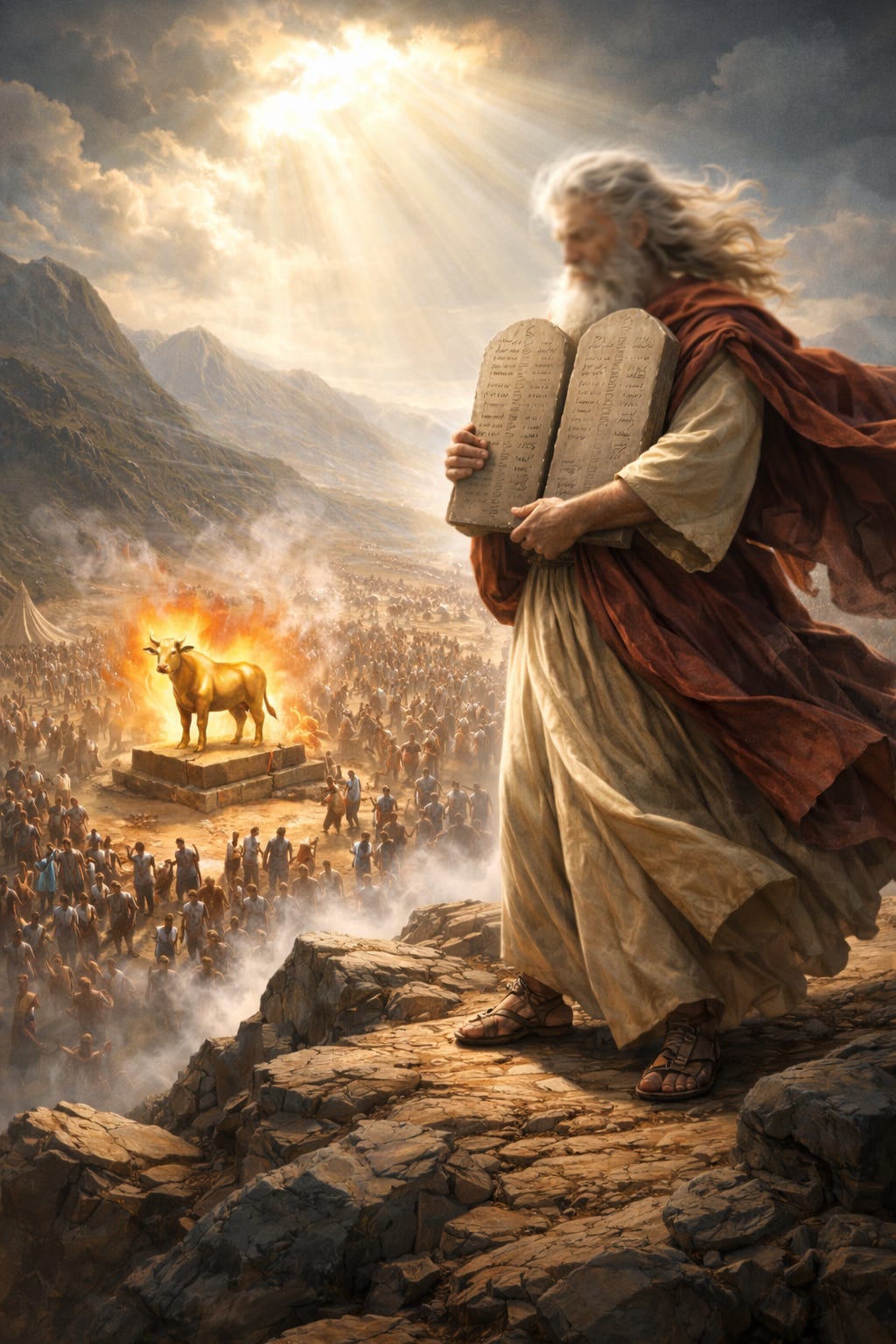
There’s a relationship between two פסוקים in this parsha that, if you read it slowly, makes the whole חטא העגל stop feeling “random.” It becomes one story with one central theme.
The Torah ends one section with:
וַיִּתֵּן אֶל־מֹשֶׁה כְּכַלֹּתוֹ לְדַבֵּר אִתּוֹ… שְׁנֵי לֻחֹת הָעֵדֻת… כְּתֻבִים בְּאֶצְבַּע אֱלֹהִים
“He gave Moshe, when He finished speaking with him… the two Tablets of Testimony… written with the finger of God.”
And the very next פסוק opens:
וַיַּרְא הָעָם כִּי בֹשֵׁשׁ מֹשֶׁה…
“The nation saw that Moshe delayed…”
If you read those two lines as one unit, the parsha can be seen with greater understanding and unity. It’s one theme: Good intentions don’t save you if you build the wrong כְּלִי. When you grab the wrong כלי, you don’t just “mess up.” You manufacture a fake covenant. And then you need an entirely different כלי to rebuild.
On the pshat level, כְּכַלֹּתוֹ means “when He finished.” But the lashon is loaded. It’s hard not to hear כַּלָּה inside the word. Moshe wasn’t just collecting information on Har Sinai. It wasn’t a long shiur. It was a moment of קשר — a relationship moment. Something like a חתונה.
And right after that, the Torah shifts into document-language: לֻחֹת הָעֵדֻת — tablets of testimony; לֻחֹת אֶבֶן — stone tablets (fixed, permanent); כְּתוּבִים — written; בְּאֶצְבַּע אֱלֹהִים — “the finger of God,” meaning authored from Above. This isn’t only holiness. It’s shtar energy. Something that creates reality, not just inspiration. The Torah is describing the covenant in a way that feels deliverable, binding, public.
The phrase לֻחֹת הָעֵדֻת is doing more than we notice at first. On the pshat level, עדות means the tablets are the objective record of Hashem’s will — the proof of what was said at Har Sinai. Not inspiration. Not folklore. A written עדות.
But the Torah could have called them “לוחות הברית” right here. Instead, it calls them לֻחֹת הָעֵדֻת — and that word pulls you into halacha whether you like it or not. Because עדות is not just “information.” In Torah law, עדות is what turns a relationship into a binding reality. A marriage isn’t just a feeling of connection between two people. Kiddushin needs eidim — a public act that creates a new status. And the undoing of that status, geirushin, also lives in the world of a written shtar and a witnessed process. Without an עדות framework, nothing “takes effect.”
So when the Torah calls the tablets לֻחֹת הָעֵדֻת, it’s hinting that these aren’t merely tablets that teach the covenant. They are tablets that establish the covenant. They stand there as the covenant’s public testimony that this bond is real. Which is why what happens next is not merely “a sin.” It’s a disgrace of the covenant’s very form.
Now comes the interesting word: בֹשֵׁשׁ מֹשֶׁה. On the pshat level it means “Moshe delayed.” But there’s a remez here that’s too perfect to ignore: It is clearly related to בּוּשָׁה. Moshe didn’t choose the delay. He didn’t know what was happening below. But the Torah does. And the Torah is telling you: This delay is going to produce disgrace — not because Moshe did something wrong, but because the tzibbur is about to fill the emptiness with the wrong thing.
And the פסוק itself makes the panic explicit:
לֹא יָדַעְנוּ מֶה הָיָה לוֹ
“We didn’t know what happened to him.”
That’s not saying “he’s late.” That’s saying they feel emotionally abandoned. That’s a tzibbur that needs something visible now. So the Torah sets it up: “ככלה” → “עדות-document” → and then: delay… and shame begins forming.
Here’s the part that always bothers everyone. They were at Sinai. They heard the Aseres HaDibros. They know a newly-minted calf didn’t do anything. So why say:
אֵלֶּה אֱלֹהֶיךָ יִשְׂרָאֵל… אֲשֶׁר הֶעֱל֖וּךָ מֵאֶרֶץ מִצְרָיִם
“These are your god(s), Israel, who brought you out of Egypt.”
The answer is: it isn’t “belief” — it’s misdirected religious longing. It’s spiritual panic looking for a tangible handle. They want something that “goes before us,” something visible, something that feels like presence. And notice the wording: they don’t say the covenant Name. They say אֱלֹהֶיךָ — language that can be experienced as power/authority; easier to “represent,” easier to translate into an object. It’s already a step away from direct relationship.
And then the Torah zooms in on the manufacturing:
וַיָּצַר אֹתוֹ בַּחֶרֶט
“He formed it with a חֶרֶט…”
Here’s the remez: the word חֶרֶט shares letters with חֲרָטָה. They used a חרט to form the עגל. The only way back is to take the same אותיות and build a new כלי inside the person: חרטה. The sin is not just the desire for closeness. The sin is giving that desire the wrong vehicle.
Too often we struggle for something tangible that we are familiar with. That is the source of this downfall. כלל ישראל did not truly think that the עגל was their God. They were struggling to find something to cling to in a moment of doubt.
Once the Torah frames Sinai with כְּכַלֹּתוֹ — the echo of כַּלָּה — the עגל is no longer “just another עבירה.” It becomes betrayal of the relationship itself. The נביאים use this language all the time: עבודה זרה is understood as infidelity. It’s the heart detaching from Hashem’s רצון and attaching itself to a substitute.
So when they make an עגל and dance around it, they aren’t only breaking a command. They are creating a reality — a מקום — where the covenant is not being honored. A מקום where the relationship has been publicly replaced. A מקום זנות. And once you name it that way, Moshe’s next move becomes inevitable.
Moshe is coming down holding לֻחֹת הָעֵדֻת — the covenant-document, written בְּאֶצְבַּע אֱלֹהִים. And he walks into a מקום זנות. In that moment, the document cannot be delivered. So Moshe breaks the tablets.
Not like writing a get. More like ripping up the כתובה before it’s handed over — because you can’t finalize a bond in betrayal and disgrace. That’s why the breaking of the לוחות is a bechina of geirushin. Not because Moshe “gave a get,” but because he refused to let the relationship be sealed in a מקום where it was already being violated.
The delay became shame. The shame became betrayal. And Moshe tears the document rather than deliver it.
Then the parsha gives the תיקון in the most elegant way. The first set of לֻחֹת is a pure gift — “finger of God.” But after the rupture, the rebuild can’t be a pure gift anymore. It has to include human rebuilding of the vessel:
פְּסָל־לְךָ
“Carve for yourself…”
Meaning: The Torah remains Hashem’s. The words remain Divine. But the כלי now has to come through effort. That is teshuva. After failure, you don’t get the same “free” closeness. You must carve yourself into a כלי again.
But let us not forget that בעלי תשובה stand in a place where even a צדיק גמור cannot stand. Obviously כלל ישראל had bechirah and they chose poorly. But this created one of the greatest sins the world has come to know, only second to eating from the עץ הדעת.
This is where the title of the piece becomes the avodah.
Because the story of אַהֲרֹן הַכֹּהֵן is not the story of a villain. It’s the story of a gadol trying to survive an impossible ציבור moment. He has good intentions. He’s trying to delay. He’s trying to save lives. He’s trying to buy time until Moshe returns. And the מפרשים explain that צד of the story.
But the Torah still doesn’t write this story like an apology letter. It writes it in a way that leaves אהרן inside the moment — because the Torah is teaching a frightening אמת: Kavanos only go so far. In the end, you’re judged by what you have produced.
And here’s where we have to add the word that matters: אחריות. A gadol doesn’t just have private avodah. A gadol carries a ציבור. That means he also gets judged differently — בחוט השערה. Not because Hashem is looking to “get” him, but because when you’re the one holding things together, a small misstep can create a reality for thousands of people.
Hashem knows your נסיונות. He knows the pressure. He knows what you saw and what you didn’t see. He knows what options were truly on the table and which ones were fantasy. And that’s the point: He judges you based on what you were actually capable of in that moment. Not based on what you wished you could do. Not based on what would have worked in a calm world. But based on the אמת of your מדרגה and your choices inside the storm.
Which means אהרן becomes a mirror. Because if you read the parsha honestly, you’re forced to ask: Could he have handled it differently? Could he have bought time in a safer way? Could he have refused more strongly? Could he have created a different “delay” that wouldn’t have become a platform?
And then comes the hardest humility: Would I have done better? Probably not. But that’s not a free pass. That’s the mussar. Because the Torah isn’t telling us, “Go judge אהרן.” It’s telling us, “Realize how heavy אחריות is.” If an adam gadol can make a move with good intentions and still unintentionally create a vehicle for disaster, then the rest of us have to be even more careful with our own roles — at home, in shul, in business, with our kids, with our תלמידים, wherever people are watching and learning from what we do.
And I don’t think it’s a coincidence that אהרן was “paid back” in such an ironic fashion. Later on, his sons נָדָב וַאֲבִיהוּא were also driven by a desire for closeness. They weren’t trying to rebel. They were reaching — but they reached in an unofficial, ill-advised, unhealthy way, bringing an אֵשׁ זָרָה. And they were destroyed for it.
That’s exactly the point of this parsha. Wanting closeness is not the problem. Wanting closeness without the right כלי, without the right גבולות, is lethal. When desire outruns instruction, when emotion outruns ׳רצון ה, it can look holy and still be wrong.
And that takes us back to our remez:
וַיָּצַר אֹתוֹ בַּחֶרֶט — he formed it with a חֶרֶט.
The tragedy wasn’t only that they sinned. It’s that they built a כלי for the sin. And the תיקון is hidden in the same letters: the חֶרֶט leads to חֲרָטָה.
Teshuva isn’t only “I feel bad.” It’s: I ask myself what I built. Where did my “good intentions” create the wrong כלי? Where did my פחד or pressure create a platform for something I never wanted?
And then the real question becomes: Given my מדרגה, given my tools, given my situation, what could I have done better? That’s what Hashem judges. Not perfection, not fantasy, but honesty. Did you rise to what you were capable of?
Good intentions matter. They’re part of the story. But the parsha is teaching that the סוף מעשה matters too — because your choices create reality. And sometimes the biggest avodah is not having good intentions. It’s making sure your good intentions don’t become the wrong כלי.
May we be zocheh to not only having good intentions, but to follow through and create a כלי that is truly worthy of the covenant we carry.