


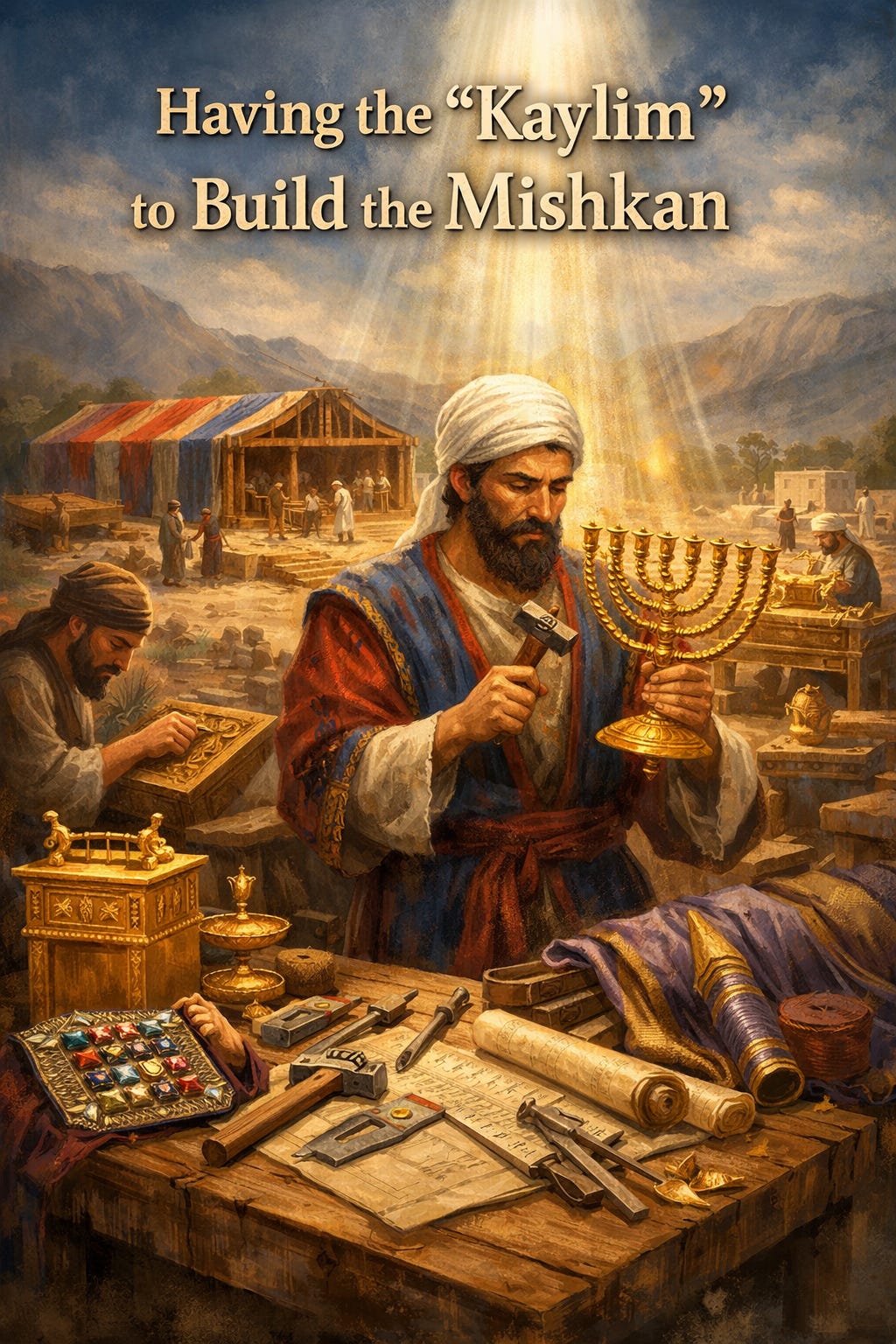
Why did Hashem need people to build the משכן (Tabernacle)?
In כי תשא, the פסוק (verse) says about בצלאל:
״ואמלא אותו רוח אלקים בחכמה בתבונה ובדעת ובכל מלאכה״
A basic question is: why was all of this necessary? If Hashem wanted a משכן, why involve people at all? And even if people needed to build it, why couldn’t משה simply appoint capable workers and have them construct it?
The רמב״ן explains that בני ישראל had been slaves in מצרים for so many years that they did not naturally have master craftsmen, certainly not experts in all the many disciplines required to build the משכן. This was not a nation trained in architecture, metalwork, weaving, woodworking, and artistic design. So Hashem Himself had to endow בצלאל with the abilities needed for the task.
But the פסוק is still striking. It does not just say that Hashem gave him wisdom. It says:
״ואמלא אותו רוח אלקים״
“I filled him with the spirit of God.”
And then the פסוק lists חכמה (wisdom), תבונה (understanding), and דעת (knowledge).
רש״י explains the distinctions between them:
חכמה is what a person learns from others.
תבונה is the ability to understand one thing מתוך דבר אחר — to derive and infer.
And דעת is a higher kind of awareness, which רש״י associates here with רוח הקודש (Divine inspiration).
But perhaps there is another layer here as well.
Knowing something is not the same as being able to bring it into reality. A person can have knowledge, ideas, and even inspiration, but still lack the ability to translate all of that into action. There is a separate gift: the capacity to take wisdom and make it real, to turn potential into accomplishment, to bring vision into fruition.
Maybe that is part of what it means that Hashem “filled” him. Hashem did not only give בצלאל information. He gave him the inner capacity, the confidence, the intuition, the steadiness, and the practical ability to carry that wisdom through to completion.
And maybe that is a lesson far beyond the building of the משכן.
Very often in life, Hashem places a person into a situation that feels bigger than them. A challenge, a mission, a responsibility, or a ניסיון (test). We may look at it and think: I am not equipped for this. I do not have the tools. I do not have the background. I do not have the strength.
But the story of בצלאל teaches us that when Hashem gives a person a mission, He also gives them the tools needed to fulfill it. Sometimes those tools are obvious, and sometimes they are hidden inside us until the moment we need them. Hashem does not just ask; He also enables.
So perhaps the message is this:
Hashem gives a person the skills they need to stand up to their נסיונות.
If He calls on us to build, to lead, to endure, or to grow, then He also fills us with what we need in order to succeed.