

The claim of קרח was not simply that he wanted אהרן’s position.
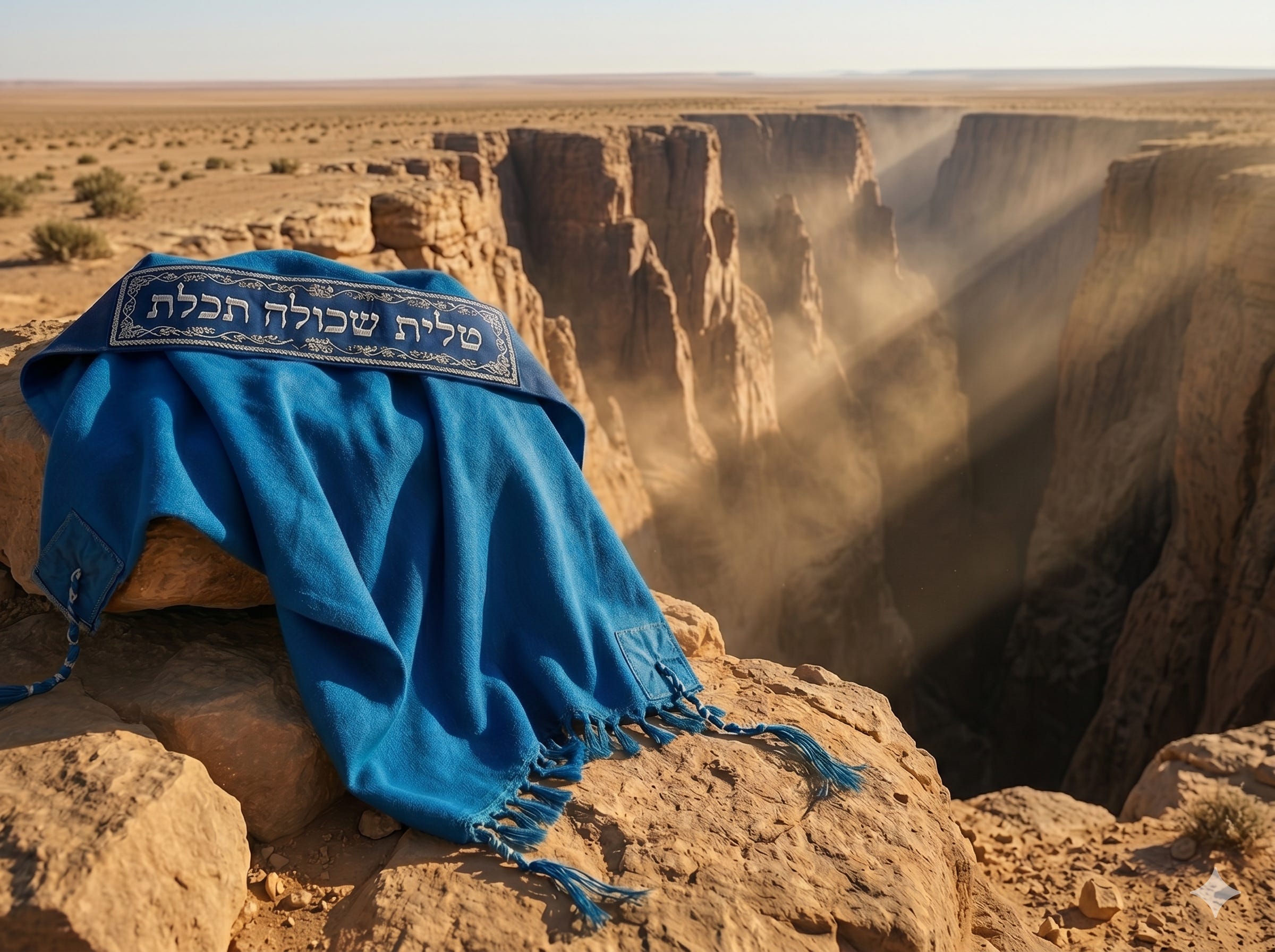
חז״ל show us that his challenge went deeper. קרח came to משה with a טלית שכולה תכלת. If the entire garment is תכלת, does it still require the mitzvah? משה’s answer was yes.
Then came the question of a בית מלא ספרים. If the whole house is full of ספרים, does it still require a מזוזה? The answer was still yes.
These were not random questions. They were the same claim as the פסוק of “כי כל העדה כולם קדושים.”
If the בגד is completely תכלת, why do we need one חוט of תכלת? If the whole house is full of ספרים, why do we need one מזוזה? If the entire כלל ישראל is קדוש, why do we need the position of אהרן?
But the first two questions are not identical. They are seemingly opposites.
By ציצית, the symbol seems to be everywhere. The whole garment is תכלת. It is filled with the color that points upward, from sea to sky to the כסא הכבוד. But the execution is missing. There are no חוטים, no קשרים, no כריכות. The symbol is there, but the mitzvah is not.
By מזוזה, the words seem to be everywhere. The house is full of ספרי תורה, and those ספרי תורה contain the very פרשיות of שמע and והיה אם שמוע that are written in a מזוזה. But here too, the execution is missing. The פרשיות are not written and placed on the doorway as a מזוזה. And once they are not on the doorway, the symbol of מזוזה is gone.
A מזוזה is not only words of Torah. It contains parts of the Torah that are placed where Hashem commanded. On the מזוזת הבית, the doorway of the home, those פרשיות become a visible sign that this house belongs to Hashem and stands under Him. All those who live and dwell there are committed to a life of Torah and mitzvos.
So the two cases move from opposite sides toward the same mistake. By ציצית, the way קרח understands it as a symbol without the act. By מזוזה, he has the words without the doorway-symbol. In both cases, he thinks that what the mitzvah points to can replace the way Hashem commanded it to be done.
That is also the larger claim of קרח. The whole כלל ישראל is full of קדושה. Why do we need one אהרן?
A garment full of תכלת. A house full of ספרים. A nation full of קדושה. In each case, קרח sees fullness and thinks fullness can replace form.
But the purpose of the mitzvah does not cancel the צורה of the mitzvah.
This is not only a question of details. It is a question of what Torah is.
A person can read the written words and say, “I understand the idea. I understand the purpose.” But Torah is not a text handed over to private interpretation. It is תורת משה, given and transmitted through מסורה.
That is תורה שבעל פה: the ground beneath the מצוות. It tells us what the words mean when they enter life. It tells us what counts as ציצית, what makes a מזוזה, who may bring the קטורת, and where קדושה belongs.
קרח was not openly denying the פסוקים. He was doing something more subtle. He accepted the language of קדושה. He even used something that sounded like a Torah tool.
His questions have the shape of a קל וחומר (an a fortiori argument). If one thread of תכלת is enough, then surely a whole garment of תכלת should be enough. If one מזוזה at the door is enough, then surely a house full of ספרים should be enough.
But that is exactly where the danger sits. A Torah tool becomes warped when it is detached from מסורה. A קל וחומר is not a license for personal logic to stand above the mitzvah. It is part of תורה שבעל פה, and תורה שבעל פה begins with surrender to what was received.
קרח took a legitimate form of Torah reasoning and used it to reject the ground that gives Torah reasoning its authority.
In פנימיות התורה, the תורה שבכתב is rooted in שמים, and תורה שבעל פה is rooted in the ארץ. The תורה שבכתב descends from above as the word of Hashem. תורה שבעל פה is where that word takes root below, in the world of פרטי המצוות and מסורה, and finally lived קיום.
קרח wanted the שמים without the ארץ. He wanted the holiness of Torah’s words without surrendering to the grounded form of מסורה. He wanted to stand on Torah while refusing the ground that makes Torah stand in this world.
This is the crucial difference between קרח and תורה שבעל פה.
חז״ל tell us that קרח was not a fool. “קרח שפיקח היה.” He saw that שמואל would come from him. There was something real in what he saw. There was greatness in his future. There was a true point of קדושה connected to him.
But חז״ל also tell us, “עינו הטעתו.” His eye misled him. The problem was not that he saw nothing. The problem was that he trusted his vision in the wrong way.
That is what happened with his קל וחומר as well. He was using a real Torah mechanism, and he was taking תכלת, ספרים, and קדושה seriously. But a true insight becomes twisted when it is no longer held within מסורה.
The world of תורה שבעל פה is the opposite. It is not man imposing himself on Torah. It is the כח of מסורה and חכמים to receive Hashem’s will, guard it, and bring it faithfully into the details of life.
This is why the קטורת is so central to the story.
The עבודה of קטורת is the most inward עבודה. It is hidden and subtle. It is bound to ריח. On יום כיפור it enters the קדש הקדשים. It represents the deepest closeness.
The shadow of נדב ואביהוא stands behind this. As we discussed by שמיני, their חטא was not a rebellion like the חטא of קרח. They were reaching for closeness. But the Torah says “אשר לא צוה אותם.” Even holy closeness becomes dangerous when it is self-authored.
That same danger now returns in a darker form. By קרח, the קטורת is not merely unauthorized closeness. It becomes the expression of a challenge to אהרן and to תורת משה. The lesson of שמיני was that fire needs ציווי. The lesson of קרח is that even a real yearning for קדושה must remain grounded in מסורה.
Since the challenge of קרח is aimed at אהרן, the response of משה is to test it through קטורת. If their claim is about access to the highest קדושה, then let the קטורת itself reveal the truth.
At first glance, the test itself is difficult. משה tells them to bring קטורת, and that קטורת becomes the act through which they are judged. Why is this not a problem of “לפני עור לא תתן מכשול” — the prohibition against placing a stumbling block before another person?
The answer seems to be that משה was not placing a new stumbling block before them. Their claim already led there. If “כולם קדושים” means that all have equal access to the highest עבודה, then קטורת is the honest expression of that claim.
They could have attempted such an עבודה on their own. משה was not giving them access to something they did not already have. He was revealing what their claim already encompassed.
And even then, משה does not tell them to bring the קטורת immediately. He says “מחר,” tomorrow. Like אהרן by חטא העגל, who says “חג לה׳ מחר,” the moment is pushed off. There is still space for the fire to cool, for the warning of “רב לכם בני לוי” to be heard, for the claim to lose its urgency. Perhaps this is something we can learn from both משה and אהרן: when the יצר הרע or מחלוקת is burning, sometimes the first victory is simply to push it off until tomorrow.
But if they will not step back, the קטורת will reveal where their claim truly leads.
The test took the slogan of “כולם קדושים” and turned it into a מחתה held before Hashem.
And the מחתות show us something very important. The Torah does not treat them as meaningless metal. The פסוק says, “כי הקריבום לפני ה׳ ויקדשו.” They were brought before Hashem, and they became קדוש. There was something real in the reaching.
But real does not mean right.
The מחתות became קדוש, but they could not remain in the hands of קרח. They had to be hammered into the מזבח itself. The wild and rebellious act of קטורת had to be taken out of the form קרח gave it and placed into the exact structure of Hashem’s עבודה.
That became the זכרון. Not that yearning for קדושה is false. It is very real. But it must be placed with care and precision into the מצוות as Hashem gave them. Our fire belongs on the מזבח. It does not belong in self-authored interpretations.
And now the punishment becomes very precise.
The ground opens.
חז״ל tell us in אבות that פי הארץ was created בערב שבת בין השמשות, at the edge of the first week of creation. That means this response was not improvised. From the beginning of מעשה בראשית, the world already contained an answer to this kind of claim.
But perhaps there is more.
If פי הארץ was created then, it was created after the first human failure around ציווי. Hashem commanded אדם not to eat from the עץ הדעת. Yet when חוה spoke to the נחש, she added, “ולא תגעו בו.” Not only may we not eat from it, she said, we may not even touch it.
חז״ל see in that addition the root of the fall. Once the boundary of the command becomes self-authored, the boundary becomes unstable. The נחש can push her against the tree and say: just as touching did not kill you, eating will not kill you either.
It began as an added fence. It ended as a collapse of the command.
This does not mean that every fence is a distortion. Quite the opposite. One of the foundations of תורה שבעל פה is “ועשו סייג לתורה,” to make a fence around the Torah. But a true סייג does not replace the Torah. It protects it. חכמים do not stand above Torah when they make גזירות and תקנות. They stand beneath Torah, guarding the integrity of the ציווי. The deciding difference is knowledge. חכמים build a fence knowing what is command and what is fence, and they keep the two apart. חוה’s fence failed because that knowledge was missing — and a fence mistaken for the command itself does not fall alone. When it goes, the command goes with it. (אבות דרבי נתן).
With חוה, the movement is to add. With קרח, the movement is to subtract.
חוה says, in effect: I understand the command, so I can extend the boundary.
קרח says: I understand the purpose, so I can remove the form.
But the root is the same. In both places, human reasoning begins to stand over the ציווי instead of beneath it.
And this was not a long shot. This kind of claim was anticipated from מעשה בראשית. Once the world had seen what happens when man begins to reshape the borders of command, creation itself was given an answer for the day when that same danger would return within כלל ישראל.
Not that קרח was forced to be the one to make it. But the claim was going to come. Somewhere in history, someone would rise up and say: if we already have the purpose, why do we need the form? If we already have קדושה, why do we need גבולות? If Torah speaks from שמים, why must I submit to the ארץ of מסורה?
So the mouth of the earth was prepared from creation.
Because this claim touches the foundations of the world. The world was created with Torah as its ground. And if a person tries to stand on Torah while hollowing out the ground of תורה שבעל פה, the ground itself must answer.
קרח tried to use the holiness of the written word while cutting away the מסורה that makes it תורת משה.
But the ground cannot be stolen. קרח cannot change the Torah. He cannot corrupt the מסורה. He can only lose his place upon it.
So the ארץ opens beneath him.
Perhaps this is the ברכה we need to take from פרשת קרח. We should be זוכה to hear the מוסר of the מצוות themselves, the way the Torah gives them to us. Not to reshape Torah around our needs, our wants, or even our own sense of what should be meaningful.
Rather, we should be זוכה to be מקיים nullifying our will before His will: בטל רצונך מפני רצונו“.” We should let the Torah shape us, instead of trying to shape the Torah around ourselves.
Because once a person lifts the purpose away from the commanded form, he has not made Torah higher. He has made it rootless.
And a rootless Torah cannot hold a person up.