

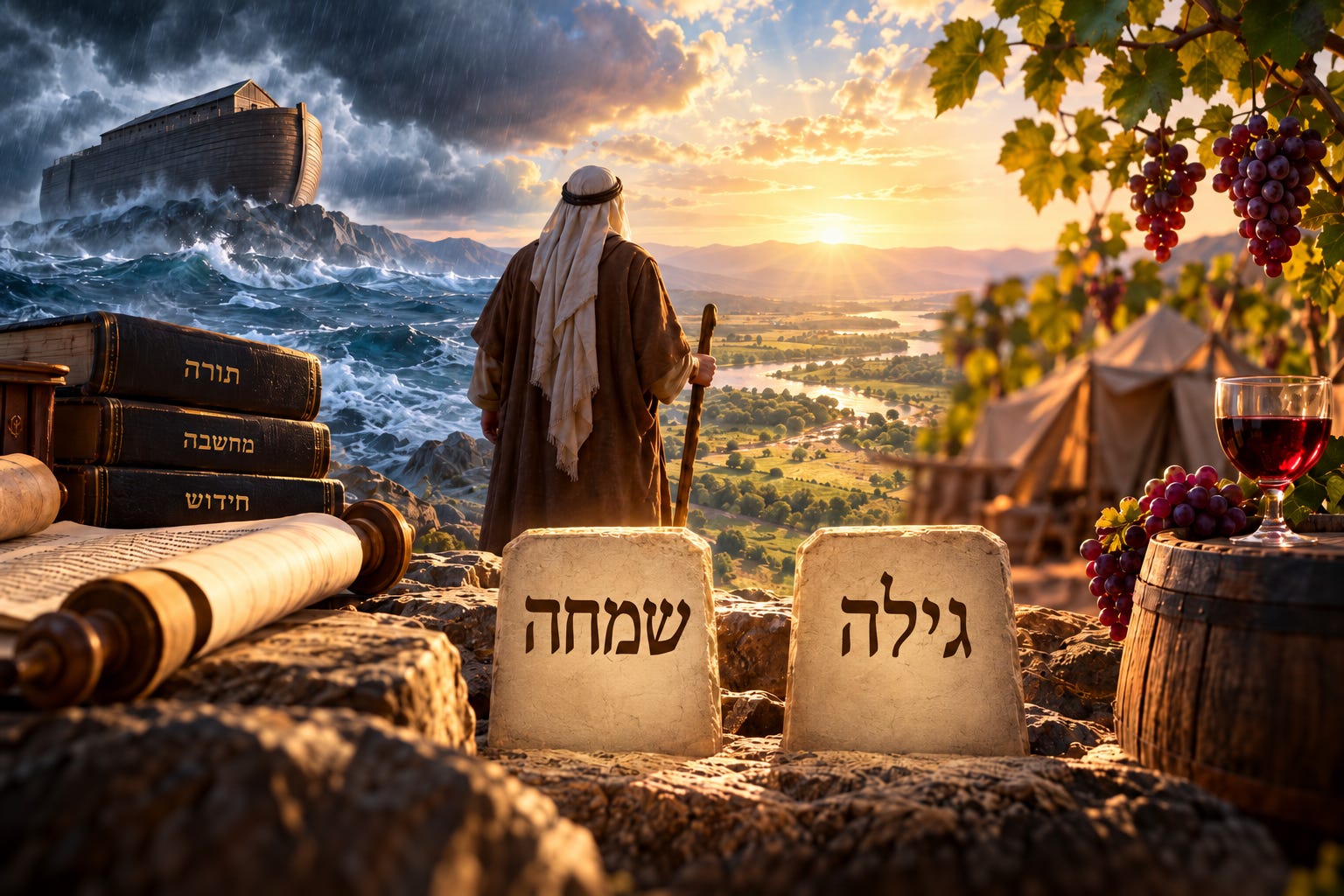
What is a true צדיק (righteous person)? The Torah describes נח with extraordinary praise:
אֵלֶּה תּוֹלְדֹת נֹחַ נֹחַ אִישׁ צַדִּיק תָּמִים הָיָה בְּדֹרֹתָיו אֶת־הָאֱלֹהִים הִתְהַלֶּךְ־נֹחַ.
“These are the descendants of נח, who was a righteous man, complete in his generations; he walked with Hashem.”
בראשית ו׳:ט׳
He is not merely called a צדיק. The Torah calls him an איש צדיק תמים, and he walks with Hashem. Earlier, the Torah tells us that he found חן in the eyes of Hashem. The גר״א points out that before the words ונח מצא חן, it appeared that no human being would remain after the flood. The existence of נח was pleasing to Hashem, and through him humanity was saved.
Yet the same נח who saves the world later plants a vineyard, becomes drunk and lies exposed within his tent. Another ten generations stand between נח and אברהם אבינו in the account of the משנה. What remains unfinished in the righteousness of the man who preserved humanity?
There are two readings of בדורותיו brought by רש״י (in his generations). Some understand it as praise: had he lived among righteous people in his own generation, נח would have become still greater. Others understand it as a limitation: in a generation where he has to stand beside אברהם אבינו, he would not have been considered significant.
What is being measured? The Torah itself testifies to his righteousness. How can that genuine greatness contain a limitation that becomes visible in his downfall?
Perhaps the question concerns not only what a צדיק accomplishes, but what kind of happiness he takes his accomplishment to be. To approach that question, we must first distinguish the constancy of the צדיק from the חידוש (new understanding) of the חכם (wise person).
The פסוק in משלי says:
גִּיל יָגִיל אֲבִי צַדִּיק וְיוֹלֵד חָכָם יִשְׂמַח בּוֹ.
“The father of a צדיק will rejoice greatly, and one who gives birth to a חכם will be happy with him.”
משלי כ״ג:כ״ד
The פסוק does not merely repeat the same praise in different words. It distinguishes between a צדיק and a חכם, between גילה and שמחה, and between a father and one who gives birth to wisdom.
In the פירוש of the גר״א in תהלים, he explains the distinction through another פסוק:
יִשְׂמְחוּ הַשָּׁמַיִם וְתָגֵל הָאָרֶץ.
“The שמים will be happy, and the ארץ will rejoice.”
תהלים צ״ו:י״א
The גר״א explains that שמים corresponds to Torah and מחשבה (thought), while ארץ corresponds to מצוות and מעשה (action). The Torah belongs to שמים because it contains constant חידוש. Its words remain eternally the same, yet every true encounter with the Torah can reveal something that had not previously been seen. The Torah is never exhausted.
The ארץ represents מעשה. It receives the רצון השם (will of Hashem) and gives it physical expression through מצוות. The task of the צדיק is to preserve the exact form of that רצון and carry it faithfully into action.
The fixed boundaries of מצוות are expressed in the prohibitions of בל תוסיף and בל תגרע (adding to or subtracting from the command):
אֵת כָּל־הַדָּבָר אֲשֶׁר אָנֹכִי מְצַוֶּה אֶתְכֶם אֹתוֹ תִשְׁמְרוּ לַעֲשׂוֹת לֹא־תֹסֵף עָלָיו וְלֹא תִגְרַע מִמֶּנּוּ.
“Everything that I command you, you shall carefully perform; you shall neither add to it nor subtract from it.”
דברים י״ג:א׳
Adding a fifth פרשה to תפילין would not demonstrate greater devotion. It would alter the מצוה that Hashem commanded. The purest מעשה is not the one into which a person inserts the most of himself. It is the one that most precisely expresses the רצון השם.
The חכם is no less faithful. He, too, cannot create his own Torah or add his own מצוות. But within the unchanged boundaries of the Torah, he reveals depths that had not previously been seen. He cannot add another פרשה to תפילין, but he can reveal endless חידושים within the four פרשיות that Hashem gave.
The distinction is therefore not between a צדיק who merely keeps the status quo and a חכם who invents. Both submit themselves entirely to Hashem. The צדיק preserves the boundaries of the Torah. The חכם reveals the infinity within those boundaries.
This may explain why the פסוק joins גילה (rejoicing) to the צדיק and שמחה (happiness) to the חכם in its two clauses. This application is not stated explicitly by the גר״א; I am suggesting it from the structure he describes. The צדיק reveals in מעשה the enduring רצון השם. The חכם continually brings forth new understanding within the same Torah.
The father and the Rebbe may express these two kinds of joy. A father rejoices in his son’s faithful performance of the will of Hashem. A Rebbe also gives birth to the דעת (understanding) of his תלמיד (student), and experiences the happiness of seeing true חידושי תורה emerge. Both rejoice in what is revealed through the child or תלמיד, while recognizing its source in Hashem.
The greatest שמחה of a Rebbe is not simply hearing his own words repeated. It is seeing the Torah become alive within his תלמיד until the תלמיד can reveal something that even the Rebbe had not previously expressed, while remaining completely faithful to the Torah he received.
Ultimately, this may allow us to understand something of the שמחה of Hashem, כביכול (as it were), when כלל ישראל learns His Torah faithfully. Hashem desires not only that His מצוות be faithfully performed, but that His Torah be learned, entered and continually revealed. A true חידוש does not create another Torah. It reveals another פנים (facet) within the one Torah that Hashem gave.
Two Ways of Reading One Word
Before going further we must confront something that stands in the way. The distinction we have been using is not the only one, and it is contradicted by a מפרש who holds the opposite plainly and consistently.
Notice first that these two words (שמחה and גילה) stand in parallel to one another wherever they are set side by side. They are not unrelated terms that happen to fall together. Each פסוק places one against the other, which means the question was never whether they differ, but along what axis they differ. That is precisely where our two מפרשים part.
The מלבי״ם explains:
שָׂמְחוּ לְפָנֶיךָ כְּשִׂמְחַת בַּקָּצִיר כַּאֲשֶׁר יָגִילוּ בְּחַלְּקָם שָׁלָל.
“They rejoiced before You as with the happiness of the harvest, as they rejoice when dividing spoils.”
ישעיהו ט׳:ב׳
For him, the harvest returns according to an established order, and that dependable return is what produces שמחה. Spoils arrive without warning, and that suddenness is what produces גילה. Where the גר״א gave שמחה to what is new, the מלבי״ם gives it to what comes continually; where the גר״א gave גילה to what already stands, the מלבי״ם gives it to what arrives all at once.
This is not a passing remark. In that very place the מלבי״ם says of this distinction that he has explained it throughout all of תנ״ך. Elsewhere he refers the reader back to where he laid it out before, giving גילה as the joy over news newly come to a person, like one who finds a lost object, and שמחה as the continual gladness of the heart when things go well with him, the opposite of sadness.
He applies it again:
בִּנְפֹל אוֹיִבְךָ אַל־תִּשְׂמָח וּבִכָּשְׁלוֹ אַל־יָגֵל לִבֶּךָ.
“When your enemy falls, do not be happy, and when he stumbles, let your heart not rejoice.”
משלי כ״ד:י״ז
The fallen condition is the state that remains, and it receives שמחה. The stumble is the moment of the thing, sudden and passing, and it receives גילה.
So we are not dealing with a stray comment. We are dealing with a standing position, announced as such, that says the opposite of what we have been building upon.
The ordinary way to relieve a difficulty of this kind is to say that the two are describing different בחינות (aspects), each true within its own setting. That answer is available here, and I do not believe it is sufficient — because of what happens when both approaches read the same פסוק.
Return to ישמחו השמים ותגל הארץ, the פסוק through which we first learned the distinction. Both of them read it. Both place ישמחו with שמים and ותגל with ארץ. They agree completely about where the two words belong.
But they arrive there by opposite reasoning. For the גר״א, the שמים are continually renewed and therefore receive שמחה, while upon the ארץ there is nothing new beneath the sun. For the מלבי״ם, the שמים proceed constantly according to the fixed natural order and therefore receive שמחה, while events upon the ארץ are renewed according to human מעשים and השגחה (Divine providence), and therefore receive גילה.
Two men define the words in opposite directions, characterize the two realms in opposite directions, and place the words identically. If these were merely two incompatible definitions, that outcome would be an accident. It does not look like an accident.
Their own words also show how the two terms are working. In both approaches, it is גילה that is being fixed, and the place of שמחה follows from where גילה has been set. But שמחה is not therefore merely a leftover term. The two stand as a pair, and a pair is one relationship seen from both ends. To fix one of them is to fix the relationship itself, and the other receives its place from within that relationship rather than by simple negation. Whatever is happening here is happening inside one relationship between two words, not inside two definitions that merely stand opposed.
There is one further hint before we attempt an answer. The מלבי״ם, explaining ותגל הארץ, continues by describing how the sea may overflow and flood the world when humanity is guilty. The מפרש whose entire distinction rests upon the sudden rise, glossing this word, reaches for water rising over its boundary.
That is where I want to begin.
The גל, Wave
The difficulty has usually been described as a disagreement over what two words mean. I want to suggest that it has been described poorly, and that only one of the two words is actually in dispute.
The word is גילה. There are other words associated with happiness and joy, like ששון. These two, however, are continually paired together and clearly have a specific relationship, which is what we are focusing on.
My Rebbe, HaRav Nochum Lansky שליט״א, taught me that when two words share their base letters, the question of whether they belong to the same technical שורש is not the question to ask. Shared letters mean the words are intrinsically connected. That connection is the starting point, not the conclusion.
The word גילה shares its letters with גל, a wave. It shares them with גלה, to uncover. It shares them with the גל of גל עד, a heap of stones piled up as a witness, and with גלגל, that which rolls.
These are not separate meanings that happen to resemble one another. They are one motion. A גל rolls. In rolling it comes and comes again, without interruption. In rolling it turns over what lay beneath and brings it into view. And in rolling it rises above the water around it, and then sets back down. Recurrence, revelation and elevation are not three things a wave does. They are one thing a wave is, described from three positions. The reading of these as one motion is my own.
What follows is my own bridge. I have not found either מפרש drawing this connection, and I am not reporting the method of either one. I am saying what I believe lies beneath their disagreement: that each of them has taken hold of one face of a single word, and that this is why the dispute takes the shape it does.
What the גר״א has isolated, I would say, is גילה in the sense of גלה. For him it belongs to what already stands there and is now uncovered, and שמחה belongs to what is renewed.
What the מלבי״ם has isolated is גילה in the sense of גל. For him it is the crest, the abrupt rise above the sustained level of the water, and שמחה belongs to that sustained level.
On this reading, neither of them is importing a definition from outside. The letters hold both senses, and each has taken hold of one.
So this is not a comparison. We are not saying that גילה is like a wave. The word for this joy is the word for a wave, and it is the word for uncovering. What a גל does is therefore not an illustration of anything. It is what the word has been telling us.
This means we may look at the thing itself. There is no flat surface that a crest rises above. The surface is the wave. The crest stands above the mean level, and the trough falls below it by exactly the same measure. There is not calm water with peaks appearing in it. There is one water, measured in two ways.
And there is no rising without the coming again. The same rolling that lifts the water is the rolling that brings it back. A person who wants the crest has not asked for a different gift from the one who wants the steady surface. He has asked for the same water, measured differently.
Now the harvest can be heard again. According to the approach of the גר״א, I would read that contrast through constancy: each harvest brings a newly grown crop, while בחלקם שלל (when they divide spoils) describes the distribution of wealth that already exists. That is a possible reading, not a פירוש of the גר״א that I have found on this פסוק. What matters is that both readings work, and why. The harvest genuinely is both. It recurs dependably, and it is newly produced each time. That is not a weakness in either approach. It is what we should expect if both men are holding one word.
And the agreement about ישמחו השמים ותגל הארץ is no longer strange. Both of them are placing ותגל first. The גר״א puts it upon the ארץ because there is nothing there to be uncovered that was not already standing; the מלבי״ם puts it upon the ארץ because what happens there rises up suddenly. Each has taken hold of גילה by a different face of the word, as I am reading them, and each lets שמחה take the remaining place. The assignment comes out identical because a single word is being read from two sides.
Nothing is wrong with either aspect. A person is meant to have both.
A Difficulty Within the גר״א
There is a second difficulty, and the answer we have just given does not touch it.
Earlier in משלי, the פסוק describes those:
הַשְּׂמֵחִים לַעֲשׂוֹת רָע יָגִילוּ בְּתַהְפֻּכוֹת רָע.
“Who are happy to perform evil and rejoice in the distortions of evil.”
משלי ב׳:י״ד
In his primary פירוש there, the גר״א gives the distinction we have been using. שמחה belongs to something new, while גילה belongs to something that already existed and is now being revealed.
An alternate פירוש of the גר״א brought from כתב יד (in the Artscroll מקראות גדולות) says the opposite:
כי שמחה הוא מה ששמח בדבר תמידות ואינו מתחדש תמיד, אבל יגילו בדבר שנתחדש לו תמיד.
“שמחה is what one experiences concerning something continuous that is not constantly renewed, while גילה concerns something that is continually renewed.”
Read the two together. In the first, שמחה is the new and גילה is what already stands. In the second, שמחה is the continuous that is not renewed and גילה is what is renewed constantly. The terms have traded places entirely, in the same מפרש, upon the same פסוק.
Notice that the גל does not help us here, and we should say so plainly. It told us what each of the two מפרשים has taken hold of. It says nothing at all about why one of them should take hold of one face in his פירוש and the other face in a second explanation of the very same words. A word with two faces does not explain a man who uses both of them in one place.
So we must look at the פסוק itself.
Look at where it places the two words. השמחים לעשות רע attaches שמחה to עשיה, to מעשה. In the framework of the גר״א, the domain of מעשה is ארץ, and ארץ is where גילה belongs. And יגילו is attached to בתהפכות רע, which is not an act at all, but a condition. The two words have exchanged their domains before any definition has been offered. This observation is my own.
That is already part of the היפוך (reversal) the פסוק is describing. The word תהפכות is not incidental to the difficulty. It is the subject of the פסוק.
Read against the לעשות, the כתב יד is not the גר״א contradicting himself. It is the גר״א reading a פסוק whose domains have already been exchanged, and following his own framework into that exchange. Where שמחה has landed upon מעשה, it takes the profile of מעשה. Where גילה has landed upon a standing condition, it takes the other. The definitions follow the domain, not the word. I suggested an explanation of this reversal to my Rebbe, who described it as quite a חידוש. But that was prior to my realization that the variance regarding the verb of לעשות was being associated with שמים. I am confident that the variance gives this approach a great deal more validity and is not simply an explanation without a proper textual root.
The היפוך of the רשע
And the לשון of the כתב יד tells us exactly what the distortion is. יגילו בדבר שנתחדש לו תמיד — the גילה of this person is renewed for him constantly.
That is the perversion. Not that the רשע enjoys the crest; a crest is not evil. It is that he demands the crest as his constant. He wants the burst of elation to be the steady surface of his life, and he arranges his life to produce it again and again.
Consider the terrible example of a murderer who feels satisfaction in his crime. The feeling may be real, but it is deeply perverted; the fact that he enjoys the act does not make it a source of true happiness. What should have been a passing elevation becomes the thing he returns to, and what should have been the sustained good of an ordinary life yields him nothing at all.
Here the wave shows us why this cannot work, and the reason is not moral advice but the shape of the thing itself. A crest cannot be raised without deepening the trough by the same measure. The person who lives at the crest is not merely choosing a less reliable good. He is manufacturing the drop. The greater the height of a rollercoaster’s rise, the greater its eventual drop.
The פסוק itself says so:
גַּם־בִּשְׂחוֹק יִכְאַב־לֵב וְאַחֲרִיתָהּ שִׂמְחָה תוּגָה.
“Even during laughter, the heart may ache, and the end of that happiness is sorrow.”
משלי י״ד:י״ג
The אחריתה is not a punishment attached to the crest from outside. It is the crest, measured from the other side. This is the שחוק we are describing — mirth pursued for itself, even as the heart beneath it is in pain. Not every laugh is such שחוק, and not every strong feeling of happiness is excessive. The boundary is crossed when the desire to prolong the elevation overrides the purpose and limits that should govern it.
That is also why the movement cannot stay level:
עבירה גוררת עבירה.
“One עבירה draws another עבירה.”
אבות ד׳:ב׳
An עבירה (transgression) can strengthen the תאוה (desire) that produced it. But under the wave we can say more precisely why the next one must be larger. Each crest has deepened the trough beneath it, so the next reach must clear a lower floor. The רשע does not repeat himself. He escalates, because he has to.
Neither aspect of the גל is wrong. The question that will meet נח is not which one is legitimate. It is which one he takes as the measure of his life.
None of this places נח among those רשעים. He retains the name צדיק, and the Torah’s testimony to his righteousness remains true. But the question the wave puts to the רשע in its extreme form is put to every person in an ordinary one. Which aspect of the גל do I take as the measure of my life — the sustained good that is always arriving, or the moments of elevation that stand above it?
The חכם is praised for his שמחה, his חידוש, because it is קדושה and being מגלה כבוד השם. That is the exact challenge of נח, wanting that “high” to be sustained with intention to do קדושה.
The test will be especially searching for a man who has already succeeded. נח has obeyed Hashem and preserved life. Can he receive the fruit of that success without making the crest of it his purpose?
He was, first, entirely faithful:
וַיַּעַשׂ נֹחַ כְּכֹל אֲשֶׁר־צִוָּה אֹתוֹ אֱלֹהִים כֵּן עָשָׂה.
“נח did according to everything that Hashem commanded him; so he did.”
בראשית ו׳:כ״ב
This is the purity of his righteousness. נח does not redesign the תיבה (ark) or improve upon its measurements. He constructs the exact כלי (vessel) that Hashem commanded and thereby preserves the world. The deed is complete. What remains is what he will do with what the deed has earned him.
When ברכה Breaks the כלי
Hashem could have destroyed the דור המבול in countless ways. Instead, He brought water.
That choice is worth pausing on now. Water is the substance whose whole nature is the גל. It is never still, it rises and falls, and it has no shape of its own except the shape of what contains it. Rain is ordinarily one of the purest expressions of ברכה. It descends from שמים, awakens the ארץ and allows life to emerge. Yet in the מבול, that same water became the force of destruction.
Perhaps the apparent contradiction lies in the כלי receiving the ברכה. When the כלי is properly formed, the שפע (Divine abundance) enters it and produces life. When the כלי has become corrupted, that same abundance overwhelms it. Even an outpouring of חסד (kindness) can exceed the capacity of its recipient. What descends and how it is received cannot be considered separately. Rebbe quotes the גר”א to say that just as the עולם can not be קיים on pure דין, so too it can not be sustained by unbridled חסד.
The דור המבול was filled with חמס (violence and theft). The boundaries that allow one person to exist beside another had collapsed. When there is no respect for what belongs to another person, there can be no true חיבור (genuine connection). Everything is taken, absorbed and violated. The world had destroyed its own כלים.
Therefore, the rain that should have sustained the world dissolved it instead. The waters rose above every boundary. The distinction between land and sea, established during בריאת העולם, disappeared. The world returned to a condition resembling the water that preceded form.
A world that recognizes no boundary is a wave with nothing to break against. It is all crest and no shore.
Yet the very same water that destroyed the world lifted the תיבה.
That is the greatness of נח. The שפע that shattered everything outside raised the properly constructed כלי within it. The issue was not the water alone. The question was whether there remained a structure capable of receiving it.
The forty days of rain contain the בחינה of a מקוה. A מקוה requires forty סאה, and the מבול brought forty days of water upon the בריאה (creation). The world was not merely destroyed. It was cleansed from the חמס that had made continued existence impossible. The מבול returned the world to water so that the process of בריאה could begin again.
The תיבה was therefore more than a means of surviving a natural disaster. It was a miniature world. Within it were distinctions, boundaries, times, and appointed places. Each creature had its place and received its food. The disorder outside was answered by an extraordinary order within. נח preserved the structure through which life could again emerge.
This explains why the Torah repeatedly emphasizes זכר ונקבה. If the purpose had been only to preserve specimens, the Torah would not need to stress the relationship between male and female so consistently. נח was preserving the possibility of חיבור and תולדה (continuation through offspring). The world is built through the joining of זכר ונקבה, through the relationship of נותן and מקבל (giver and recipient), and through the ability of two distinct sides to unite without erasing one another.
The דור המבול had corrupted חיבור. And נח preserved it.
The תיבה became a protected כלי holding the fundamental relationships of the בריאה. It preserved not merely life as it had been, but the possibility that life could continue to unfold. נח carried the building blocks of a future world, even though he would not be the one to complete that building.
The order of Hashem’s words also draws our attention to the command. Hashem announces the end of all flesh and gives the instructions for constructing the תיבה before specifying that the destruction will come through a flood of water. The instructions precede that explanation within the speech; the Torah does not say that נח began building before hearing the rest.
There is something in this order resembling נעשה ונשמע. The command is not made dependent upon a prior grasp of all its reasons. נח accepts the will of Hashem and carries it faithfully into action.
Perhaps Hashem saw within נח this quality of אמונה: the ability to construct a כלי for the רצון השם even before he fully understood what that כלי would be required to hold. That is what made him worthy of carrying the world through its destruction.
Inside the תיבה itself, נח preserves the relationship of giver and recipient through his own tireless care. Outside it, he will face a different test: how to receive and enjoy the bounty of the world he has saved.
The כרם and the Struggle of נח
My Rebbe pointed out that the עלה זית (olive leaf) brought by the יונה (dove) contains the future light of חנוכה in its promise. The olive carries the שמן (oil) that can be raised into the מנורה and become the light of a מצוה. We will return to that possibility after examining the planting נח actually chooses.
My Rebbe further pointed to the significance of the first word describing the vineyard of נח:
וַיָּחֶל נֹחַ אִישׁ הָאֲדָמָה וַיִּטַּע כָּרֶם.
“נח began as a man of the ground, and he planted a vineyard.”
בראשית ט׳:כ׳
On this, רש״י explains:
ויחל — עשה עצמו חולין, שהיה לו לעסוק תחילה בנטיעה אחרת.
“He made himself חולין, for he should have first occupied himself with a different planting.”
רש״י שם
Nor is this the only place that joins wine to joy:
וְיַיִן יְשַׂמַּח לְבַב אֱנוֹשׁ לְהַצְהִיל פָּנִים מִשָּׁמֶן וְלֶחֶם לְבַב אֱנוֹשׁ יִסְעָד.
“And wine gladdens the heart of man, to brighten the face with oil, and bread sustains the heart of man.”
תהלים ק״ד:ט״ו
Read the order of that פסוק. The bread sustains, and that is the base. The wine gladdens and the oil brightens, and these grow above the base. According to the approach of the גר״א, the שמחה that wine produces is the joy of what is new and of the moment, not the joy a person himself carries. That is precisely what the drinker reaches for. Applying his distinction to this פסוק is my own; I have not found it in his name here.
And notice what stands beside the wine. The oil is there in the same פסוק, and both of them grow from the ארץ that has just been restored. Before נח stood the fruit that gladdens for a moment and the fruit whose inner substance becomes light. The other planting that רש״י says he should have occupied himself with first is named in the same breath as the one he actually chose.
The failure was not that wine has no place in קדושה (holiness). Wine will be used for קידוש and נסכים (libations), and it can serve the happiness of a מצוה. The failure begins with the priority נח gives it.
Consider what stands before him at this moment. A world has been preserved. The אדמה has been restored, the seasons have been promised never again to cease, and the bounty of ordinary life is arriving reliably and will keep arriving. That is the sustained surface of the water, and it is the largest gift any human being has ever been handed.
And the first thing the Torah records him planting is the one fruit whose entire character is elevation. Wine does not sustain. Wine lifts. It raises the experience of the drinker above where it stood a moment before, abruptly, and then sets him down.
We are not told what נח intended, and we do not need to be told. The Torah records no reason and no thought. It records an order: a whole world restored to him, and the first planting set down is the one that lifts. That order is the evidence, and רש״י reads it as one — not that the wine was forbidden, but that another planting should have come first. This is what makes the word ויחל so exact. The חול is not in the wine. It is in what came first.
The Torah describes the outcome:
וַיֵּשְׁתְּ מִן־הַיַּיִן וַיִּשְׁכָּר וַיִּתְגַּל בְּתוֹךְ אָהֳלֹה.
“He drank of the wine and became drunk, and he became uncovered within his tent.”
בראשית ט׳:כ״א
The man who preserved the boundaries of the world loses command of his own boundaries. And the word the Torah chooses for it is ויתגל, built from the same letters we have been tracing. His גילה ends in an uncovering after all, but not the uncovering of what Hashem placed in the world. Where the צדיק should reveal the will of Hashem through his deeds, נח ends with his own body exposed. The recipient is visible, and the purpose of the bounty is not.
The trough follows the crest exactly as it must. He does not remain elevated. He is found lying uncovered in his tent, lower than where the sustained surface had already placed him.
This does not mean that נח never recognized the source of his salvation. Before the vineyard, he builds a מזבח (altar) and brings offerings to Hashem. What the כרם shows is not the absence of that recognition, but its reach. Whatever stood behind the מזבח did not determinewhat he planted next.
We need not say that the full inversion described in the רשע has occurred in him. נח does not demand the crest as his constant. But the vineyard shows how a genuinely righteous man can take up a good thing ahead of a better one, and how little has to go wrong for that to happen. נח remains a צדיק. What the episode exposes is not his motive, which we do not know, but his order of priority once the commanded work was finished.
My Rebbe’s distinction between the failures of אדם הראשון and נח now becomes especially significant. אדם הראשון mixed טוב and רע through the עץ הדעת טוב ורע, and the דור המבול carried that corruption toward its terrible conclusion.
And נח survives the destruction of that corrupt world. He then enters a new world, capable of a new beginning. Yet the vineyard introduces the different confusion my Rebbe identified: the mixture of קודש and חול (the holy and the ordinary). The good that has reached the recipient is treated as though its purpose ends with him.
Yet חול is not itself evil, and bodily enjoyment is not itself a failure. The physical world can be directed toward the will of Hashem. The same wine that brings drunkenness can serve קידוש at another table. A crest within a life is a gift. A life built to chase crests is something else.
The מבול could destroy a world overwhelmed by corruption. It could not, by itself, teach the surviving recipient how to sanctify his enjoyment. That requires human עבודה (service of Hashem) within the ordinary world, continually bringing the gift back into the service of its Giver.
This may also illuminate the two readings of בדורותיו brought by רש״י at the beginning of the פרשה. On the reading לשבח (as praise), the greater environment of righteous people would have helped נח rise further. On the reading לגנאי (as a limitation), his existing righteousness falls short when measured against אברהם אבינו. Perhaps the latter reading directs us toward the limitation exposed by the vineyard: genuine righteousness in action had not yet become a sustained way of receiving all of life from Hashem.
The משנה in אבות counts ten generations from אדם הראשון to נח and ten from נח to אברהם אבינו. It describes both periods as generations that provoked Hashem, not as a steady spiritual ascent. Yet the different outcomes may disclose what the world was still awaiting. נח preserves life through the first catastrophe; אברהם אבינו will demonstrate how the recipient’s ordinary life can be returned to its source. The need left visible in the כרם remains unanswered until that further stage.
Still, אברהם אבינו does not replace נח as though נח had accomplished nothing. אברהם אבינו begins from the world that נח preserved. נח is the bottom point from which the ascent becomes possible.
The הליכה from נח to משה רבינו
The גר״א explains that there are four forms of human action, and that הליכה is the greatest. A person who lies, sits or even stands remains within his present place. The מהלך can leave his existing position and advance toward another מדרגה.
This makes the Torah’s description of נח enormously significant:
אֶת־הָאֱלֹהִים הִתְהַלֶּךְ־נֹחַ.
“נח walked with Hashem.”
בראשית ו׳:ט׳
He was not merely static. He possessed the capacity for movement and עליה. That may be part of why he was worthy to save the world. At the end of ten generations of descent, there remained one person who could still walk with Hashem.
There is a contrast drawn by רש״י between the need of נח for support with the ability of אברהם אבינו to strengthen himself and walk in righteousness. This does not mean that אברהם אבינו was independent of Hashem. He could carry his attachment to Hashem forward through his own initiative. Perhaps that is precisely what נח struggles to sustain when the setting changes from the commanded תיבה to the vineyard he chooses to plant.
The tragedy is therefore not that נח never possessed the power of הליכה (movement and ascent). Walking is the sustained form of rising. It is the constant aspect of the גל lived out in a human life — one step and another step, none of them dramatic, all of them upward. The crest is not walking. The crest is being lifted and set down in the same place.
This is where אברהם אבינו begins:
וַיֹּאמֶר ה׳ אֶל־אַבְרָם לֶךְ־לְךָ.
“Hashem said to אברם: Go forth.”
בראשית י״ב:א׳
The first command given to אברהם אבינו is הליכה. He must leave his land, birthplace and father’s house. He cannot remain confined within the מדרגה into which he was born.
The language continues throughout his life:
וַיִּסַּע אַבְרָם הָלוֹךְ וְנָסוֹעַ הַנֶּגְבָּה.
“אברם journeyed, continually traveling toward the south.”
בראשית י״ב:ט׳
And afterward:
קוּם הִתְהַלֵּךְ בָּאָרֶץ לְאָרְכָּהּ וּלְרָחְבָּהּ.
“Arise and walk through the land, through its length and breadth.”
בראשית י״ג:י״ז
Eventually, Hashem tells him:
הִתְהַלֵּךְ לְפָנַי וֶהְיֵה תָמִים.
“Walk before Me and become complete.”
בראשית י״ז:א׳
Here, הליכה is joined directly to תמימות. It is שלימות (completeness) that is not merely a finished condition in which a person remains. True שלימות is achieved through continued movement.
Already נח is called תמים, but his תמימות preserves the existing world. אברהם אבינו is commanded והיה תמים — to become complete through walking. His שלימות is not only what he is; it is what he is continually becoming.
The עבודה of אברהם אבינו brings this attachment into the ordinary world. He travels through it, feeds others within it and builds מזבחות upon its ground. Wherever he goes, he calls in the name of Hashem:
וַיִּבֶן שָׁם מִזְבֵּחַ לַה׳ וַיִּקְרָא בְּשֵׁם ה׳.
“He built a מזבח there to Hashem, and he called in the name of Hashem.”
בראשית י״ב:ח׳
The contrast becomes particularly clear in another planting:
וַיִּטַּע אֶשֶׁל בִּבְאֵר שָׁבַע וַיִּקְרָא־שָׁם בְּשֵׁם ה׳ אֵ־ל עוֹלָם.
“He planted an אשל in באר שבע, and there he called in the name of Hashem, G-d of the world.”
בראשית כ״א:ל״ג
There are explanations of אשל brought by רש״י as an orchard supplying fruit to guests or an inn offering hospitality. Through that hospitality, אברהם אבינו taught those who ate and drank to acknowledge that the food came from the Creator, and not ultimately from their host.
Both נח and אברהם אבינו plant, and both plantings lead to consumption. But the כרם ends with its planter overcome by what he consumes. The אשל leads its guests from the enjoyment they receive to recognition of its source.
And notice what אברהם אבינו does with the crest rather than against it. He does not ask his guests to deny their satisfaction or to feel it less. He lets the elevation be real and teaches them where it comes from. The crest is not the problem. An unattached crest is.
Yet even אברהם אבינו is not the culmination.
Building from the Bottom
The תיקוני זהר connects the words שיח and עשב to the structure through which the world is prepared for the Torah. The גר״א develops these words as a progression beginning with נח and his sons, continuing through the אבות and culminating with משה רבינו.
The initial letters of שם and of חם and יפת form שח״י, containing the same letters as שיח. These are the three sons through whom the entire human world continues. Together with נח, they preserve the lower structure of the בריאה associated with נה״י at its foundation, which is to say נצח and הוד and יסוד, the three lowest ספירות. This is demonstrated by נח himself, who is connected to the עטרה (the crown of that foundation), the lowest point through which what is above enters מלכות (the receiving ספירה). This is why the first ברית of the Torah, sealed with the sign of the קשת (the rainbow), is established with נח.
The work of נח begins from the ארץ. His task belongs to the lowest level because he must preserve the world as a world. Before the Torah can descend, there must be an ארץ capable of receiving מצוות. Before there can be a nation carrying the Torah, there must remain human beings capable of fulfilling even the שבע מצוות בני נח.
Seven represents completeness within the created order. The בני נח were not left without an עבודה through which they could attain their proper שלימות. Their seven מצוות form a complete path belonging to the sevenfold structure of the world. It is a different form of completion from the Torah given to כלל ישראל, but it is nevertheless a genuine completion. Just as a complete landscape can be formed from a limited range of colors, a bounded set of מצוות can still produce the complete form intended for those who received it.
So נח becomes the father of the nations, and those nations retain enormous potential. יפת in particular receives the ברכה:
יַפְתְּ אֱלֹהִים לְיֶפֶת וְיִשְׁכֹּן בְּאָהֳלֵי־שֵׁם.
“Hashem will grant beauty to יפת, and he will dwell in the tents of שם.”
בראשית ט׳:כ״ז
The beauty of יפת is capable of entering the tents of שם. The nations are not defined by an absence of potential. They descend from the man who walked with Hashem and preserved the entire world. Their tragedy is that this potential can remain outside the אוהל, detached from the Torah that would elevate it.
The next level is built by the אבות, whose qualities correspond to חג״ת in this structure, the ספירות of חסד and גבורה and תפארת. The characteristics of אברהם אבינו together with יצחק אבינו and יעקב אבינו do not merely preserve humanity. They establish the distinct spiritual qualities from which כלל ישראל will emerge. Through them, the world begins moving upward ממדרגה למדרגה.
But even the אבות do not yet bring the Torah.
That requires משה רבינו.
The תיקוני זהר connects שיח and עשב ultimately to משה רבינו. The numerical value of שיח together with עשב equals משה משה. What begins below with נח and his sons and rises through the אבות reaches its purpose when משה רבינו brings the Torah. נח, the אבות and משה רבינו are not separate stories. They are stages in constructing a world capable of receiving the Torah.
The הליכה follows the same structure.
So נח walks with Hashem upon the ארץ below. אברהם אבינו is commanded to walk through the ארץ and advance within it. משה רבינו ascends beyond the ארץ:
וּמֹשֶׁה עָלָה אֶל־הָאֱלֹהִים.
“משה ascended to Hashem.”
שמות י״ט:ג׳
With משה רבינו, human הליכה becomes עליה from ארץ to שמים. But משה רבינו does not ascend in order to abandon the world below. He ascends so that he can bring the Torah back down into it.
This is the culmination of the מהלך (line of thought). The highest movement is not escape from the physical world. It is to rise toward Hashem, receive the Torah and return with it so that the ארץ itself can become a place of קדושה.
So נח preserves the ארץ and the possibility of מעשה within it. אברהם אבינו and the אבות begin moving that world upward. משה רבינו ascends to שמים and brings down the Torah with its endless possibility of מחשבה and חידוש.
There is a final echo at the end of the life of משה רבינו:
וַיֵּלֶךְ מֹשֶׁה.
“משה went.”
דברים ל״א:א׳
The Torah does not tell us where משה רבינו went. At the end of his life, after reaching a שלימות no other person attained, he remains a מהלך. His final public actions begin with וילך משה and lead into וזאת הברכה, the ברכה of משה איש האלקים. He has reached the highest מדרגה, yet he never becomes static. His very identity is continued הליכה.
The רשע also appears to move, and here the two movements can finally be told apart. The רשע moves in amplitude, reaching higher and falling lower, and arriving nowhere. משה רבינו moves in עליה, where every step remains faithful to the same Torah while revealing a higher מדרגה within it.
The רשע has repetition without renewal. The חכם has constancy through renewal.
שמחה and מחה
There may be a further רמז (allusion) within the word שמחה itself.
The word שמחה contains the word מחה. Remove the letter ש and what remains is erasure. The words מחה and וימח are central to the מבול:
אֶמְחֶה אֶת־הָאָדָם אֲשֶׁר־בָּרָאתִי.
“I will erase mankind whom I created.”
בראשית ו׳:ז׳
And afterward:
וַיִּמַח אֶת־כָּל־הַיְקוּם.
“He erased all existence.”
בראשית ז׳:כ״ג
If the ש represents the ordered חיבור passing through נה״י toward מלכות, the רמז is striking. When that חיבור is absent, there is מחה. The כלי below loses its connection to the source above, and the שפע that should sustain it becomes destructive.
When the ש remains, however, the מחה is not an absolute ending. It becomes שמחה. The old form is removed so that life can be renewed through an unbroken חיבור to its source.
That is precisely what occurs in the מבול. Outside the תיבה there is מחה. Within the תיבה itself, נח preserves the חיבור through which the world can be recreated. The same water that erases the old world raises the כלי containing the next world.
One water, measured two ways. That sentence has been the thesis of this מהלך from the beginning, and here the מבול states it outright.
The difference between מחה and שמחה is therefore not whether something passes away. Creation is constantly passing from one moment into the next. The difference is whether the apparent disappearance remains attached to the source of renewal.
Without the ש, disappearance becomes מחה. With the ש and its חיבור, every passing moment is replaced by a newly created moment:
הַמְחַדֵּשׁ בְּטוּבוֹ בְּכָל יוֹם תָּמִיד מַעֲשֵׂה בְרֵאשִׁית.
“Who, in His goodness, continually renews the work of Creation every day.”
The word תמיד is the whole matter. The חיבור is constant precisely because it is constantly being renewed. Constancy does not mean that creation was made once and then left standing. Its constancy is the uninterrupted חידוש of its existence.
This is the true form of the constant aspect of the גל, and it is what the גר״א has been describing. The surface of the water looks steady only because the renewal beneath it never stops.
For the רשע, repetition leads toward מחה because it is severed from its source. For the חכם, continued attachment produces שמחה. The Torah he learns is the same Torah he received, and it is never twice the same, because his own חידושים keep opening it. The letters do not change. What stands revealed within them does.
The Leaf נח Did Not Take
When the waters begin to withdraw, the יונה returns to נח:
וְהִנֵּה עֲלֵה־זַיִת טָרָף בְּפִיהָ.
“And behold, an olive leaf had been plucked in its mouth.”
בראשית ח׳:י״א
The olive leaf announces that the ארץ can once again produce life. But it contains more than a sign that the water has receded.
The olive contains oil. Oil produces light. That light can become a נר מצוה and ultimately תורה אור. The עלה זית carries the possibility of taking what grows from the ארץ and raising it toward the Torah.
Even the word עלה suggests עליה. The יונה brings נח the possibility of renewed movement. The world has emerged from its מקוה, and the first plant placed before נח is the plant whose inner substance can become light.
Oil is also the opposite of wine in exactly the respect we have been tracing. Wine lifts the drinker and sets him down. Oil burns. It gives light steadily, for as long as it lasts, and what it produces does not fall back.
The next planting described by the Torah, however, is a vineyard.
In the light of my Rebbe’s connection, the עלה זית can now stand for the possibility the כרם leaves unfulfilled. Will the produce of the ארץ end with the recipient’s elevation, or will it be raised into a light that keeps giving? נח receives a sign of renewed life; the task of directing that life toward קדושה remains before him.
The connection to חנוכה is not incidental.
Among the nations, יון is a descendant of יפת. It possesses the beauty and intellectual power that could have entered the tents of שם. It was capable of becoming part of the ascent from נח toward the Torah. Instead, יון attempted to separate wisdom from קדושה and beauty from the רצון השם.
The wording of על הנסים is exact:
לְהַשְׁכִּיחָם תּוֹרָתֶךָ וּלְהַעֲבִירָם מֵחֻקֵּי רְצוֹנֶךָ.
“To make them forget Your Torah and remove them from the laws of Your will.”
The struggle, as we are reading it here, was not merely over possessing information. The words תורתך and רצונך keep the source before us. The Torah is not simply an achievement of the person who understands it. It remains the Torah of Hashem.
There is value placed upon חכמה by יון, but its חכמה remains human wisdom. It seeks the world of thought while separating it from Hashem. It can accept חידוש as the achievement of the human mind, but not as the unfolding of Hashem’s Torah through the minds of those who learn it.
The true חכם does not replace the Torah with his own brilliance. His חידוש remains rooted entirely in the Torah given by Hashem. That is the שמחה of the rebbe in his תלמיד: the תלמיד produces something new, yet what he reveals remains the Torah that he received.
The זית itself carries the whole struggle, and the numbers in it are exact. חז״ל say in הוריות that one who regularly eats olives forgets seventy years of his learning, and that olive oil restores seventy years of learning. The same fruit holds both. What is lost is the identical measure that is recovered. The difference lies in whether one remains with the outer fruit or presses out the oil concealed within it.
That is precisely the struggle with יון. The external beauty of יפת can produce forgetfulness when separated from its inner purpose. But when כלל ישראל presses beyond the exterior and reveals the שמן, the same potential becomes the light through which the Torah is remembered.
The unrealized possibility of the olive leaf can thus find a later expression. In חנוכה it is כלל ישראל who takes the olive and kindles pure oil in the service of Hashem.
An עלה זית was received by נח from the dove. כלל ישראל takes the זית and makes שמן. The שמן becomes a נר. The נר becomes the visible expression of:
כִּי נֵר מִצְוָה וְתוֹרָה אוֹר.
“For a מצוה is a lamp and the Torah is light.”
משלי ו׳:כ״ג
The plant growing from the ארץ is not rejected. It is elevated. The purpose is not to abandon the physical world, but to reveal the light hidden within it.
The נר itself joins the two worlds described by the גר״א. The כלי and oil belong to the ארץ and to מעשה. The light rises upward and reveals the Torah of שמים. A נר מצוה produces תורה אור. The גילה of the ארץ becomes joined to the שמחה of שמים.
The Greeks defiled the oil because their attack was precisely against the distinction between קודש and חול. They did not seek to eliminate wisdom. They sought to make the Torah another form of human wisdom and to remove the seal that marked it as belonging to Hashem. The small container of pure oil remained closed with the seal of the כהן גדול. Its physical substance had not changed, but its connection to קדושה had been preserved.
So חנוכה is, in this proposed מהלך, a תיקון (rectification) of ויחל and its descent. The ordinary fruit of the ארץ is used for the light of a מצוה. The recipient’s possession becomes service, and the bounty points back to Hashem.
From Seventy Nations to Seventy Faces
The number seven represents completeness within the created world. The number seventy expands that completeness across the nations and languages of humanity. All those nations descend from נח and retain the possibility of greatness. But כלל ישראל is charged with carrying that possibility toward the Torah brought by משה רבינו.
The seventy of the olive now reads against the seventy of the nations. יון seeks להשכיחם תורתך, and the fruit whose seventy years are forgotten becomes the oil through which the same seventy are restored. Nothing is destroyed and replaced. The identical measure is turned.
The seventy scattered possibilities of humanity can then become שבעים פנים לתורה.
There are seventy faces, but there are not seventy Torahs. Each פנים reveals another dimension of the same Torah. The letters do not change. The מצוות are not expanded through בל תוסיף. The חכם remains entirely bound to what Hashem gave, yet within that fixed Torah he discovers light without end.
That is the constant aspect of the גל in its highest form. The Torah is not renewed by being altered. It is renewed by being entered again, and again, and the surface holds because the renewal never stops.
The infinity of the Torah does not lie outside its boundaries. It lies within them.
We began with a question about נח and were led into what looked like a dispute about two words. It was not a dispute about two words. I have suggested, as my own reading and not as anything either מפרש states, that it was not finally a dispute at all. גילה uncovers what stands there, and גילה rises above the water around it, because a גל does both in the same motion. Each of the מפרשים took hold of one of these meanings, and the word holds both. The water is always arriving, and sometimes it rises.
That is why the question could never be settled by choosing between them, and why it matters so much for נח. He was not asked which definition is correct. He was asked which aspect he would build a life upon.
So נח faithfully preserves the commanded form of the world. Then the commanded work ends, the sustained bounty of a restored world is placed in his hands, and he reaches instead for the fruit that lifts and drops him. אברהם אבינו seeds the other planting and teaches his guests to carry their elevation back to its Giver. משה רבינו turns the whole movement into עליה, where every rise holds and the next step begins from it. And חנוכה reveals the fruit of the ארץ becoming a light that burns steadily in His service.
The distinction my Rebbe drew holds the stages together. אדם הראשון confused good and evil; נח introduced the subtler confusion of the holy and the ordinary. The recipient can possess something good and still miss its purpose. The task that awaits אברהם אבינו is to take that ordinary life and direct it back toward Hashem.
That may be the true measure of the צדיק in our opening question. His deeds must be faithful, and his happiness in those deeds must be faithful as well — not the elevation of a moment taken as the whole, but the sustained good received continually from its source. נח was genuinely righteous. His downfall does not erase that testimony; it reveals the further depth his righteousness had not yet securely attained.
The father rejoices in the faithful deeds of his son, and the Rebbe rejoices in the new understanding of his תלמיד. Both forms of joy reach their purpose when the achievement points beyond its human recipient. The גילה of the ארץ and the שמחה of שמים belong together because they were never two waters. They are one גל, and the completed מעשה below remains attached to Hashem above.
May we be זוכה (merit) to perform the will of Hashem faithfully and to receive the good of our lives as it is continually given, without needing it to lift us in order to recognize it. May the ברכה we receive lead us back to its Giver, and may we reveal the light within what He has placed in our hands. Then the words ישמחו השמים ותגל הארץ will find expression in our lives, as our joy upon the ארץ remains joined to its source in Hashem.