

Parshas פנחס has a very strange structure.
It starts with פנחס, but then almost immediately it seems to leave him. We go to the מנין (the census), בנות צלפחד (the daughters of Tzelophchad), חלוקת הארץ בגורל, משה being told that he will see ארץ ישראל (the Land of Israel) but not enter, סמיכת יהושע, and then the קרבנות (the offerings) of the מועדים (the festivals).
At first glance, it feels like a list of unrelated things.
But it is not unrelated at all.
This is not merely the theme of continuity that we spoke about in חוקת. חוקת was about rupture: מרים dies, אהרן dies, משה is told he will not enter, the דור המדבר (the wilderness generation) is ending. The question there is: how does כלל ישראל (the Jewish people as a whole) continue after loss?
פנחס is different.
פנחס is about צורה (form).
It is about how רצון ה׳ (the will of Hashem), which is infinite, takes form in the physical world. קדושה (holiness) cannot remain abstract. A שם (a name) cannot remain a memory. רצון ה׳ cannot remain a floating concept. It has to become something: a person, a ברית (a covenant), a family, a נחלה (inherited portion), a גבול (boundary), a מנהיג (a leader), a מועד (a festival), a קרבן (an offering).
The infinite becomes real when it enters גבול.
And that is not a ירידה (a descent).
That is the point.
פנחס: the רמח, the cut ׳ו, and כהונה born through rupture
The פרשה (the Torah portion) begins with פנחס because he appears at the moment when the צורה of כלל ישראל is collapsing.
The חטא (the sin) of זמרי and כזבי was not only an עבירה (a transgression). It was a breakdown of boundaries. ישראל and מדין, קדושה and טומאה (impurity), public ברית and private desire, נשיא בישראל (a prince in Israel) and בת צור. Everything was becoming blurred. The form of כלל ישראל was being dissolved.
פנחס acts with קנאות (zealotry) and restores the line.
But this is very strange, because פנחס is connected to כהונה (the priesthood), and כהונה normally looks like שלום (peace), ברכה, עבודה (the Temple service), dignity, order. A כהן blesses. A כהן serves. A כהן brings קרבנות. A כהן is supposed to be peaceful.
But פנחס kills.
It looks like the opposite of כהונה.
And that is exactly where the תורה places the most famous anomaly in the פרשה:
הנני נתן לו את בריתי שלום
The ו׳ of שלום is a ו׳ קטיעה (a severed vav).
That is not a technicality. That is the whole דרשה.
This is שלום, but it is a broken שלום. A שלום restored through rupture. A שלום whose own letter bears the scar of how it had to come into the world.
The תורה is not letting us say simply, “פנחס made peace.” It is more exact. פנחס restored the possibility of שלום, but he did it through an act that cut. So the ו׳ in שלום itself is cut.
That is the yesod.
שלום is not shapelessness. שלום does not mean everything blends into everything else. שלום means each thing stands in its proper place. When גבולות are erased, שלום itself requires גבול.
But when שלום comes through a רמח, that שלום carries a scar.
The restored צורה bears the mark of the rupture that made restoration necessary.
And the next פסוק becomes even sharper:
והיתה לו ולזרעו אחריו ברית כהנת עולם
פנחס was not simply a כהן who happened to act violently. חז״ל (our Sages) say in זבחים, and רש״י brings it, that כהונה had already been given to אהרן, his sons who were anointed with him, and the descendants born afterward. פנחס was already born. He was not included in that original משיחה. He becomes a כהן now, through this act.
That changes everything.
He does not become a כהן despite the killing.
He becomes a כהן through that very act.
The act that least resembles כהונה becomes the source of his כהונה.
That is this פרשה in its hardest form. צורה does not always descend in the form we expect. We think כהונה should descend through tranquility, through clean order, through already existing שלום. But here, כהונה descends onto the one who restores order when order has collapsed.
This is not violence as a value, חס ושלום. It is the terrifying truth that when the body of כלל ישראל is losing its form, the restoration of form may itself look like rupture.
That is also why the תורה says:
ויקח רמח בידו
On the surface, רמח means spear. But רמח is also רמ״ח (248) — the רמ״ח מצוות עשה (the 248 positive commandments).
That is not a small רמז. פנחס is not merely taking a weapon. He is taking up the positive body of תורה.
The רמ״ח מצוות עשה are not just “commandments.” They are the limbs of קדושה in this world. They are how קדושה acts, moves, builds, and takes physical form. So פנחס is not simply stopping an עבירה. He is preserving the possibility of מצוות עשה having a body in which to live.
If the boundaries of כלל ישראל collapse, then the רמ״ח מצוות עשה lose their vessel.
So the opening has three layers:
רמח – the defense of רמ״ח מצוות עשה, the positive body of תורה.
ו׳ קטיעה – the scarred שלום that comes when form is restored through rupture.
ברית כהנת עולם (an eternal covenant of priesthood) – כהונה itself descending onto the act that preserved the possibility of כהונה.
That is why פנחס is not a side point. He is the opening symbol of the entire פרשה.
קדושה cannot live in shapelessness.
משה and אלעזר: a new national structure
Immediately after the מגפה (the plague), ׳ הspeaks to משה and אלעזר:
ויאמר ה׳ אל משה ואל אלעזר בן אהרן הכהן לאמר
This is a big shift.
Until now, the main unit was משה and אהרן. That was the structure of the מדבר (the wilderness): משה as אהרן, תורהas כהונה, open גילוי (open revelation), מן (the manna), ענני הכבוד (the Clouds of Glory), באר (the well), direct הנהגה (divine governance).
But אהרן is gone.
Now ה׳ speaks to משה and אלעזר.
The first מנין was under משה and אהרן. This מנין is under משה and אלעזר. Meaning, the generation entering ארץ ישראל is being shaped through a new structure.
אלעזר is not merely “the next אהרן.” He is אהרן’s כהונה taking inherited, institutional form. כהונה is no longer only the greatness of אהרן as a person. It becomes a כלי (a vessel) that can go into ארץ ישראל.
And אלעזר is everywhere in this פרשה.
משה and אלעזר count the nation.
בנות צלפחד stand before משה, אלעזר, the נשיאים (the tribal princes), and the עדה (the congregation).
יהושע will later stand before אלעזר, and אלעזר will ask through the אורים before ה׳.
So this is not just משה being replaced by יהושע. Something larger is happening. קדושה is being arranged into vessels.
תורה through משה.
כהונה through אלעזר.
Leadership through יהושע.
שבטים (the tribes) through the נשיאים.
נחלה through גורל (the lottery).
זמן (time) through מועדים.
עבודה through קרבנות.
This is כלל ישראל being given physical architecture for life in ארץ ישראל.
בנות צלפחד: a שם must become a מקום
בנות צלפחד are not asking a real estate question.
They say:
למה יגרע שם אבינו מתוך משפחתו
The issue is שם.
Their father died in the מדבר, but his שם cannot disappear from the future of כלל ישראל. It cannot remain a memory, a story, a sentiment. It needs a physical place in ארץ ישראל.
That is why the connection to יבום (levirate marriage) is so important.
יבום is also about שם:
יקום על שם אחיו המת
בנות צלפחד are making that same kind of claim. If we are זרע (offspring), let us inherit. If we are not זרע, then our mother should fall to יבום. Either way, the תורה cannot allow our father’s שם to vanish.
יבום preserves שם through זרע.
נחלה preserves שם through מקום (place).
In that sense, נחלה is the יבום of land. Not literally in הלכה, but in the inner structure. Both are asking the same question: how does someone who is no longer physically here remain planted in the future?
By יבום, the שם is rebuilt through a child.
By בנות צלפחד, the שם is rebuilt through a חלק (a portion) in ארץ ישראל.
That is the חידוש (the novel insight). A שם in כלל ישראל cannot just float. It must become situated.
A שם must become a מקום.
משה cannot answer: the גבול of דעת
Then the תורה says:
ויקרב משה את משפטן לפני ה׳
משה רבינו cannot answer?
This is משה, the giver of תורה, the highest human דעת (intellect). Yet here, by this question, he brings the משפט (the legal case) before ה׳.
That tells us what kind of question this is. בנות צלפחד are not merely asking about property. They are asking what counts as המשכת השם (the perpetuation of the name), what counts as זרע, what counts as נחלה, how a family becomes rooted in ארץ ישראל.
That touches something beyond regular דעת.
רבינו בחיי gives the language for this. He notes the enlarged נו״ן (the letter nun) in משפטן. In the view of רז״ל, the הלכה was hidden from משה entirely. The large נו״ן hints to שער החמשים, the fiftieth gate, which was not given to משה and remains לפני ה׳.
That is enormous.
The תורה marks נחלה with שער הנון (the gate of the fiftieth).
Meaning, when we are discussing a person’s חלק in ארץ ישראל, even משה reaches the boundary of דעת. Even משה has a גבול. Even משה’s understanding stops before the secret of נחלה.
משה’s hidden הלכה says:
Even the highest דעת cannot fully grasp the secret of נחלה.
The גורל will say:
Even human calculation cannot determine the form of נחלה.
A Jew’s חלק in ארץ ישראל comes from higher than טעם ודעת (reason and intellect).
: גורל בחירה dressed as מקרה
Then the תורה says:
אך בגורל יחלק את הארץ
The land must be divided by גורל.
This is bizarre. In a world of השגחה (Divine providence), what does “random” even mean? ה׳ is המחדש בכל יום תמיד. Nothing is actually random. What we call chance is hidden השגחה.
So why dress חלוקת הארץ in an exterior of chance?
Because ה׳ wanted the division to carry an air of chance.
Not because it was chance, but because chance removes the ability to explain the outcome through the recipient.
If one שבט (a tribe) receives land because it deserves it, that is דין (strict justice).
If one receives better than it deserves, that is חסד (kindness).
If one gets the coast because it is commercial, fertile land because it is agricultural, or a border because it is militarily strong, that may be Divine wisdom, but it is still explainable through the qualities of the שבט.
גורל is beyond that.
גורל says: this חלק is yours not because you earned it, optimized it, negotiated it, deserved it, or because your qualities forced the result. It is yours because רצון ה׳ placed you there from a place higher than explanation.
That is why the exterior of randomness is necessary. It removes טענה (a claim). It removes נגיעות (personal bias). It removes politics. It removes “we deserved better” and “we deserved this.”
In human life, we use a lottery when we want no bias, no allegiance, no manipulation. When ה׳ uses a גורל, He is revealing a רצון that cannot be reduced to the visible qualities of the receiver.
בחיק יוטל את הגורל ומה׳ כל משפטו
The גורל is thrown into the hidden place, the place that looks uncontrolled, and davka there:
ומה׳ כל משפטו
גורל is not the absence of בחירה (choice). It is בחירה so deep that it cannot be explained from below.
This is exactly the point of:
אתה בחרתנו מכל העמים
If כלל ישראל were simply better than the nations in a measurable way, then ה׳ choosing us would not be pure בחירה. It would be the logical decision. True בחירה means the choice comes from the בוחר (the One who chooses), not from the superiority of the chosen.
So too by נחלה.
If each שבט’s חלק could be fully explained by its traits, the land would be an allocation, a policy, a calculated distribution.
But the תורה wants it to be a נחלה.
A purchase is based on what I choose to acquire. A נחלה comes from a relationship that precedes my choice. It comes from who I am before I even understand who I am.
בחירה means ה׳ chooses.
גורל means ה׳ chooses in a way that erases every lower explanation for why this was chosen.
The בוחר hides Himself so completely that the result looks like no one chose.
That is not less בחירה. It is higher בחירה.
It is בחירה dressed as מקרה (chance).
צורה comes from above
The גורל answers the larger question: where does צורה come from?
Does the form of each שבט’s life in ארץ ישראל come from the חומר (matter) itself — population, resources, talent, strategy, merit, need?
The גורל says no.
The צורה of each נחלה descends from רצון ה׳, from above טעם ודעת. The land is physical. The mountains, valleys, borders, agriculture, and military realities are physical. But the form is not produced by the physical. The form descends from above.
That is why the timing of the גורל must be right before entering ארץ ישראל.
The מדבר was open.גילוי ארץ ישראל is קדושה hidden inside land, rain, harvest, war, economy, inheritance, and boundary. The גורל teaches כלל ישראל how to read that world.
What looks like circumstance is not circumstance.
What looks like geography is not mere geography.
What looks like distribution is not mere distribution.
It is רצון ה׳ taking physical form.
This is also why the other major גורל is יום הכיפורים. The two שעירים are made as similar as possible. Human דעת cannot distinguish. Then the גורל says: this one is לה׳, this one is לעזאזל.
Where human categories disappear, a higher designation appears.
גבול is shape
ארץ ישראל has infinite רוחניות, and yet it has physical borders.
That is not a contradiction. That is the point.
גבול is not merely limitation. גבול is what allows צורה to exist. Something without boundaries has no shape.
A land without borders cannot be inherited.
A בית המקדש (the Holy Temple) everywhere is no בית המקדש anywhere.
A שבט without a defined חלק cannot actualize its תפקיד (its role).
A person without a place remains abstract.
Not everyone gets the same first-class ticket. That is not unfairness. It is the structure of קדושה. Equality is not sameness. Each שבט receives the חלק through which its own תפקיד becomes real.
The infinite becomes visible through גבול.
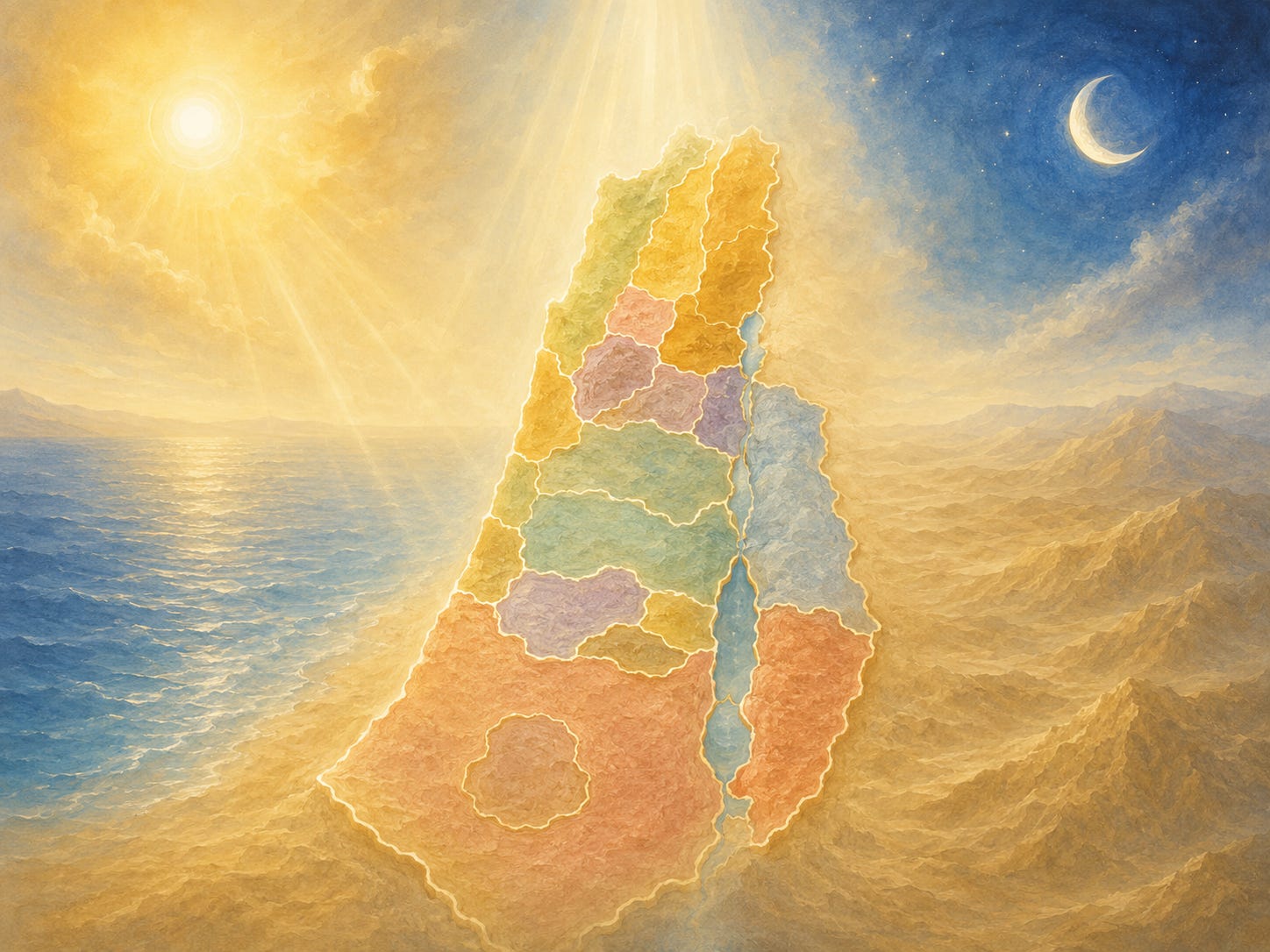
משה, יהושע, and the לבנה
Immediately afterward, משה is told to see the land but not enter it. He asks ׳ה to appoint a leader:
יפקד ה׳ אלקי הרוחות לכל בשר איש על העדה
משה has no personal נחלה in ארץ ישראל. But he does have a kind of נחלה: יהושע.
משה’s תורה and leadership must enter the next generation. But that requires צמצום (contraction). משה is the source, but he is not the one who brings כלל ישראל into the land.
משה belongs to the מדבר: the מן, ענני הכבוד, באר, open גילוי. ארץ ישראל is land, war, rain, agriculture, economy, גבול, hidden השגחה. It needs a different kind of leader — not greater than משה, but able to carry משה’s light into the lower world.
חז״ל say:
פני משה כפני חמה, פני יהושע כפני לבנה
משה is חמה (the sun). יהושע is לבנה (the moon).
רבינו בחיי explains the משל: just as the לבנה has no light of its own but receives from the חמה, so יהושע receives from משה.
יהושע stands in the shadow of משה. But reflected light is not merely weakness. The חמה is source-light, overwhelming and direct. The לבנה is received light, but it shines in the night. It brings the light of the חמה into a place where the חמה itself is not directly present.
משה gives תורה.
יהושע brings תורה into ארץ ישראל.
משה is גילוי.
יהושע brings thing to למעשה or fruition.
יהושע does not outshine משה by becoming greater. He outshines him only in this sense: he carries משה’s light into the place משה cannot enter.
משה gives תורה.
יהושע gives תורה a land-shape.
יהושע and the beginning of מלכות
The fact that יהושע is זוכה (merits) to enter ארץ ישראל is not just historical. It means he can lead כלל ישראל in a way משה was not permitted to lead them.
But he still stands in משה’s shadow.
That shadow is the beginning of מלכות (kingship).
מלכות has no independent light; לית לה מגרמה כלום. It receives from above. But מלכות is not empty. מלכות is where the upper light becomes visible below.
A king does not create מלכות ה׳.
A king reveals מלכות ה׳.
That is why מלכות belongs in ארץ ישראל. ה׳’s מלכות cannot remain only an idea in שמים. It must become visible in land, nation, throne, law, justice, and history.
יהושע is not דוד and not משיח (Mashiach). But he begins the line of תורה becoming national authority in ארץ ישראל.
משה is תורה as גילוי.
יהושע is תורה as command in the land.
דוד is תורה as מלכות.
משיח is מלכות ה׳ revealed בשלימות.
Right now, the לבנה is diminished. The lower world does not fully reveal the upper light. The י־ה and ו־ה are not visibly one. The שם and כסא (the throne) are not fully revealed.
The future is:
והיה ה׳ למלך על כל הארץ ביום ההוא יהיה ה׳ אחד ושמו אחד
That is מלך המשיח (the Messianic king): מלכות ה׳ visible below, in ארץ ישראל, through the כסא of מלכות.
The לבנה does not defeat the חמה.
The לבנה reveals why the חמה was shining.
That is also why יהושע stands before אלעזר. ארץ ישראל will not be led by משה’s direct light alone. It will have structured vessels: יהושע, אלעזר, אורים ותומים (the Urim ve-Tumim), שבטים, נחלה, institutions.
The light is not disappearing.
It is becoming architecture.
מועדים: כלל ישראל’s נחלה in זמן
After נחלה in מקום and leadership in ארץ ישראל, the פרשה turns to the מועדים.
This is not a technical list. This is the climax of the same סוגיא, now in זמן.
בנות צלפחד taught that a שם cannot remain abstract. Their father’s שם cannot disappear into memory. It needs a חלק in ארץ ישראל. It must attain a location.
The מועדים teach the same thing about כלל ישראל itself.
The national שם of כלל ישראל cannot remain a memory.
יציאת מצרים (the Exodus from Egypt) cannot be an old event.
מתן תורה (the giving of the Torah) cannot be ancient history.
ענני הכבוד cannot become nostalgia.
יום הכיפורים cannot be a one-time כפרה (atonement).
They must remain alive.
How does a national שם remain alive through history?
Through מועדים.
The מועדים are כלל ישראל’s נחלה in זמן.
But here there is an added depth. The מועדים are not only received by us. They are shaped through us.
שבת is קביעא וקיימא (fixed and permanent). שבת comes from above. But מועדים depend on כלל ישראל. בית דין (the rabbinical court) declares the חודש (the new month). כלל ישראל shapes the calendar. The day becomes a יום טוב (festival) through the mouth and action of ישראל.
That is why we say:
מקדש ישראל והזמנים
׳ה sanctifies ישראל, and ישראל sanctify the זמנים.
This is תורה שבעל פה (the Oral Torah) in its clearest form. תורה שבכתב (the Written Torah) gives the command, the קדושה, the ׳ה רצון. But the actual צורה of the מועד in this world comes through כלל ישראל.
We do not create the קדושה from nothing, חס ושלום. It is ׳ה’s קדושה. It is ׳ה’s שם. But our actions create the כלי. Our declaration creates the זמן-form in which that קדושה appears.
It is ׳ה’s שם, but כלל ישראל gives that שם its living צורה.
יבום preserves שם through זרע.
נחלה preserves שם through מקום.
מועדים preserve שם through זמן.
And by מועדים, כלל ישראל itself participates in forming that זמן.
פסח keeps יציאת מצרים alive.
שבועות keeps מתן תורה alive.
סוכות keeps ענני הכבוד alive.
יום הכיפורים keeps כפרה alive.
The past remains alive because it receives recurring form in the calendar. A מועד is not a commemoration of something dead. It is the recurring נחלה of a living שם.
In מקום, each שבט receives its own חלק.
In זמן, all of כלל ישראל receives a shared נחלה.
And this shared נחלה is not passive. כלל ישראל has שליטה (mastery) over זמן in this world. We declare it. We shape it. We bring the קרבנות. We eat the מצה. We sit in the סוכה. We fast on יום הכיפורים. We take ׳ה’s רצון and give it צורה in the lower world.
This is also why the לבנה matters.
Jewish time is lunar. The מועדים are bound to the לבנה and to כלל ישראל’s sanctification of time. The לבנה has no independent light, but it is the כלי through which time is measured. כלל ישראל receives Divine light from above, but gives that light calendar-form below.
That is תורה שבעל פה.
תורה שבכתב is like the חמה — source-light from above.
תורה שבעל פה is like the לבנה — received light shaped by כלל ישראל below.
After יהושע, the לבנה-leader, is appointed, the פרשה moves to the לבנה-structure of Jewish time. That is not accidental.
יהושע brings משה’s light into ארץ ישראל.
כלל ישראל brings ׳ה’s light into זמן.
By the land, the choice is hidden through גורל.
By the מועדים, the choice is revealed through מקראי קודש (sacred appointed times).
גורל is hidden בחירה.
מועד is declared בחירה.
Both are רצון ה׳ giving form to a שם so that it does not disappear.
But by מועדים, the חידוש is even greater: ה׳ gives כלל ישראל the authority to create the צורה of that זמן in this world.
קרבנות: the body of holy time
The קרבנות make the point sharper.
The קדושה of יום טוב is not left as an idea. It becomes פרים (bulls), אילים (rams), כבשים (lambs), סולת (fine flour), שמן (oil), יין (wine), numbers, dates, and עבודה.
The day receives a body.
קדושה is not vague inspiration. It has form.
It has מקום.
It has זמן.
It has number.
It has גוף.
It has עבודה.
The מוסף (Musaf offering) of פסח is brought at a specific time, in a specific place, through a specific קרבן. The קדושה of זמן enters the קדושה of מקום through physical עבודה.
That completes the movement.
קדושה takes form in פנחס and כהונה.
Then in the מנין of משה and אלעזר.
Then in נחלה and גורל.
Then in יהושע.
Then in the beginning of מלכות.
Then in מועדים.
Finally in קרבנות.
Closing
This is why the פרשה is called פנחס even though פנחס seems to fade.
פנחס is the introduction.
He appears when the form of כלל ישראל is dissolving.
He takes a רמח — the רמז to רמ״ח מצוות עשה, the positive body of תורה — and restores the boundary.
ה׳ gives him ברית שלום (covenant of peace), but the שלום itself has a ו׳ קטיעה, because שלום restored through rupture bears a scar.
Then ה׳ gives him ברית כהנת עולם. The act that looked least like כהונה becomes the source of his כהונה.
The rest of the פרשה unfolds that idea on a national scale.
A moment of קנאות becomes ברית שלום.
But the שלום is written with a ו׳ קטיעה.
A רמח becomes the defense of רמ״ח מצוות עשה.
A man not yet fully inside כהונה becomes a כהן through the act that preserved the possibility of כהונה.
A nation becomes counted families.
A father’s שם becomes a נחלה.
A hidden רצון ה׳ becomes a גורל.
An infinite land becomes bordered portions.
משה’s light becomes יהושע’s לבנה.
יהושע’s לבנה begins the path toward מלכות.
The flow of time becomes מועדים.
The national שם of כלל ישראל remains alive through its נחלה in זמן.
And that זמן itself is shaped by כלל ישראל through תורה שבעל פה.
The קדושה of a day becomes קרבנות.
The infinite becomes eternal not by avoiding form, but by entering it.
That is פרשת פנחס: רצון ה׳ becoming the physical architecture of Jewish life — in מקום, in זמן, in אדם, in נחלה, in מלכות, in עבודה — until the day when the לבנה no longer stands in shadow, מלכות is revealed in ארץ ישראל, and:
והיה ה׳ למלך על כל הארץ ביום ההוא יהיה ה׳ אחד ושמו אחד.
✦
May we be זוכה to see the inheritance and fruit of the רצון ה׳ in everything we do. May we usher in the ברית שלום with the רמח grasped tightly in our hands. May we each find our חלק in ארץ ישראל and in our own עבודה.