

At first glance, תזריע–מצורע looks like one long halachic unit about טומאה וטהרה (ritual impurity and purity), birth, and נגעים (afflictions). But it could be that the connection between the two פרשיות (Torah portions) runs much deeper.
תזריע opens not only with לידה (birth), but with ברית מילה (circumcision). That itself is striking. The תורה (Torah) begins here by speaking about the sanctification of the very place through which life is brought into the world. The אבר (organ / limb) is placed under ברית (covenant). The lower place of human emergence is marked with קדושה (holiness).
There is a well-known יסוד that the human being has not one such ברית, but two.
There is a ברית תחתון (lower covenant) on the אבר below, and there is also a ברית עליון (upper covenant) in the פה (mouth) above. One gives forth life, and one gives forth word. One brings continuity into the world, and one brings the inner person outward into the world. Both are places where what is hidden becomes revealed. Both are places of expression. And both therefore require קדושה.
Seen this way, the movement from ברית מילה to מצורע is not incidental at all. תזריע opens with the sanctification of the lower מוצא (point of emergence), and מצורע reveals what happens when the upper one is corrupted.
That would also explain the unusual severity of מילה. It is one of the rare מצוות (commandments) whose neglect carries כרת (spiritual excision), and one of the rare מצוות that is דוחה שבת (overrides Shabbos) בזמנה (in its proper time). That alone tells us that the תורה does not treat this as a side mitzvah. The sanctification of the lower place is foundational to covenantal life. The human being must bear the ברית in his very flesh.
It is also important that חז״ל (the Sages) include גילוי עריות among the causes of נגעים. That means the connection between תזריע and מצורע is even more meaningful. תזריע opens with ברית מילה, with the sanctification of the lower place. And מצורע is not only about the corruption of the פה through לשון הרע (harmful speech), but about the possibility that the lower place as well can be violated, and that its פגם can also break outward into נגעים. The pair thus holds together both forms of ברית: the one above and the one below, the sanctity of both, and the damage that comes when either is corrupted.
If so, then perhaps מצורע reveals the parallel truth above. The mouth too is not neutral. It too must bear a covenant and קדושה. It too is a place where the person is either holy or corrupted. In חז״ל, the connection between צרעת (tzaraas) and לשון הרע is of course famous, but perhaps the point is even more revealing: The פה is not merely a place of sound, but a place of covenantal expression. It is where the inner self crosses into the outer world. As that is the main mechanism with which a person shows their innermost thoughts and makes them tangible.
And that may be why the נגע (affliction / mark) does not remain confined to one place. It spreads across the whole outer envelope of a person’s life:
the body
the garment
the house
The corruption does not stay hidden. Once the upper place is damaged, the disorder begins to settle into everything that covers, carries, and contains the person’s life.
It is also striking that צרעת attaches in degrees. It does not simply appear all at once at the broadest point. It moves through layers of the person’s world, as though the תורה is showing us a disorder that is becoming more and more impossible to ignore. The further the נגע comes inward, the more the inner corruption has taken hold. That too suggests that this is not merely punitive. There is warning built into it, space to awaken, chances to recognize that something in the self has become disordered, before the person himself fully becomes the מקום (place) of the נגע.
But perhaps the deepest question in the whole סוגיא is not what the תורה says, but what it does not say.
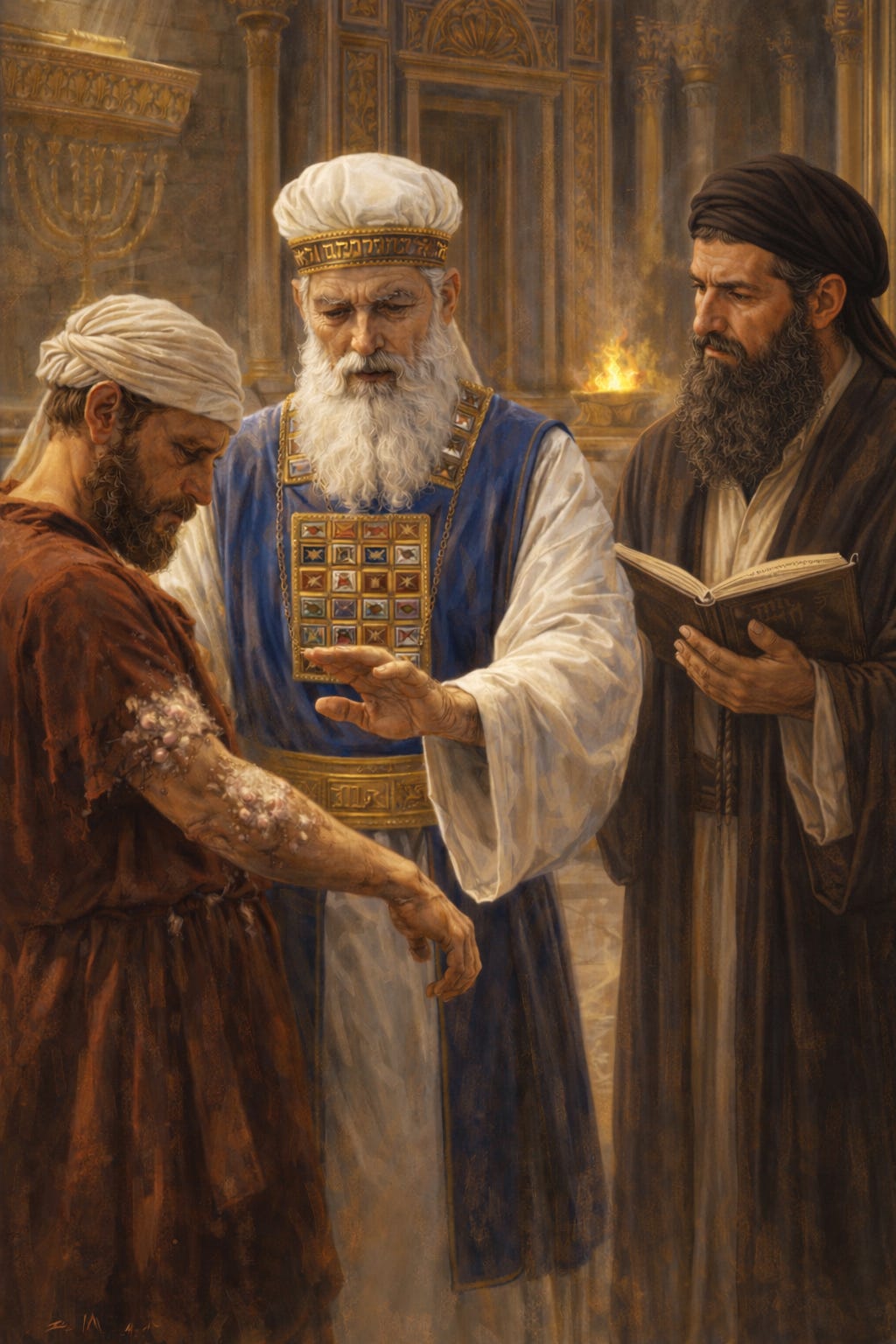
The תורה gives remarkable detail about how a נגע appears, how it is examined, how the כהן (priest) responds, how the person is separated, and how he is purified. But in the פרשה itself it never plainly tells us what brings this affliction upon a person. That silence is hard to miss.
And it is of course not accidental.
If the פה is itself a place of ברית, then the תורה may be resisting the temptation to make even this סוגיא transactional. It does not say: Guard your speech so that you will not get spots. The roots of צרעת are already אסורים (forbidden) whether or not they ever become visible. A person is already forbidden to speak לשון הרע. He is already forbidden to live with גסות הרוח (haughtiness), גזל (theft), צרות העין (stinginess / begrudging others), and the like. These things do not become wrong because they lead to visible affliction. They are wrong because they are ׳נגד רצון ה (against the will of Hashem).
So perhaps the תורה withholds the explicit cause here in order to elevate the person. It does not want the פה to be guarded only out of fear. It wants the פה to be guarded because it is a place of ברית. It wants a person who avoids evil not only because of consequence, but because he wants to live ׳בתוך רצון ה.
That may be part of what the משנה (Mishnah) in אבות (Ethics of the Fathers) is training us toward: “אַל תִּהְיוּ כַּעֲבָדִים הַמְשַׁמְּשִׁין אֶת הָרַב עַל מְנָת לְקַבֵּל פְּרָס — Do not be like servants who serve the master for the sake of reward.” And perhaps the same is true in reverse as well: One should not avoid עבירה (sin) merely out of fear of punishment. The תורה is not only teaching us how to pursue blessing or evade consequences. It is trying to make us into the kind of people who love Hashem, fear Heaven, and therefore know what must be guarded because it is ׳רצון ה, not merely because of what may happen if we fail.
If that is so, then one has to ask: Where does the תורה begin to reveal what the legal סוגיא leaves unstated?
It may be that it does so not through law, but through narrative. And that is where the story of מרים (Miriam) becomes so important.
Even if one invokes אין מוקדם ומאוחר בתורה (there is not necessarily strict chronological order in the Torah), the order in which the Torah teaches us things still matters. The chronology of events may be flexible, but the chronology of Torah disclosure is not meaningless. The Torah chose to place the laws of צרעת first, and only later reveal Miriam’s case. That itself is part of the teaching.
Even without the סוגיא in תזריע–מצורע, we would later learn that Miriam was punished — but we would not yet understand the weight of the מציאות (state of being) into which she had entered. By teaching the halachic world of צרעת first, the תורה allows the later story to function not just as narrative, but as revelation.
And in that story, the תורה is extremely precise.
It begins ((במדבר י”ב:א:
ותדבר מרים ואהרן במשה על אדות האשה הכשית אשר לקח כי אשה כשית לקח
At first glance, the complaint sounds like it is about Moshe’s wife. But the very next פסוק reveals that this is not really the center of the issue:
ויאמרו הרק אך במשה דבר ה׳ הלא גם בנו דבר וישמע ה׳
That means the surface topic is the wife, but the real issue is Moshe’s uniqueness. The speech is not just criticism. It is comparison. It is: Why is Moshe set apart? הלא גם בנו דבר. Hashem speaks to us too.
And then the תורה inserts one of the most striking פסוקים in the whole story (במדבר פרק י”ב: ג):
והאיש משה ענו מאד מכל האדם אשר על פני האדמה
That line is not incidental praise. It is part of the explanation. If צרעת emerges from a self that has become too central, then ענוה (humility) is its opposite. Moshe is precisely the one whose פה can be פה אל פה because there is so little self in the way. Miriam’s speech comes from comparison and self-reference; Moshe’s greatness is that he is ענו מאד. The תורה places that line here because it is setting ענוה against צרעת itself.
The story then continues:
ויאמר ה׳ פתאם אל משה ואל אהרן ואל מרים צאו שלשתכם אל אהל מועד
The לשון (language) of פתאם is also significant. Hashem does not allow the speech to linger. He interrupts immediately. It is as though Heaven does not want the לשון הרע to settle, spread, and acquire a more lasting standing.
And then comes the crucial line (פסוק ח):
פה אל פה אדבר בו
That is not only an explanation of Moshe’s superior נבואה (prophecy). It belongs deeply to the whole סוגיא. Their failing is a failing of the פה, and Hashem responds by revealing Moshe’s greatness דווקא through the language of פה. The mouth is not incidental here. The whole story is revolving around the קדושת הפה (holiness of the mouth).
And then Hashem says:
ומדוע לא יראתם לדבר בעבדי במשה
That line may be one of the most profound in the whole episode. The problem is not merely that they said something factually wrong. It is that they lacked יראה (reverent fear / awe) in speech. לא יראתם לדבר. The failure is not only bad speech. It is speech without fear of Heaven.
In the next two פסוקים, the תורה says:
ויחר אף ה׳ בם וילך
והענן סר מעל האהל והנה מרים מצרעת כשלג
The anger is against both of them. But Miriam alone is struck. That asymmetry is important. Perhaps Aharon was present, but Miriam was the initiator, or the one more inwardly identified with the speech. In any case, the תורה clearly wants us to notice that the real center of the failing lies with her.
And what is that failing? Not only speaking ill, but perhaps also an inability to make room for the unique place Hashem gave Moshe. There is something here not only of לשון הרע, but of subtle קנאה (jealousy / envy), or at least of comparison born of self-reference.
That fits very deeply with what חז״ל say in ערכין ט״ז א, that נגעים come due to seven things. The list is broader than לשון הרע alone. But perhaps all of them share one common root: the self becoming too central. Sometimes that takes the form of pride. Sometimes speech. Sometimes theft. Sometimes misuse of Hashem’s Name. Sometimes refusal to let another person have room. The form changes, but the root is the same: The self has expanded beyond its place.
And that makes the purification exact. The person is sent outside the מחנה (camp). Why? Because he must learn again that he is not the center. He must learn proportion. He must learn that Hashem is the center, and that other people are real. The self that expanded beyond its place is displaced from communal life until it can return — different.
And here the role of the כהן becomes central.
A תלמיד חכם (Torah scholar) may know whether the mark is טמא (impure) or טהור (pure), but only the כהן can actually pronounce the ruling. That means the presence of the כהן is not merely ceremonial. The חכם may possess the דעת (knowledge) to clarify the reality, but the חלות (legal effect / status) of טומאה or טהרה only becomes real through the פה of the כהן.
That is a breathtaking point. The mouth is not only expressive. It is effective. It does not merely describe a מצב (state). It brings a מצב into force.
If so, the whole סוגיא becomes even more exact. The פגם (damage) of מצורע is rooted in the corruption of the upper ברית, the mouth. And therefore, its resolution comes not only through visual inspection or intellectual determination, but through sanctified speech. The חכם gives the בירור (clarification). The כהן gives the חלות.
And perhaps that is why the כהן belongs here so significantly. At first glance, his role seems to look like דין (judgment): He inspects, he declares, he separates. But in truth, the כהן is not a cold judge. His task is כהונה (priesthood), and כהונה is always ordered toward כפרה (atonement), cleansing, and return. We see this across the תורה. By סוטה (the suspected adulteress), the כהן enters a shattered and suspicious reality in order to bring it to clarity and, if possible, restore peace. By קרבנות (offerings), the כהן stands at the center of the process through which sin is met, confessed, and elevated toward כפרה. The כהן is not the מידת הדין in its stark form. He is the one who carries the person through the דין toward restoration. That is why כהונה belongs more to שלום (peace) and to the דרך of אהרן than to severity for its own sake.
Even here, by מצורע, where the כהן seems to stand in a more distancing mode, his role is still not to crush the person but to restore him. He names the affliction, sets the boundary, and guides the process by which the person can return. So this is not raw דין. It is closer to הוד (splendor / yielded acknowledgment), the מידה (attribute) of אהרן and כהונה — the kind of holy boundary that exists not to destroy peace, but to make real peace possible again.
The כהן does not merely decide the fate of the מצורע. He does what כהונה always does: He brings fractured reality back toward שלום.
And perhaps there is even more mercy here than one first notices.
A mark may already be a נגע, but until the כהן speaks, it has not yet become צרעת in the full halachic sense. That gap is not merely procedural. It may itself be merciful. Heaven has already begun to speak to the person, but the condition is not yet fully fixed. There is still room to awaken.
חז״ל say in קידושין מ״ט ב that even a complete רשע (wicked person) may in a moment already have had הרהור תשובה (thoughts of repentance): שמא הרהר תשובה בדעתו. Perhaps it is so here as well. Even once the warning is visible, the תורה is still allowing a person a path back before the holy word of the כהן seals the condition into full status. The נגע appears before the finalization descends. That delay may itself be an invitation to תשובה.
In that light, תזריע–מצורע becomes a very unified pair. תזריע opens with the sanctification of the lower place of covenantal expression. מצורע reveals the damage that comes when the upper one is violated. And the whole סוגיא, from נגע to כהן to exile from the camp to purification, becomes one long teaching in what it means for a human being to bear covenant not only below, but above as well.
And perhaps that is the deepest point of all of this. The תורה spent an entire סוגיא describing צרעת in precise detail — how it appears, how it spreads, how the כהן responds — but never once stated plainly what causes it. We said earlier that this silence was intentional, that the תורה does not want the פה to be guarded out of fear of consequence. But now we can say something sharper. Hashem runs this world בניסתר. He does not show us the direct ledger. If we saw clearly and immediately how every עבירה produced its punishment, we would have no בחירה — and that freedom of choice is the entire עבודה of being human. צרעת is the rare moment where the hidden becomes visible, where the inner disorder breaks through to the outer world. The תורה shows us that moment not so we can track the system, but so we know the system exists — even when we cannot see it. Guard the ברית above and the ברית below not because the consequences will be visible. Guard them because the reality is always there, whether revealed or not.
May we be זוכה to carry both בריתות with קדושה — the power to bring forth life and the power to bring forth words — and may that שמירה, especially of the פה, help bring משיח במהרה בימינו.