


I’ve been thinking about something that always felt a little “off” in פרשת תרומה (Parshas Terumah).
If I were writing the parshah, I think I’d write it like any normal building project: first we do the fundraising, then we describe the structure, and only after that do we define the things that go inside. Money → building → furniture.
But the Torah doesn’t do that.
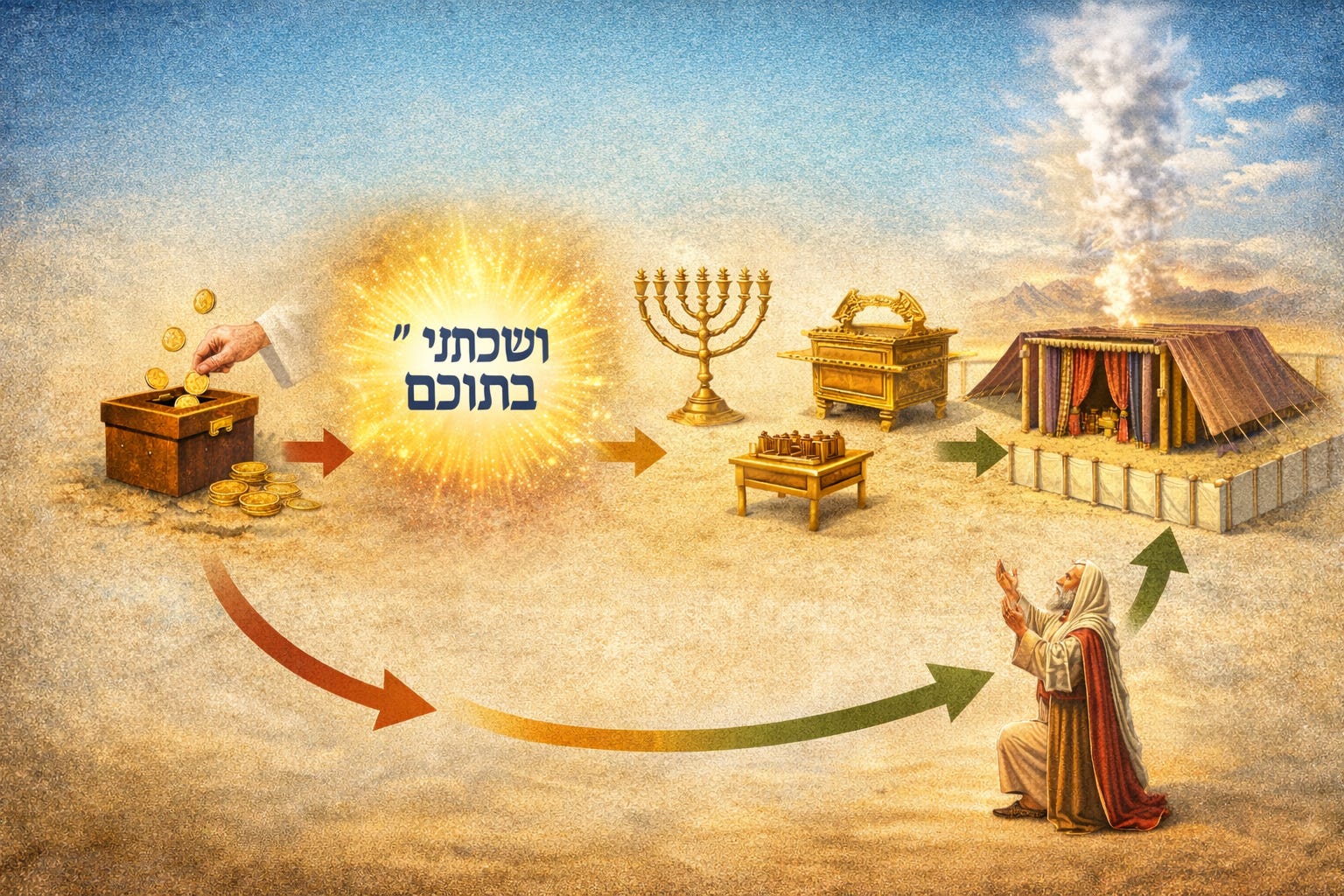
The Torah starts with תרומה (a donation), then gives the big mission statement “ועשו לי מקדש ושכנתי בתוכם” (“They shall make for Me a sanctuary and I will dwell among them”), then it goes into the כלים (vessels), and only afterward does it really spell out the structure of the משכן (Mishkan) itself.
That order is unusual. It’s already telling you: this isn’t just a construction manual. It’s teaching how closeness to Hashem is built.
Rashi vs. Ramban: is the Mishkan “Plan A” or “Plan B”?
The famous fork:
רש״י learns the command of the Mishkan was given after חטא העגל (the sin of the Golden Calf), even though it appears earlier — אין מוקדם ומאוחר בתורה (“the Torah is not always chronological”), see רש״י to שמות ל״א:י״ח and שמות ל״ה:א׳.
הרמב״ן argues the Mishkan is not a reaction; it’s the continuation of מעמד הר סיני (Sinai), see רמב״ן introduction to שמות כ״ה.
Here I’m leaning into the רש״י approach: if the Mishkan is connected to a ירידה, why would the Torah choose to teach it before the narrative of the ירידה?
“The cure before the illness”
Chazal say תשובה (repentance/return) was created before the world — פסחים נ״ד ע״א (and related in נדרים ל״ט ע״ב).
Meaning: Hashem didn’t “invent” a way back after failure. The way back is built into reality. So maybe the Torah is doing the same thing structurally: it teaches the Mishkan first to show that even when there will be a ירידה, the דרך back was already waiting.
A Rambam framework
The רמב״ם lays out what teshuvah looks like (see הלכות תשובה ב:ב):
עזיבת החטא (abandoning the sin), קבלה על העתיד (commitment for the future), and חרטה (regret). And וידוי (confession) is the concrete mitzvah-act that gives teshuvah its halachic reality (see הלכות תשובה א:א).
Now here’s the חידוש: the “backwards” order of תרומה reads like a national teshuvah process.
1) תרומה / נדבה = עזיבת החטא
If the Torah would have said: “Everyone must pay X amount,” it might have worked financially, but it would have missed the whole point.
A forced contribution is still “building,” but it’s not return. It’s not רצון. If it’s forced, then the only reason the gold ends up in the Mishkan is because someone took it from you.
But נדבה (a voluntary gift) is different. It shows: we’re not stopping the behavior because we have no choice — we’re stopping because we want to. We want to redirect ourselves. We want to return.
That’s why the Torah emphasizes “מאת כל איש אשר ידבנו לבו” (“from every person whose heart moves him”). Teshuvah begins with ownership: I’m done with this דרך, and I’m choosing something else.
2) “ושכנתי בתוכם” = חרטה
Charatah isn’t just guilt. It’s clarity: “I wanted closeness, but I went about it the wrong way.”
So before we get lost in measurements, the Torah states the goal: build a מקדש, and “ושכנתי בתוכם” — not “in it,” but “among them.” The goal is relationship. The object was never the point.
3) הכלים = קבלה על העתיד
Here’s an important layer: the כלים aren’t just “what goes inside.” They’re what you actually use. They’re the tools of interaction — how a human being relates to Hashem in a כשר (permitted) way: תורה, אור, שפע, עבודה.
And in a post-ירידה world, that’s everything. Because when we fall, the avodah is rarely to erase desire. It’s to take the כוח that went wrong and give it a legitimate channel.
There’s a Gemara that says someone born under מאדים (a “blood” tendency) will be drawn to spilling blood, but it depends where it goes: it can become a מוהל, a רופא, a שוחט, or chas v’shalom a thief (שבת קנ״ו ע״א). Same טבע, totally different outcome — the whole question is whether it finds a כשר outlet.
That’s what הכלים are: a system of kosher outlets. A stable way to approach Hashem so the energy doesn’t slip back into the wrong מקום again.
4) The structure of the משכן = the “walls” of teshuvah (slow change, but real change)
The Torah does eventually describe the “walls” — the curtains, beams, sockets — because the structure matters. The משכן isn’t just ideas; it needs a framework that holds and protects the עבודה.
But it’s telling that the Torah puts that after the כלים. Because in real life, the “walls” are usually the hardest part to change. A person’s environment, routines, responsibilities, even parts of their טבע — those are more fixed, or at least slow-moving. You can’t always rebuild your whole life overnight.
So the Torah starts where teshuvah actually starts: with what’s in our hands right now — our כלים, meaning the tangible ways we interact with Hashem in a כשר way. And then, once the inner עבודה is in place, you build the walls: boundaries, structure, safeguards, a סביבת חיים that protects the gains and makes them sustainable.
In other words: the “walls” are absolutely part of the process — just not the first step. First we change what we can touch today. Then, gradually, we elevate the framework of life itself until the whole “home” becomes fit for “ושכנתי בתוכם”.
Where is וידוי? That’s הקמת המשכן
In the Rambam, וידוי is the moment teshuvah becomes real and spoken, not just felt (see הלכות תשובה א:א).
So it makes sense that the parallel of וידוי isn’t in the planning of תרומה — it’s later, by the actual הקמת המשכן (the erection/establishment of the Mishkan) in פרשת פקודי. That’s when כלל ישראל takes everything from “we would like to return” to “this is who we are now,” and the שכינה actually comes down. The return is no longer theory — it’s standing there in the camp.
The punchline
So according to רש״י, the Torah isn’t ignoring chronology randomly. It’s teaching a hierarchy.
Even when a ירידה happens, the story of ישראל isn’t “first we broke, then we scrambled.” The Torah teaches the return first — because תשובה קדמה לעולם.
And that’s why it starts with a נדבה: not because Hashem needed the money, but because Hashem wanted our hearts to be invested in the process.
A מוסר note
A lot of us get discouraged because we think the only way to grow is to “not have struggles.” But the Torah is telling us something much more realistic: the עבודה is not to become a different person overnight. The עבודה is to take the same drives, the same personality, the same fire — and build כשר כלים for it.
If you don’t give your energy a holy outlet, it will find its own outlet.
So the question isn’t only “What am I trying to stop?” It’s also:
What’s my נדבה — the small voluntary step that shows I want to come back?
What are my כלים — the practical, kosher ways I’m going to interact with Hashem this week?
And then slowly, what “walls” can I build — small boundaries and frameworks that protect the good and make it last?
May we be זוכה that our efforts, even small ones, become a מקום of “ושכנתי בתוכם”.