

Many of these ideas are rooted in many years of sitting at the feet of my great Rebbe, HaRav Nochum Lansky שליט”א. Many are my own, but at this point, I am not sure which are his and which are mine. So I want to, as with much of my own Torah, give credit to my Rebbe for inspiring many of the concepts here. May he (and we) continue to teach Torah for many years to come!
The pasuk says in ויקהל:
אֶת־בִּגְדֵי הַשְּׂרָד, לְשָׁרֵת בַּקֹּדֶשׁ: אֶת־בִּגְדֵי הַקֹּדֶשׁ לְאַהֲרֹן הַכֹּהֵן, וְאֶת־בִּגְדֵי בָנָיו לְכַהֵן׃
(שמות ל״ה:י״ט)
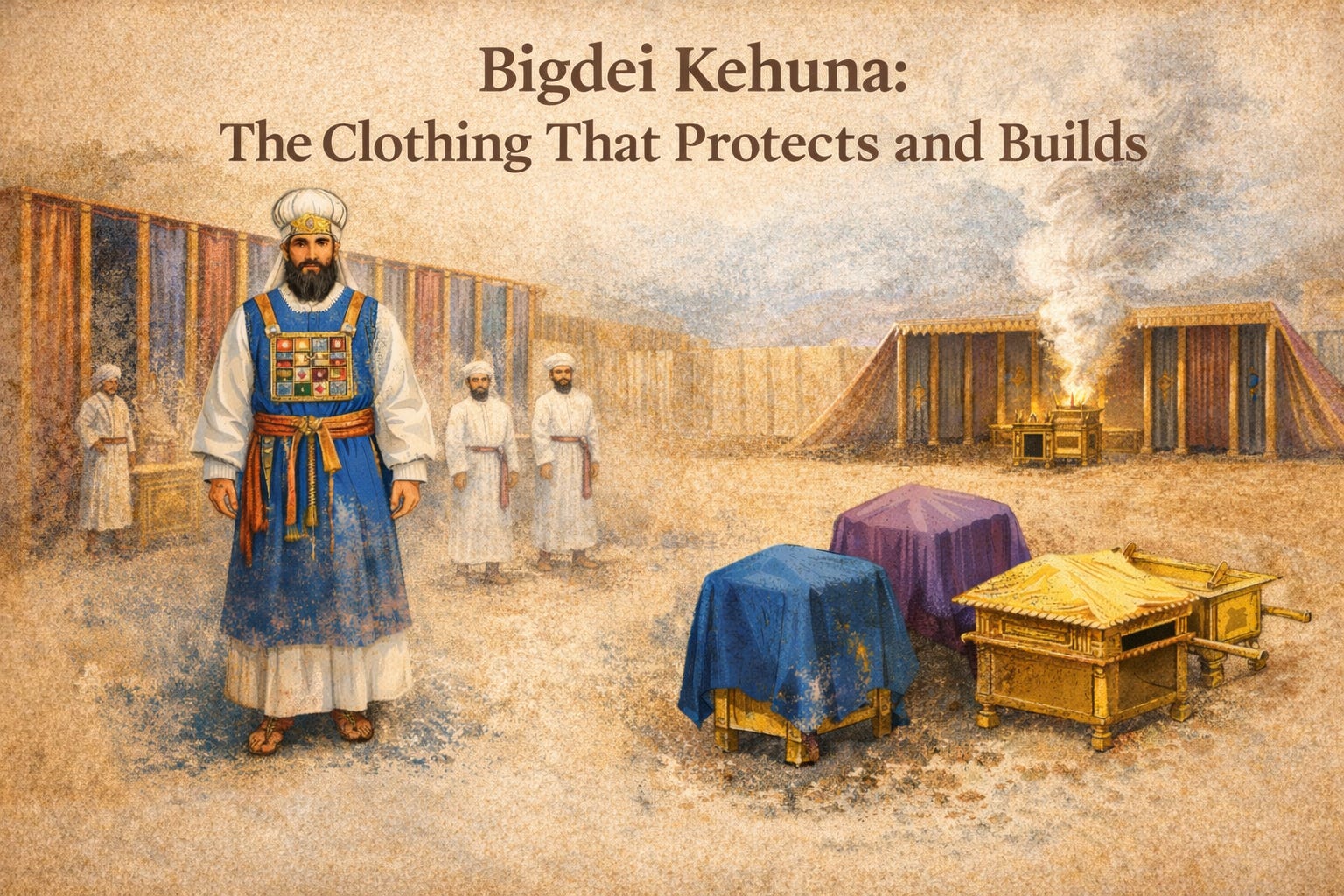
What always bothered me is that the פסוק brings בגדי השרד and בגדי כהונה together, as though they belong to one עולם. And the obvious question is: why? They do not seem similar at all. According to Rashi, בגדי השרד are the coverings for the כלים (vessels) when the משכן (Tabernacle) is traveling. They are there to cover, to protect, to preserve. But בגדי כהונה (priestly garments) are part of the actual עבודה (service). A כהן without them is a מחוסר בגדים (lacking the required garments), and the עבודה itself can be affected. So why would the תורה place these two together?
That question really opens up a deeper חקירה (conceptual inquiry): What exactly are בגדי כהונה? Are they just the clothing a כהן has to wear while he works? Are they an incidental part of the עבודה, a kind of uniform? Or are they something much deeper — the thing that actually makes the כהן into the kind of being who can do עבודה at all?
And I think that is the real יסוד (fundamental idea). The בגדי כהונה do not just accompany the כהן. They “make” the כהן into a כלי for the עבודה. Not a כלי in the simple literal sense, of course, but in the lomdish sense: the Mishkan is not only built out of beams, curtains, and כלים. It also has a human element. The כהן and his עבודה are the human element of the Mishkan. Just as the כלים need their correct צורה, so the כהן needs his correct צורה, and that צורה comes through the בגדים. He is not standing outside the system and making use of it. He is part of it.
And maybe this is why מחוסר בגדים feels even more radical than other פסולי כהונה (priestly disqualifications). A בעל מום (a kohen with a disqualifying blemish) is still a כהן, just a כהן who is disqualified from serving. But מחוסר בגדים is something deeper. The Gemara says, “לשוינהו זרים כשאין בגדיהם עליהם” — when their garments are not on them, they are treated like זרים. That means the problem is not just that something is wrong with this כהן. The problem is that without the בגדים he has not yet taken on the very שם of כהן העובד (serving kohen). A mum is a פסול in the כהן. But the בגדים are what positively constitute the כהן as an עובד.
That is why בגדי כהונה are so different from the other כלים. A כלי matters when it is directly part of the עבודה it serves. The שולחן (table) is absolutely essential for לחם הפנים (showbread), but not for most korbanos. The מנורה (menorah) is central to its own עבודה, but not to every korban. The מזבח (altar) is different because it is mamash part of the very גוף of הקרבה (offering). But בגדי כהונה cut across all of this, because they are not just another object in the Mishkan. They define the גברא העובד (the serving person) himself. They are not only part of one עבודה; they are part of what creates a valid oved in the first place.
And that is what makes the פסוק so rich. The Torah is not linking בגדי השרד and בגדי כהונה because both happen to be called בגדים. It is linking them because both are forms of לבוש (vesture / clothing) in the world of the Mikdash. But they operate on two different sides of kedushah. בגדי השרד are levush for the כלים. They preserve holy objects when those objects are vulnerable in motion. בגדי כהונה are levush for the כהן. They form the holy person when that person is vulnerable in action. One protects the sacred object so it can travel. The other clothes the sacred human being so he can serve. Their functions seem diametrically opposed, and that is exactly why they belong together.
Once you see that, another layer opens up. Most of the בגדי כהונה are woven. And I do not think that is just because clothing happens to be woven. The Torah could have commanded something much more metallic, something harder, something like armor, something made of plates and links and gems. But instead, the כהן is formed mainly through אריגה (weaving). That means something. Weaving does not produce a hard object. It is the joining of separate strands into one fabric. It is a language of חיבור (joining), of bringing things together without crushing them into sameness. As threads are merged into a single entity, their strands still remain distinct.
And that is exactly the עבודה of the כהן. The כהן is not only the one who offers קרבנות. He is the one whose whole עולם is כפרה (atonement), קירוב (bringing near), and reconciliation. He stands between Hashem and כלל ישראל and helps restore the relationship. He is not mainly the כוח of collision, pressure, and conquest. He is the כוח of bringing things back together. That is why his בגדים are woven. His בגדים match his mission.
And that is also why it matters so much that the last word of ברכת כהנים (the priestly blessing) is שלום (peace / wholeness). That is not just a nice ending. That is the final definition of what כהונה is. And שלום does not just mean the absence of conflict. שלום means שלמות (completion / wholeness). It means something positive has been built. Things that were separate are now held together properly. Something has been completed.
Anyone who is married knows exactly what that means. Peace is not simply “no fighting.” Peace takes work. Peace is an עבודה. To hold together different people, different needs, different sensitivities, different wounds, and make a home out of them — that is not passive. It is woven. It takes patience, softness, tension held correctly, and constant adjustment. That is שלום. And that is the כהן. His עבודה is not just to remove פסול. It is to restore שלמות. So the last word of his brachah is שלום because the deepest work of the כהן is to bring things back into wholeness.
And then the contrast inside the Mishkan becomes even more beautiful. The כלים themselves are often hard, metallic, exact, formed through fire and pressure. The Mishkan needs that too. It needs firmness, גבול (boundary), endurance, and strength. But that is not the whole Mishkan. The Mishkan also needs softness, receptivity, beauty, and the ability to hold. The metals give it spine, but the textiles give it heart. And the כהן stands mainly on that side of the Mishkan. He is a כלי חי, a living vessel, but not one made of metal. The כהן does not become a כלי for עבודה by being forged like the other כלים. He is clothed and anointed. That is how the human being enters the עולם of the Mishkan.
That is why the ציץ (forehead plate) is so fascinating. Within the בגדי כהונה there is one clear point of metal, one sharp place of gold engraved with ׳קדש לה (Holy to Hashem). But it is only one point. It is not the whole garment system. And maybe that is the point. The כהן is primarily clothed in weaving, softness, beauty, and human harmony. But within all that there is one concentrated נקודה of firmness, one place of rigidity, and that is דווקא the part that carries the כוח of ריצוי (obtaining acceptance / appeasement) for certain פסולים and טומאות. Even where there is hardness in כהונה, it is only a point בתוך a much larger עולם of woven חסד. Showing the בחינה that even חסד has its firmness, but it portrays further חסד.
But maybe the deepest מוסר comes back דווקא to בגדי השרד. What exactly are they protecting the כלים from? Not from a boulder. Cloth will not save a כלי from being crushed. It protects from something smaller and subtler — friction, scratches, exposure, the wearing effect of contact. That is the point. Not every danger comes in a dramatic form. Not everything that ruins holiness does so by shattering it. Sometimes the danger is only a scratch. Sometimes the כלי still looks whole from the outside, and yet it has become פסול. Nothing exploded. Nothing visibly broke. But something touched it, something rubbed against it, something entered the camp that did not belong there, and now the purity is gone.
That is true in our own lives also. We tend to imagine that the great dangers are the big dramatic failures, the obvious catastrophes. But often the real danger is much more subtle. It is what we let into our מחנה (camp). It is the little contacts, the little exposures, the things that slowly coarsen us, the quiet compromises that scratch the נשמה so delicately that we barely notice. And then one day a person still looks intact, but something in him is no longer so fit for עבודה.
And that is the chiddush here: Protection does not always come in a hard form. Sometimes protection is soft. Sometimes what preserves קדושה is not a tank. It is not armor. It is a בגד (garment). A covering. A boundary. A little distance. A little refinement. Something gentle but real, something soft but taut, something that keeps the scratches away before they become a פסול. The soft cover is not weak. It is a different kind of strength. It is the strength to preserve what is delicate. The strength to prevent erosion. The strength to guard holiness not only from destruction, but from subtle contamination.
So maybe that is why the פסוק brings these two בגדים together. One teaches how to protect holiness in the כלים when they travel. The other teaches how to form holiness in the אדם when he serves. And together they teach one yesod. The question is not only what breaks us. The question is also what scratches us. And not every protection is hard and metallic. Sometimes the deepest protection is woven. Sometimes the deepest protection is שלום — not “peace” as quiet, but שלום as שלמות, the patient עבודה of keeping something whole.
May we be zocheh to protect ourselves from all harm, even the things that look like subtle surface scratches, and may our own daily עבודה bring Moshiach Tzidkainu in our lifetime.