


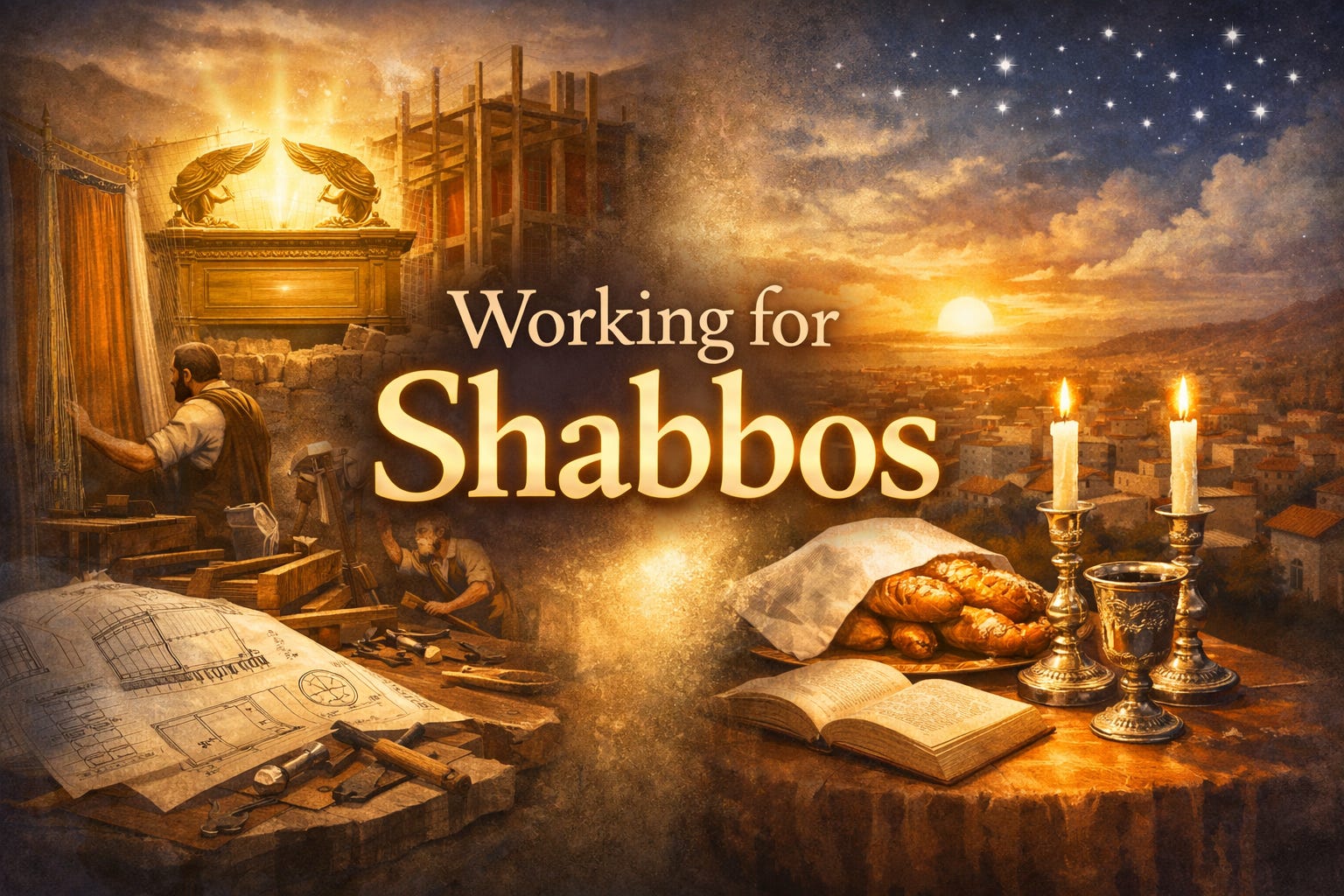
One of the first things to notice in פרשת ויקהל (Parshas Vayakhel) is that the Torah opens with שבת (Shabbos).
At first glance, that almost feels repetitive.
We already know about שבת. The Torah has already taught it in בראשית (Genesis), in עשרת הדברות (the Ten Commandments), and again in כי תשא (Ki Sisa). And the Torah does not mince words. If שבת is being brought up again here, right before the building of the משכן (Tabernacle), then it is not just repeating itself. It is doing something essential.
So why is it essential to place שבת here?
The first answer is the most basic one: to teach that the building of the משכן is not דוחה שבת (does not override Shabbos). However holy the project is, when שבת comes, the work stops.
The weaving stops.
The building stops.
The crafting stops.
Even the making of a dwelling place for Hashem yields to שבת.
That already tells us something important. The Mishkan is holy, but שבת is more fundamental.
Not “older” in the simple chronological sense. More fundamental. More enduring. Even within the מחלוקת (dispute) about the Mishkan — whether the Mishkan in the form we know it was part of the original ideal or bound up with the world after the חטא העגל (sin of the Golden Calf) — שבת would still be שבת. The form of the Mishkan may be debated. שבת would endure either way. It may have been lived differently, it may have felt different, but it would still have been שבת nonetheless.
That means the Mishkan is not the source of שבת.
But then the paradox begins.
Because even though the Mishkan is not the source of שבת, it is the source of the ל״ט מלאכות (39 categories of creative labor).
And that is where things start to open up.
The meaning of שבת comes from בראשית, from creation, from Hashem’s rest on the seventh day, from the truth that the world belongs to Him. שבת is the revelation of ׳מלכות ה (the kingship of God) in time. It is also an אות (sign) between Hashem and כלל ישראל (the people of Israel).
The Mishkan does not create that.
But חז״ל (the Sages) teach that the מלאכות of שבת are learned from מלאכת המשכן (the labor of the Mishkan). So while the Mishkan is not the source of שבת itself, it does help shape how שבת is observed in our world, and perhaps even something of how שבת feels. שבת gets its essence from creation. The Mishkan gives form to the lived expression of שבת.
That is why שבת is brought here, specifically. The Torah is not introducing שבת again. It is telling us what שבת means in relation to the Mishkan.
And I think this becomes sharper when we listen carefully to the Torah’s own words:
ועשו לי מקדש ושכנתי בתוכם
That pasuk says something enormous.
The Mishkan is not simply holy on its own. It does not fall from Heaven as a fully formed sacred reality. First there is ועשו. בני ישראל must build it. They must give, weave, carve, shape, and construct. They must make it into a מקדש (sanctuary). And only then: ושכנתי בתוכם.
In other words, the Mishkan becomes the place of divine dwelling through our preparation and work and ultimately worship.
That is not a weakness in the Mishkan. That is exactly its greatness. Hashem wanted a place in this world that would become holy through the obedience, generosity, and עבודה (service) of ישראל.
But that is also exactly why the building of the Mishkan is not דוחה שבת.
Because שבת does not become holy through our labor. שבת is not waiting for us to sanctify it by building something. שבת arrives already holy. It is woven into creation itself. The Mishkan becomes holy through ועשו. שבת is holy before we do anything at all.
That, I think, is the heart of the contrast.
The משכן is the place where Hashem’s presence is revealed through the work that He commanded us to do.
שבת is the day that bears witness that Hashem created the world and rested on the seventh day.
The Mishkan says: Make a place for Hashem in the world.
שבת says: Stop, because the world already belongs to Hashem.
That brings us into the deeper distinction between קדושת המקום (the sanctity of place) and קדושת הזמן (the sanctity of time).
The Mishkan is holiness in place. It gives holiness a center. It gives it a structure, a location, an address. It is where the שכינה dwells and where the עבודה is performed.
שבת is holiness in time. It does not occupy one place. It returns through the calendar and transforms the very condition of the day. It is not holy geography. It is holy time.
The Mishkan says: Here is where Hashem’s presence is encountered.
שבת says: Now is when the world stands before Hashem.
Both are ways Hashem enters our lives, but they are not equal.
Holy place is בתוך העולם. It sanctifies part of the world.
Holy time goes deeper. It says something about the world as a whole, about the rhythm of creation itself; it technically embraces the entire world, though Shabbos is a gift for the Jewish people.
That is why the Mishkan yields to שבת. Before there is a place for Hashem in the world, there is already a day that testifies that the whole world belongs to Him.
And maybe that is why the irony here is so powerful: The very labors used to build the Mishkan are the labors forbidden on שבת.
That is not incidental. That is exactly the point.
The Torah could have defined שבת in all sorts of other ways. It could have instructed us not to do “hard work,” not to conduct business, not to engage in weekday labor. Instead, the categories of מלאכה are learned from the Mishkan.
Why?
Because the Mishkan is the purest example of meaningful, purposeful human creativity. Not random labor. Not burdensome labor. Creative labor. Skilled labor. Labor that orders the world toward holiness.
And still it must stop on שבת.
That teaches something deep about what שבת really is. שבת is not just a break from mundane work. שבת is a break even from sacred creativity. Even building for Hashem must stop before the day that declares Hashem’s Kingship.
So again: The Mishkan does not give שבת its holiness. The Mishkan helps shape how שבת is lived in our world, because the Mishkan provides the language through which the Torah teaches what kind of human creativity does not belong on the seventh day.
This also helps explain another distinction.
Certain forms of עבודה are דוחות שבת (override Shabbos). But the building of the Mishkan is not.
Why not?
Because building the Mishkan is still preparatory. It creates the setting. It is holy, but it is still an act of making.
עבודה is something else. עבודה is the actual standing before Hashem within the sanctified reality. It is not the creation of the container, but the service within the container.
So the distinction is not simply that one thing is “holier” than the other. They are different kinds of acts.
בנין (building) creates the place.
עבודה serves within the place.
The first, even at its holiest, is not דוחה שבת. The second, in Torah-defined cases, is.
There is another piece here too, and it feels important.
שבת is one of the most central realities in Jewish life, and yet the תורה שבכתב (Written Torah) tells us very little about how to keep it in practice. We are told not to do מלאכה, but what מלאכה means, why the Mishkan defines it, how the categories work, how something can be an מלאכה אב (primary category of labor) or a תולדה (derivative category) — all of that belongs overwhelmingly to תורה שבעל פה (Oral Torah).
That itself says something.
The Written Torah gives us the grandeur of שבת: creation, covenant, holiness, kingship.
The Oral Torah gives us the lived life of שבת.
Without תורה שבעל פה, we would know that the seventh day matters. We would not know how to inhabit it.
And maybe that too belongs to the theme of שבת as gift. The world can know of the seventh day. But the intimate life of שבת belongs to ישראל, to the people who received not only the written word, but the transmitted one.
I think there may be one more way to tie this together.
In גן עדן (the Garden of Eden), man is placed there לעבדה ולשמרה — to work it and to guard it.
That feels like the earliest version of the same dual calling.
עבודה — building, shaping, serving.
שמירה (guarding) — restraint, fidelity, honoring limits.
The Mishkan is the great expression of עבודה in place.
שבת is the great expression of שמירה in time.
And then שבת deepens that further with זכור ושמור (remember and guard). Not only to stop, but to remember, to proclaim, to make inward room for holiness.
So maybe the movement is something like this: The human task begins in בראשית as ולשמרה לעבדה, and later unfolds in the life of ישראל as Mishkan and שבת.
The Mishkan is לעבדה.
שבת is לשמרה, deepened by זכור.
And that may be why שבת comes first here, right at the threshold of construction. Before man builds a place for Hashem, he has to learn how to stop before Hashem. Before he sanctifies place, he has to receive sanctified time.
And maybe that is the deepest מוסר השכל (moral lesson) here as well.
A person can think that once he is doing something holy, everything is justified. If the goal is a מצוה (commandment), if the intention is pure, if the work is being done for Hashem, then surely it is all called ׳עבודת ה (service of God).
But the Torah says no.
Even the building of the Mishkan is not דוחה שבת.
That means that לשמה (for its own sacred sake) is not just doing something holy. It is doing it the way Hashem wants, within the boundaries Hashem gave it. We do not simply mix everything together and say that since it is all vodas Hashem, all distinctions disappear. The Torah is more exacting than that. It teaches that holiness itself must be disciplined by obedience.
A person can be building something beautiful, something meaningful, something full of mitzvos. But if he cannot stop when Hashem says to stop, then even holy work begins to turn into his own project.
The Mishkan teaches us to build for Hashem.
שבת teaches us to stop for Hashem.
And the fact that the Mishkan is not דוחה שבת reminds us that the deepest ׳עבודת ה is not just passion, productivity, or even noble intention. It is the humility to serve Hashem on His terms.
So the larger picture looks like this:
The Mishkan teaches that Hashem has a place in our world.
שבת teaches that our world already belongs to Him.
The Mishkan becomes holy through ועשו לי מקדש.
שבת is holy because Hashem rested on the seventh day. Its whole avodah is a testimony to בריאת העולם, to the truth that Hashem created the world in six days and rested on the seventh. To keep שבת is to live inside that truth. To desecrate שבת is, in a deep sense, to deny it.
The משכן is different. The משכן is where the שכינה dwells within the world. It is the place of revealed holiness, the place of עבודה, the place where man makes room for Hashem. But שבת goes deeper. שבת is not just one more holy institution within creation. It is the weekly testimony that creation itself belongs to Hashem.
That is why the building of the משכן is not דוחה שבת. The place where Hashem dwells cannot override the day that bears witness that He created the world.
May we all be zocheh to embrace the gift of Shabbos every week not merely as something we “do” but something that truly defines our very existence.