

Parshas וירא begins with three מלאכים (angels) appearing before אברהם. There רש״י explains that each had one שליחות (mission). מיכאל came to announce the birth of יצחק, while רפאל came to heal אברהם, and גבריאל came to overturn סדום. Once אברהם was healed, that same מלאך continued on to סדום to rescue לוט. Healing and rescue are one kind of mission.
That always bothered me. If גבריאל’s mission was in סדום, why did he first come to אברהם’s tent? Why did all three מלאכים have to travel together?
One could suggest that they accompanied רפאל while he performed his עבודה (service). But that only moves the question. A מלאך does not wander without purpose. If Hashem instructed גבריאל to accompany רפאל, why would that not itself be another שליחות?
The answer lies in the order of events at סדום. The destruction could not begin until לוט had first been removed. The מלאך himself said:
כִּי לֹא אוּכַל לַעֲשׂוֹת דָּבָר עַד בֹּאֲךָ שָׁמָּה.
I cannot do anything until you arrive there.
בראשית י״ט:כ״ב
Destruction had to wait for rescue, and rescue belonged to רפאל. So גבריאל could not go ahead to סדום alone. He was not helping רפאל perform his שליחות, nor was he performing a second one. His own mission could not proceed until רפאל was present to complete the rescue, and רפאל’s mission began at the tent.
As for מיכאל, he had his own reason to come. His announcement concerned אברהם and שרה directly. רפאל had to begin at the tent and then continue toward סדום. And גבריאל had to remain with רפאל because דין (judgment) could not be carried out before הצלה (rescue) had been secured.
So the rule that one מלאך does not perform two missions does not mean that each mission unfolds in isolation. The missions remain separate, but they are dependent upon one another. No מלאך performs two שליחויות, yet the mission of one may have to wait for the mission of another.
Already, before אברהם serves the meal and before he pleads for סדום, Hashem has built that truth into the arrival of the מלאכים. The מלאך of destruction cannot run ahead. The מלאך of rescue must accompany him. דין cannot enter סדום until the possibility of הצלה is already in place.
The three מלאכים arrived together, each remaining completely within his own purpose. Yet Hashem wove their separate missions into one unfolding event: the future birth of יצחק, the healing of אברהם, the rescue of לוט, and the destruction of סדום.
That resolves why the three traveled together. But once they arrived, אברהם fed them. Generations later, that meal became part of Hashem’s answer when the מלאכים opposed giving the Torah to כלל ישראל.
The Meal That Returned at הר סיני
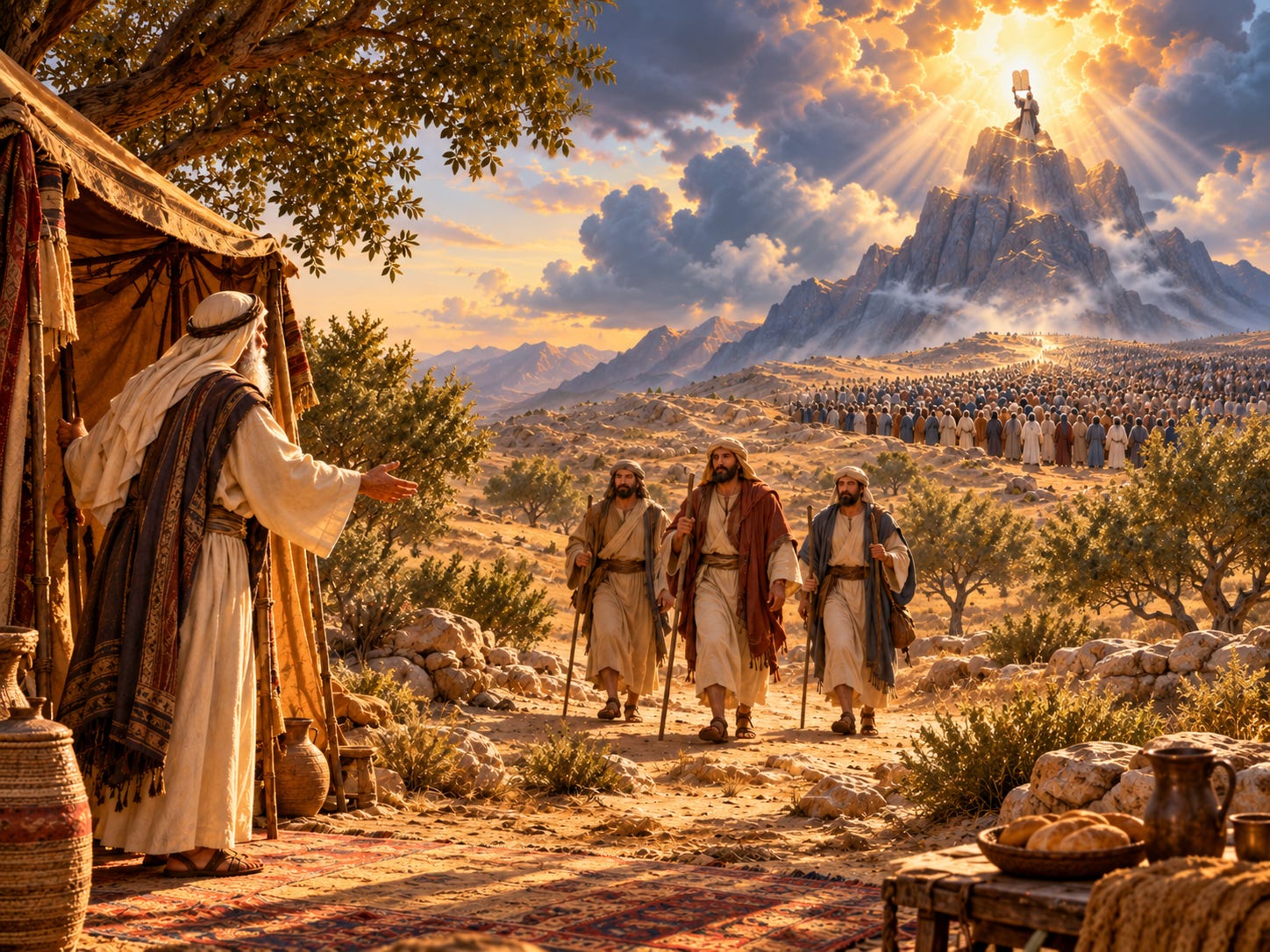
The Torah describes what אברהם served:
וַיִּקַּח חֶמְאָה וְחָלָב וּבֶן הַבָּקָר אֲשֶׁר עָשָׂה וַיִּתֵּן לִפְנֵיהֶם וְהוּא עֹמֵד עֲלֵיהֶם תַּחַת הָעֵץ וַיֹּאכֵלוּ.
He took butter, milk, and the calf that he had prepared, and placed them before them. He stood over them beneath the tree, and they ate.
בראשית י״ח:ח
The דעת זקנים brings a מדרש (teaching of חז״ל) that when the מלאכים later opposed giving the Torah to כלל ישראל, Hashem answered them from this meal. The Torah says not to cook a kid in its mother’s milk, yet they had descended to אברהם’s home and eaten בשר בחלב (meat and milk). They immediately conceded.
The חזקוני gives the argument an especially sharp form:
תנוק הנמול בבית ישראל משמרה יותר מכם שאכלתם בשר בחלב.
A circumcised infant in a Jewish home observes it better than you, for you ate meat with milk.
חזקוני על בראשית י״ח:ח
But what exactly did they do wrong?
The פסוק (verse) lists the dairy first and the meat afterward. If אברהם served them in that order, there was no Torah-level prohibition. At most, they would have needed קינוח והדחה (cleansing and rinsing the mouth) before eating the meat. That is a rabbinic requirement.
Earlier, אברהם had promised bread, and שרה prepared cakes. Yet the Torah does not list bread among the foods ultimately placed before the מלאכים. According to רש״י, the bread was not served because שרה became impure and the dough was affected. Other approaches may understand the meal differently. If bread or another suitable food was available, it could have been used for קינוח. A drink could have been used for הדחה.
Even if אברהם placed everything before them simultaneously, the meat and milk remained separate. Unless they had been cooked together, eating them together would still not violate the Torah prohibition of בשר בחלב.
The ברכת פרץ brings a remarkable answer based upon a ירושלמי. A מלאך’s physical form is fire. When the meat and milk entered their fiery bodies, the two were cooked together. What had been separate upon אברהם’s table became בשר בחלב inside them.
As best as I can tell, that is where the first answer (he gave another) of the ברכת פרץ ends. But that answer opens an entire סוגיא (Torah discussion).
Perhaps the meat had already been cooked. And this should be subject to אין בישול אחר בישול (there is no cooking after cooking).
The חתם סופר, in יורה דעה סימן פ״ב, distinguishes between reheating an existing cooked mixture of meat and milk and cooking together meat and milk that had previously been cooked separately. Here, this was their first joint cooking. The heat created a new exchange of taste between the two. The earlier cooking of the meat does not remove the new prohibition.
But if the גוף (body) of a מלאך is literally fire, perhaps the food was not cooked at all. Perhaps it was incinerated. For the answer of the ברכת פרץ to work, their fire must have caused something recognizable as בישול (cooking) and נתינת טעם (transfer of flavor). If it immediately reduced everything to ash, that would be שריפה (burning) rather than the normal process of cooking.
There is another question. When the food entered their mouths, it was not yet בשר בחלב. It became בשר בחלב only through the heat of their bodies. Did they actually eat בשר בחלב, or did their eating merely cause it to be cooked?
Perhaps their mouths and throats were also fiery, so the cooking occurred while the act of swallowing was still taking place. Otherwise, the precise prohibition may have been בישול בשר בחלב rather than eating food that was already forbidden.
What if the meat was נבילה (meat from an animal not validly slaughtered)? If אברהם did not yet possess the halachic status of a Yid, perhaps his שחיטה was not valid.
That does not remove the entire problem. The רמב״ם rules in הלכות מאכלות אסורות that one who cooks נבילה from a kosher species with milk is liable for cooking בשר בחלב. There is no additional liability for eating it as בשר בחלב because אין איסור חל על איסור (one prohibition does not normally take effect upon an existing prohibition), but the cooking prohibition remains.
In a strange way, the נבילה question strengthens the answer of the ברכת פרץ. Even if a new eating prohibition could not take effect, the fiery bodies of the מלאכים could still create the prohibition of cooking.
Then we reach אברהם himself. Was he somehow serving a prohibition to them?
If אברהם knew they were מלאכים, perhaps he knew what their fiery bodies would do. If he did not know, there would seemingly be no intention to cause anything. רש״י indicates that at first אברהם thought they were Arabs who worshipped the dust of their feet, though it remains possible that he recognized them later.
Could there be לפני עור (placing a stumbling block)? If the entire problem was failure to perform קינוח והדחה, the meal could still have been eaten permissibly if the necessary cleansing was available. More fundamentally, the מלאכים were not Yidden and had never been commanded in בשר בחלב. If there was no prohibition for them, there was no עבירה (transgression) for אברהם to facilitate.
One could even ask whether אברהם benefited from the meal. He had been distressed that there were no guests. For אברהם, giving to another person was itself his greatest pleasure.
The commentary of ר׳ אברהם מן ההר on נדרים explains that the pleasure of understanding Torah is not merely an outside benefit from a מצוה (commandment). That pleasure is part of the מצוה itself. Perhaps the joy אברהם experienced through הכנסת אורחים (welcoming guests) was similarly part of his fulfillment of והלכת בדרכיו (walking in Hashem’s ways).
But that cannot automatically permit the prohibited benefit of the meal. It only shows that saying אברהם received nothing from the meal misses who אברהם was. Feeding another person was itself his enjoyment.
Even then, the technical איסור הנאה (prohibition against benefit) is difficult to apply. אברהם’s pleasure came from serving his guests. The prohibited mixture, according to the ברכת פרץ, formed only afterward inside the מלאכים. His enjoyment was from the חסד, not from a forbidden object in his possession.
From there we could enter the topic of מצוה הבאה בעבירה (a mitzvah fulfilled through a transgression). The מנחת חינוך discusses this in connection with פריה ורביה (being fruitful and multiplying). He brings the question of whether the עבירה must still be occurring at the moment the מצוה is fulfilled.
According to the approach brought from the שער המלך, a stolen לולב remains an עבירה while the מצוה is being performed. By contrast, if מצה was carried through a forbidden הוצאה on Shabbos and eaten afterward, the act of הוצאה has already ended before the מצוה of מצה is fulfilled. The מהרי״ט אלגאזי does not accept that timing distinction so simply.
Applied here, when was the הכנסת אורחים complete? Was it when אברהם placed the food before them, when the guests ate, or when they became satisfied?
If the internal cooking occurred only after אברהם had served them, perhaps the עבירה took place after his קיום המצוה (fulfillment of the commandment). If הכנסת אורחים continued through their eating, perhaps the moments overlapped.
Still, we would not say עשה דוחה לא תעשה (a positive commandment overrides a prohibition). אברהם could have fulfilled הכנסת אורחים with entirely permitted food. No prohibited mixture was necessary.
After all this halachic discussion, the largest question remains untouched.
The מלאכים were not obligated in mitzvos. The Torah had not yet been given even to כלל ישראל. Why could Hashem hold this meal against them?
A Child Who Does Not Yet Understand
At first, one might answer that when a מלאך assumes a physical form, he becomes obligated in those mitzvos that relate to the body. There is some basis for the underlying thought. The גמרא says in בבא מציעא:
לעולם אל ישנה אדם מן המנהג, שהרי משה עלה למרום ולא אכל לחם, מלאכי השרת ירדו למטה ואכלו לחם. ואכלו סלקא דעתך?! אלא אימא: נראו כמי שאכלו ושתו.
A person should never depart from the practice of the place. משה ascended above and did not eat bread, while the ministering angels descended below and ate bread. Could it enter your mind that they ate? Rather, say: they appeared as if they ate and drank.
בבא מציעא פ״ו ע״ב
When מלאכים descend into this world, they conduct themselves according to this world. Perhaps taking on a physical גוף also creates responsibility for the laws governing that physical state.
But we do not have an explicit source that a מלאך in physical form becomes a formal בעל חיוב (person obligated in mitzvos). The חזקוני may be taking us in a different direction entirely.
Hashem did not compare the מלאכים to a תלמיד חכם or to a great צדיק. He compared them to a תנוק הנמול (circumcised infant).
That child is also not yet a בר דעת (person possessing halachic understanding). He is personally פטור (exempt) from mitzvos. Yet he is not outside the world of Torah.
His body already carries the ברית (covenant). An adult may not directly feed him forbidden food. His home determines what enters his mouth long before he knows what kosher means. Before his mind understands Torah, his physical life already belongs to it.
The מלאכים were the reverse. They possessed tremendous דעת and knew the Torah in שמים. But they did not live within a physical world of Torah. When they temporarily assumed bodies and ate physical food, their knowledge did not naturally enter their eating.
The child lacks דעת, but his גוף belongs to Torah. The מלאך possesses דעת, but his temporary גוף does not.
Hashem was not necessarily accusing the מלאכים of an עבירה for which they deserved punishment. He was answering their claim that Torah belonged with them. A circumcised infant, who cannot yet understand a word of Torah, lives a more embodied Torah life than they do.
Their answer could have been that they were not yet commanded. But neither was the infant. That is exactly the comparison. The question was not only who had received a formal command. It was whose existence was truly שייך (connected) to Torah.
This may also be why the חזקוני describes the child specifically as הנמול. This entire encounter took place on the third day after אברהם’s own ברית מילה. It was אברהם’s body that was in pain because it had been entered into the ברית. Yet that same body ran to serve others.
The infant has no דעת, but his body carries the covenant. אברהם has a suffering body, but he turns it into חסד (kindness). The מלאכים have דעת without a lasting body of ברית.
That may be why this meal became Hashem’s answer at מתן תורה.
The מדרש in שמות רבה describes the moment without mentioning בשר בחלב:
באותה שעה בקשו מלאכי השרת לפגוע במשה. עשה בו הקדוש ברוך הוא קלסטירין של פניו של משה דומה לאברהם. אמר להם הקדוש ברוך הוא: אי אתם מתביישין הימנו? לא זהו שירדתם אצלו ואכלתם בתוך ביתו?... אמר הקדוש ברוך הוא למשה: לא נתנה לך תורה אלא בזכות אברהם.
At that moment the ministering angels sought to harm משה. Hashem made the appearance of משה’s face resemble אברהם. Hashem said to them, “Are you not ashamed before him? Is this not the one to whom you descended and in whose home you ate?” Hashem then said to משה, “The Torah was given to you only in the merit of אברהם.”
שמות רבה כ״ח:א
Why specifically אברהם? He had survived אור כשדים. He would endure the עשרה נסיונות (Ten Trials). The עקידה would appear to be a far greater זכות (merit) than serving a meal.
Yet Hashem showed the מלאכים the face of the person who fed them.
Their argument was that Torah belonged in שמים. What place did a ילוד אשה, someone born of a woman, have among them? Hashem responded with the human being they had encountered on the third day after his ברית מילה.
At that moment, אברהם was sick and hurting. Everything about his body should have turned him inward. Instead, he was distressed that there was no one to feed. The moment he saw guests, he ran toward them.
A מלאך performs Hashem’s will because that is what he is. אברהם performed Hashem’s will while pain and physical weakness pulled him in the other direction.
Torah was not given to people despite their bodies. Torah was given to people because a body can hurt and still run toward another person. Hunger can become a meal for a stranger. Physical limitation can become חסד. A creature formed from the ground can rise beyond the selfish pull of the ground.
The מלאכים were already where they were supposed to be. אברהם could become more than where he began.
That led me to wonder whether אברהם himself was creating the argument that would one day allow his descendants to receive the Torah. Perhaps this meal was not merely an act of הכנסת אורחים whose significance emerged generations later. Perhaps אברהם arranged it so that the מלאכים’s own conduct in the physical world would answer their future claim that Torah should remain in שמים.
That possibility depends upon whether אברהם knew they were מלאכים. If he recognized them, perhaps he consciously prepared the argument. If he did not, then Hashem arranged the moment through him. אברהם created the answer simply by being אברהם, and Hashem preserved that meal so it would later stand for his descendants at הר סיני.
Either way, there was no prohibited לפני עור. The מלאכים were not commanded in בשר בחלב. Yet the meal exposed something fundamental. They could enter the physical world and eat, but they were not people. They were not us. Their temporary physical form did not become a Torah life.
But אברהם’s suffering body did. That was the argument he made possible for משה.
From the Tent to סדום
Immediately afterward, the מלאכים turned toward סדום. Hashem then said:
הַמְכַסֶּה אֲנִי מֵאַבְרָהָם אֲשֶׁר אֲנִי עֹשֶׂה?
Shall I conceal from אברהם what I am about to do?
בראשית י״ח:י״ז
Hashem did not need אברהם’s information or advice. He wanted to bring forth the אברהם who would care even about סדום.
Here רש״י explains that Hashem had made אברהם an אב המון גוים (father of many nations). Hashem had given him the land, including these cities. It would not be proper to destroy the children without informing their father.
And אברהם responded exactly as Hashem intended. He pleaded for the people of סדום.
This destruction resembles the מבול (Flood), but in a more contained form. At the מבול, destruction covered the world while salvation turned inward into the תיבה. There נח built the תיבה and preserved those inside it, but he did not plead for the world outside.
At סדום, destruction was limited to one region, but salvation had to move outward. Those trapped within סדום had to leave. אברהם did not build a structure to protect himself. He stood before Hashem and reached outward toward people who represented the opposite of everything he believed.
But why did he stop at ten?
There רש״י explains that אברהם remembered the eight people in נח’s family who had not saved the generation of the מבול. He had already asked whether nine could join with Hashem to complete ten. Once that was not accepted, he had no basis to ask for fewer.
Still, there is a deeper difference between one צדיק (righteous person) and ten. One צדיק can remain an isolated exception within סדום. Ten can form a ציבור (community). Ten means that another kind of society remains alive within the city. There may still be a core from which סדום can change.
With fewer than ten, the individuals might be removed, but they could not redefine the city.
Yet אברהם’s compassion did not end at ten. His חסד encountered משפט (justice). Preserving סדום without any remaining possibility of change would allow its cruelty to continue. That would not be kindness toward its victims.
This is why Hashem said that אברהם would teach his descendants:
וְשָׁמְרוּ דֶּרֶךְ ה׳ לַעֲשׂוֹת צְדָקָה וּמִשְׁפָּט.
They will preserve the way of Hashem, performing righteousness and justice.
בראשית י״ח:י״ט
Not צדקה without משפט, and not משפט without צדקה.
So אברהם pleaded as far as mercy could truthfully reach, and then he stopped.
His prayer did not preserve סדום, but it was not lost:
וַיְהִי בְּשַׁחֵת אֱלֹקים אֶת עָרֵי הַכִּכָּר וַיִּזְכֹּר אֱלֹקים אֶת אַבְרָהָם וַיְשַׁלַּח אֶת לוֹט מִתּוֹךְ הַהֲפֵכָה.
When Hashem destroyed the cities of the plain, Hashem remembered אברהם and sent לוט out from the upheaval.
בראשית י״ט:כ״ט
One person could not save the city. But one rescued person could carry a future that would not become visible for generations.
From לוט would eventually come רות and מלכות בית דוד (the kingship of the House of דוד). Here חז״ל apply the words, “I found דוד, My servant” to this hidden future inside סדום. It was דוד who was not yet visible, but the possibility of דוד was extracted from the destruction.
That does not mean לוט personally possessed enough merit to deserve such a descendant. רות possessed her own greatness. As a גיורת (female convert), she entered a new identity and chose a new direction.
That is precisely the point. Where a human being begins does not determine where that person must end.
The Salt That Could Not Move
But לוט’s wife did not make that movement. She left physically but looked backward.
The Torah tells us:
וַתַּבֵּט אִשְׁתּוֹ מֵאַחֲרָיו וַתְּהִי נְצִיב מֶלַח.
His wife looked back from behind him, and she became a pillar of salt.
בראשית י״ט:כ״ו
Here רש״י explains:
במלח חטאה ובמלח לקתה.
She sinned through salt, and she was punished through salt.
When לוט asked her to give the guests salt, she objected that he was bringing the evil practice of הכנסת אורחים into סדום.
She did not die merely because her eyes moved in the wrong direction. Her glance revealed where she still belonged. Her body was leaving סדום, but סדום had not left her.
Salt is necessary. It gives food flavor. It draws blood from meat so that the meat can be eaten. Every קרבן (offering) requires salt upon the מזבח (Altar).
וְלֹא תַשְׁבִּית מֶלַח בְּרִית אֱלֹקֶיךָ.
You shall not omit the salt of your covenant with Hashem.
ויקרא ב׳:י״ג
Salt in its proper measure enables the physical world to serve Hashem. But salt cannot be the meal. Too much salt destroys the taste and leaves land incapable of producing anything.
That was סדום. The נביא יחזקאל describes its sin as:
גָּאוֹן שִׂבְעַת לֶחֶם וְשַׁלְוַת הַשְׁקֵט... וְיַד עָנִי וְאֶבְיוֹן לֹא הֶחֱזִיקָה.
Pride, fullness of bread, and tranquil ease... yet she did not strengthen the hand of the poor and needy.
יחזקאל ט״ז:מ״ט
In סדום there was physical abundance, but it produced no חסד. There was too much flavor, too much comfort, too much געשמאק (physical pleasure). The גשמיות (physical life) that should have sustained others became an end in itself.
At the tent, אברהם slaughtered cattle for strangers. In סדום, the wife of לוט would not give them a pinch of salt.
She became the very thing she refused to give.
She also became fixed in place. מלאכים are described as עומדים — those who stand. A human being is meant to be a מהלך, someone who moves.
וְנָתַתִּי לְךָ מַהְלְכִים בֵּין הָעֹמְדִים הָאֵלֶּה.
I will make you one who walks among these who stand.
זכריה ג׳:ז
So לוט’s wife looked backward, and became unable to move forward.
Generations later, רות faced the same essential choice. נעמי repeatedly told her to return to מואב. But רות refused:
בַּאֲשֶׁר תֵּלְכִי אֵלֵךְ... עַמֵּךְ עַמִּי וֵאלֹקַיִךְ אֱלֹקָי.
Wherever you go, I will go... Your people are my people, and your Hashem is my Hashem.
רות א׳:ט״ז
One woman, לוט’s wife, looked backward toward סדום. But רות refused to look backward toward מואב.
That is the essence of אדם. A person can come from סדום and still reach דוד. A person can inherit a broken beginning without being forced to inherit its ending.
The תיבה preserved what already existed. אברהם’s תפילה (prayer) reached toward what did not yet visibly exist. There were not ten צדיקים in סדום, but there was a future רות hidden within לוט. It was אברהם’s חסד that could not preserve the corruption of סדום, but it could help pull its captive potential out of the destruction.
When חסד Gives Birth to דין
The parsha begins with אברהם’s חסד and culminates with the עקידה. On the surface, these episodes seem to reveal opposite people.
The אברהם who runs to feed strangers appears to be pure חסד. The אברהם who raises a knife over יצחק appears to be pure דין.
But the Torah later says:
אַבְרָהָם הוֹלִיד אֶת יִצְחָק.
It was אברהם who fathered יצחק.
בראשית כ״ה:י״ט
I once asked my Rebbe, HaRav Nochum Lansky שליט״א, whether these words could mean that דין comes from חסד. He answered that they could. All דין is truly rooted in חסד.
True דין does not originate in cruelty. Hashem’s boundaries allow good to become real. A love that can never say no may preserve the very thing destroying the person it claims to love.
We first see this in סדום. There אברהם’s חסד pleads all the way down to ten, but it does not ask Hashem to preserve cruelty when no possibility of change remains. חסד learns to contain משפט.
At the עקידה, the two become one.
Here יצחק represents דין, and the greatest דין is the surrender of life itself. Yet אברהם, the embodiment of חסד, is the person helping יצחק accomplish that task.
On one side, יצחק is willing to surrender his life. On the other, אברהם is willing to surrender his son, his future, and everything Hashem had promised would come through יצחק.
Yet אברהם does not act against his חסד. His חסד has become so complete that it is no longer controlled by what he wants for himself. He can help יצחק fulfill רצון Hashem (the will of Hashem) even when doing so costs אברהם everything.
That is the convergence of the greatest חסד and the greatest דין through complete ביטול (self-nullification) to Hashem.
Now the opening of the parsha returns with an entirely different meaning.
Each מלאך has one שליחות. A מלאך’s identity is bound up with the mission for which he was created. He remains within the כח (force) he was sent to express.
But אברהם can embody חסד and perform the greatest act of דין. And יצחק can embody דין and surrender himself with love. A human being can contain opposing כוחות and bring all of them beneath the דבר Hashem (word of Hashem).
The separate מלאכים had to travel together because their different missions depended upon one another. But within אברהם himself, the different כוחות could become one life.
The Torah Beneath the Tree
Now we can return to the words of the מדרש:
לא נתנה לך תורה אלא בזכות אברהם.
The Torah was given to you only in the merit of אברהם.
We know that the continued existence of the world depended upon כלל ישראל accepting the Torah. חז״ל read the extra letter in the words יום הששי as teaching that creation stood suspended until the sixth of סיון. If כלל ישראל accepted the Torah, the world would endure.
How, then, can the מדרש say that the Torah was given only בזכות אברהם?
There are really two questions.
The first is why Torah should be given to human beings rather than remain with the מלאכים.
The answer is אברהם at the entrance to his tent. Human beings are imperfect, troubled creatures. We possess bodies that hurt, desires that pull, and a selfishness that constantly asks us to turn inward.
Yet look at what a human being can become. אברהם was sick and in pain, but he wanted to perform חסד. He wanted to bring Hashem’s will into the life of someone else.
A מלאך is already close to Hashem. אברהם came from the ground and rose toward Him. A מלאך has no competing self to surrender. אברהם had a self, a body, pain, desire, and an entire future — and he placed all of it beneath Hashem’s will.
When אברהם later pleaded for סדום, he described himself with the words:
וְאָנֹכִי עָפָר וָאֵפֶר.
I am dust and ashes.
בראשית י״ח:כ״ז
That was not merely humility in speech. It was the way he lived. אברהם could completely nullify himself and still care endlessly about someone else.
Because there was no ego in his plea, he could plead with tremendous force. He did not challenge Hashem in order to assert himself. He challenged Hashem because Hashem’s חסד had become part of who he was.
The second question is why the Torah was given specifically to כלל ישראל.
That answer is also אברהם.
At הר סיני, all of כלל ישראל said:
נַעֲשֶׂה וְנִשְׁמָע.
We will do, and we will hear.
שמות כ״ד:ז
They accepted the דבר Hashem before demanding that everything first fit within their understanding.
That did not begin at הר סיני. It was אברהם who had already established that capacity within his descendants.
He turned a suffering body into חסד. He pleaded for people who represented the opposite of everything he stood for. He allowed his חסד to accept the boundary of משפט. He helped extract a hidden future from סדום. At the עקידה, he united חסד and דין through complete ביטול.
Perhaps “בזכות אברהם” does not mean only that אברהם accumulated enough merit for his descendants to receive a reward. It means that אברהם created the human and national capacity that made מתן תורה possible.
Then the הגר״א reveals what had been present at אברהם’s table all along.
Before אברהם brought the meal, he told the מלאכים:
וְאֶקְחָה פַת לֶחֶם וְסַעֲדוּ לִבְּכֶם.
I will take a piece of bread and sustain your hearts.
בראשית י״ח:ה
There רש״י explains that throughout the Torah, the נביאים, and the כתובים, bread is described as sustaining the heart. Our פסוק is the example from the Torah. The example from נביאים appears in ספר שופטים:
סְעָד לִבְּךָ פַת לֶחֶם.
Sustain your heart with a piece of bread.
שופטים י״ט:ה
The example from כתובים appears in תהלים:
וְלֶחֶם לְבַב אֱנוֹשׁ יִסְעָד.
Bread sustains the heart of man.
תהלים ק״ד:ט״ו
On the simplest level, אברהם was offering them physical food. Bread gives strength to the heart.
But רש״י then brings a precise reading from רבי חמא:
לבבכם אין כתיב כאן אלא לבכם, מגיד שאין יצר הרע שולט במלאכים.
The Torah does not say לבבכם, using the fuller form of “your hearts.” It says לבכם, teaching that the יצר הרע does not rule over the מלאכים.
A human being has a לבב, a heart containing competing inclinations. This is why we are commanded to love Hashem בכל לבבך — with both the יצר טוב and the יצר הרע. A מלאך has only one heart. There is no competing desire within him that must be redirected toward Hashem.
The הגר״א takes this further. On the words וסעדו לבכם, he connects the absence of a יצר הרע among the מלאכים with the teaching that Torah is the תבלין (remedy) for the יצר הרע.
That makes the scene even sharper. אברהם offered them bread to sustain a heart that had no internal struggle. But Torah was not given merely to sustain the single heart of a מלאך. Torah was given to transform the divided heart of a human being.
A מלאך already wants only what Hashem wants. He does not need Torah to take selfishness, appetite, fear, anger, and desire and turn them toward Hashem.
A person does.
The physical bread at אברהם’s table sustained the heart. Torah would later sustain and transform the human לבב. It would not eliminate the human struggle by turning us into מלאכים. It would teach us to serve Hashem through every part of ourselves.
Now the earlier words take on an entirely different meaning:
וְהִשָּׁעֲנוּ תַּחַת הָעֵץ.
Rest yourselves beneath the tree.
בראשית י״ח:ד
The הגר״א explains that this tree was the עץ החיים (the Tree of Life) for those who grasp the Torah. He later explains that the חמאה וחלב served at the meal also represent Torah.
Suddenly, the entire event becomes clear.
The מלאכים descended from שמים and sat beneath the עץ החיים. They received their food from אברהם, and the food itself represented Torah. They later argued that Torah should remain with them in שמים, but they had already received Torah at the table of a human being.
They received it through אברהם’s חסד.
The מלאכים sat beneath the עץ החיים and ate bread meant to sustain a heart without a יצר הרע. It was אברהם who stood over them with a human לבב, a suffering body, and every physical reason to think about himself. Yet he transformed all of it into חסד.
When Hashem later showed the מלאכים the face of אברהם and asked whether they were ashamed, the answer was not only that they owed him gratitude for a meal. Their encounter with אברהם had already demonstrated where Torah belonged.
The Torah did not belong only above. They themselves had encountered it below.
They had found the עץ החיים growing beside the tent of a human being.
This is why the meal was the answer at הר סיני. It was אברהם who did not merely teach Torah. He made his physical life into Torah. His butter and milk became Torah. His tree became the עץ החיים. His desire to feed another person became והלכת בדרכיו. His willingness to say אנכי עפר ואפר allowed Hashem’s חסד to enter the world through him.
The מלאכים knew Torah, but they did not live within a body of Torah. The circumcised infant had no דעת, yet his body already belonged to the ברית. And אברהם stood between them: a human being whose גוף and דעת, pain and pleasure, חסד and דין all became part of serving Hashem.
The מלאכים were already perfect. They stood where Hashem placed them.
We are not already there.
We can be sick and still give. We can come from broken places and choose a new direction. We can look back and become trapped, or we can be רות and continue forward. We can struggle with selfishness and become בעלי חסד (masters of kindness). We can hold חסד and דין together. We can fall, learn, return, and rise.
We are not מלאכים.
We are בני עלייה (people capable of ascent) because we are attached to Hashem and cannot stop growing through His Torah.
May we be זוכה (worthy) to sit together as one עם beneath that עץ חיים. May we be worthy of the Torah that משה רבינו received בזכות אברהם. May we not allow Torah to remain only in our minds, but bring its teachings into our bodies, our homes, our meals, and the way we treat every person Hashem places before us.
May we truly walk in the ways of Hashem.
Through that חסד, through that ביטול, and through that endless movement toward Hashem, may we merit to rebuild the בית המקדש that דוד המלך longed to build.
Then the future hidden inside סדום will finally be revealed. The path from לוט to רות, from רות to דוד, and from דוד toward the final גאולה (redemption) will reach its completion.
We will sit together beneath עץ החיים, and the Torah will no longer appear divided between שמים and earth. Its wisdom will fill human life, and the true גילוי (revelation) of Hashem will be seen in this world.