


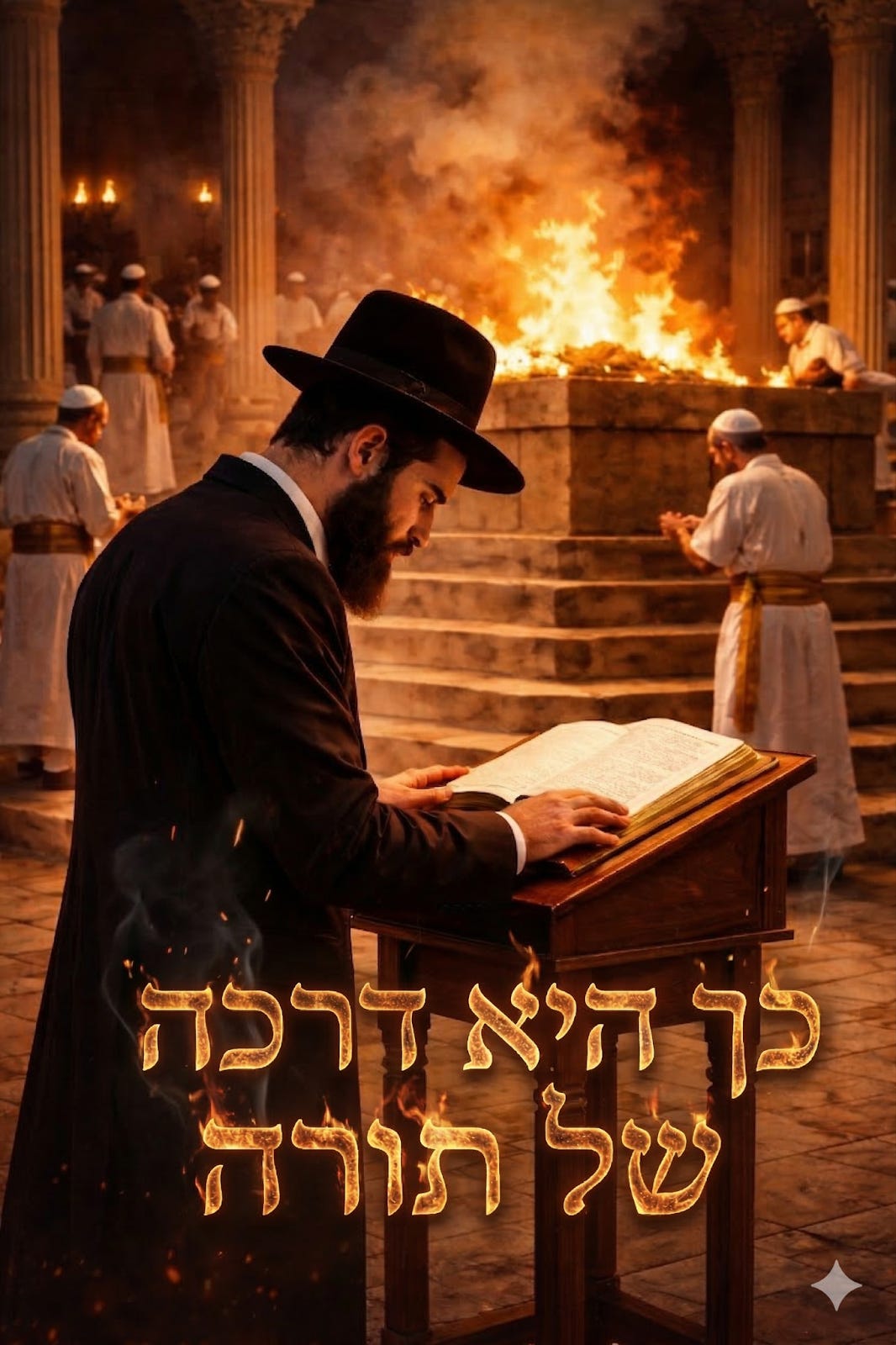
Let’s look at the first pasuk of the parshah:
וַיִּקְרָ֖א אֶל־מֹשֶׁ֑ה וַיְדַבֵּ֤ר יְהֹוָה֙ אֵלָ֔יו מֵאֹ֥הֶל מוֹעֵ֖ד לֵאמֹֽר׃
The בעל הטורים opens everything for us with his own words:
חמשה אלפי”ן בפסוק כנגד חמשה חומשי תורה. וט’ תיבות יש בו. וכן יש ט’ תיבות בפסוק אנכי ה’ אלהיך. לומר שכל הלומד תורה כאלו הקריב כל הקרבנות. וכן ט’ תיבות בפסוק זאת התורה לעולה.
That already tells us two things. First, that the opening פסוק of ויקרא contains חמשה אלפי״ם, five א׳s, corresponding to the חמשה חומשי תורה. Second, that its ט׳ תיבות link it to אנכי ה׳ אלקיך and to זאת התורה לעולה. And the בעל הטורים himself draws the conclusion: שכל הלומד תורה כאלו הקריב כל הקרבנות.
Now, the גמרא in מנחות does not say those exact words. Its language is more specific. But the direction is clearly the same, and the בעל הטורים states that direction in his own broad way. תורה does not stand outside the world of קרבנות (offerings); it enters into their inner reality.
From there, the first רמז opens up.
חמשה אלפי״ם means five letters א, not five thousand. Those five א׳s appear in order in these five words:
ויקר א
אל
אליו
מאהל
לאמר
And maybe that is the depth of the רמז: not only that there are five א׳s כנגד the five חומשים, but that each א sits in a word that reflects one of the five ספרים in order.
ויקרא — בראשית. This is the beginning, the first Divine turning toward the world and toward man. Just as בראשית is the sefer of origins, ויקרא is the originating call. And this fits even more because of the א זעירא. If that first א corresponds to בראשית, then its smallness is precise. בראשית is the foundation of everything, but it is also the part of Torah we do not fully grasp in its totality. The deepest beginnings of creation and Divine revelation are given to us, but in a hidden and contracted way. The beginning is there, but small to our comprehension.
אל — שמות. This is movement toward Hashem, toward covenant, toward revelation. שמות is the sefer in which כלל ישראל are drawn toward הר סיני and become the nation addressed by Hashem. And here there is an especially beautiful רמז that אל is not only a word meaning “to” or “toward,” but with different נקוד (vocalization) it is itself one of the שמות (Names) of Hashem. That is not accidental. ספר שמות is not merely a journey onward. It is a journey Godward. אל is both direction and destination.
אליו — ויקרא. This is the most exact one. ספר ויקרא is the sefer where the Divine speech comes directly to him, to משה, from the אהל מועד (Tent of Meeting). אליו is the sefer of intimate address.
מאהל — במדבר. This points directly to life in the wilderness, with the camp arranged around the sanctuary. The whole world of במדבר is built around the אהל מועד.
לאמר — דברים. This is not only Torah said onward. It is משה רבינו’s final speaking of Torah to כלל ישראל.ספר דברים is משנה תורה (repetition of the Torah), but not as dry review. It is משה’s final outpouring, his farewell transmission, his goodbye hug and kiss to כלל ישראל through words.
So the five א׳s may form a miniature map of the five books in sequence. The opening פסוק of ויקרא becomes a condensed image of the whole Torah.
And that raises the next question: Why specifically the letter א?
Here the point becomes even deeper. א is the letter of beginning, the letter of אנכי, and the letter of unity. More deeply, its very form is understood as two י׳s and a ו, totaling 26, a hint to ׳שם ה (the Divine Name). So the five books are not merely five ספרים standing next to each other. They are one תורה אחת (single Torah), held together by one hidden Divine unity. The five א׳s are not just a count. They are the thread that binds everything together. The whole Torah is many on the surface, but one in its source.
Then comes the second רמז.
The בעל הטורים points out that the פסוק has 9 words and compares it to אנכי and זאת התורה לעולה, this is not a coincidence and requires explanation. Perhaps the strongest way to understand the 9 is not 10 being fully revealed, but as fullness still inward. Like 9 months of pregnancy: the whole child is already there, formed and alive, but has not yet emerged into full visible revelation. 10 is open manifestation. 9 is the whole reality already present, but gathered inwardly, waiting to unfold.
That fits these three פסוקים beautifully.
אנכי ה׳ אלקיך is the whole Torah in root. It is the source of all מצוות, all revelation, all קבלת עול (acceptance of the yoke of Heaven), but still in concentrated seed-form.
ויקרא אל משה וידבר ה׳ אליו מאהל מועד לאמר is the whole Torah as transmission. It is the Divine call from which all the detailed speech of Torah unfolds.
זאת התורה לעולה... is the whole world of עבודה gathered into one line. Even though it names several קרבן categories, it begins with זאת התורה. The many קרבנות are all expressions of one Torah.
So the point of the 9 is that these are פסוקי-כלל — seed-verses. Each one contains an entire world in concentrated form. Not deficiency, but gestation. Not something missing, but something inwardly whole before its full outward revelation.
That is especially important in זאת התורה לעולה. On the surface, the פסוק names different קרבנות. But the Torah frames them with זאת התורה. The point is not only that there are many sacrifices. The point is that all of them are one Divine utterance, one Torah, one inner reality.
And from there the בעל הטורים’s line becomes much deeper:שכל הלומד תורה כאלו הקריב כל הקרבנות. תורה is not only information about עבודה. תורה is the place where the inner reality of עבודה lives.
That is why the point cannot be reduced to, “If you learn the parshah of this קרבן, it is as if you brought that קרבן.” There is truth there, but the matter is deeper. The קרבן has a Torah-form, an inner existence within Torah itself. And when a person truly gives himself over to תורה, he is not standing outside עבודה and analyzing it from a distance. He is entering its essence.
And this is not only in קדשים. Whether one learns נזיקין, נשים, or any sugya at all, if he truly gives himself over to Torah, he is engaged in הקרבה (drawing near / self-offering). Torah is not only knowledge. Torah is the place where a person brings himself close to Hashem.
And this is how רבא says it in מנחות קי:
כל העוסק בתורת חטאת כאילו הקריב חטאת, וכל העוסק בתורת אשם כאילו הקריב אשם.
Elsewhere, the same pattern is extended to עולה and מנחה as well. רבא’s formulation points to something deeper than mere substitution. He ties each קרבן to its own תורה, suggesting that each offering has an inner existence within תורה itself. One who truly engages in that תורה is not merely receiving credit as though he had brought the offering. He is entering the reality the קרבן was meant to express. And the בן יהוידע presses that point even further: אינו צריך — he does not need those קרבנות. Through תורה, the inner purpose of the קרבן has already been realized in him. The קרבן is no longer only something he brings. In a deeper sense, it is something he becomes.
That is the deeper meaning of what חז״ל say about one who ממית עצמו עליה and of the משנה in אבות about the path of Torah. It does not mean destruction, חס ושלום. It means that the self which insists on remaining separate, comfortable, and self-defining has to give way. A person has to surrender his ego, his distractions, his laziness, his private will, and become מבטל (nullify) his own דעת (mind / judgment) to Hashem’s דעת. Not to stand over Torah, but to let Torah stand over him.
And that brings us back to אנכי.
אנכי ה׳ אלקיך is not just the first mitzvah. It is the deepest demand on the נשמה (soul): to recognize that Hashem alone is the true reality, and that man’s highest truth is to stand in total acknowledgment of Him. That is the root of ביטול (self-nullification). Then זאת התורה לעולה is the fruition of that inner truth. If אנכי is total recognition of Hashem, then עולה is the lived expression of that recognition: total giving-over, total closeness.
That is why יצחק אבינו stands at the center of this whole picture. יצחק is the human עולה. At the עקידה (binding of Isaac), even though he was not actually slaughtered, he stood as one wholly prepared to give over his life to Hashem. He is the image of a human being who becomes the קרבן. So the movement is clear: אנכי is the truth in the soul, עולה is that truth offered back to Hashem, and תורה is where that same interaction continues in our lives. Of course, it is not a coincidence that the עולה is fully burnt.
And this is where it has to land for us.
We do not have the actual קרבנות. We do not have the מזבח. So our עבודה is more inward, but not smaller. Our עבודה is to be the קרבן ourselves.
A קרבן cannot have a מום (blemish). That is not only a דין in animals. It becomes a demand on us. We cannot come to Torah half-hearted, distracted, split between worlds. We cannot keep one part of ourselves for Hashem and one part outside. We have to bring our whole לב (heart), our whole רצון (will), our whole mind, all our כוחות (inner powers), into our Avodas Hashem.
To sit over a סוגיא and really give oneself to it, to pour heart and soul into understanding, to search for דעת עליון (the higher Divine wisdom), to be מבטל one’s own דעת to Hashem’s דעת, to recognize that we are not the בעלי בתים over Torah but the ones being offered through Torah — that is our קרבן.
Our עבודה is to be our own עולה. To live for Torah. To be ממית עצמו in the sense חז״ל mean: not death, חס ושלום, but total giving-over. To be the one who brings himself.
And that עבודה is beautiful and dear to Hashem. It is a true ריח ניחוח (pleasing aroma). That closeness is what makes the world worth creating. A world in which a Yid gives his heart, his mind, his strength, his whole self to Torah and to avodas Hashem is a world that justifies creation itself.
So the opportunity is enormous. We are able, even without the בית המקדש (Temple), to enter the deepest place of קירבה (closeness). To be the עולה, but to live for Torah. To bring ourselves in essence. Our heart, our לב, our mind, our powers, our whole being.
And if we do that, then through that ביטול, through that living הקרבה, we reveal the ׳שם ה in the world. We bring His מלכות (kingship) into creation. And may we be זוכה, through that עבודה, to the full revelation of His glory and to במהרה בימינו משיח צדקנו.