


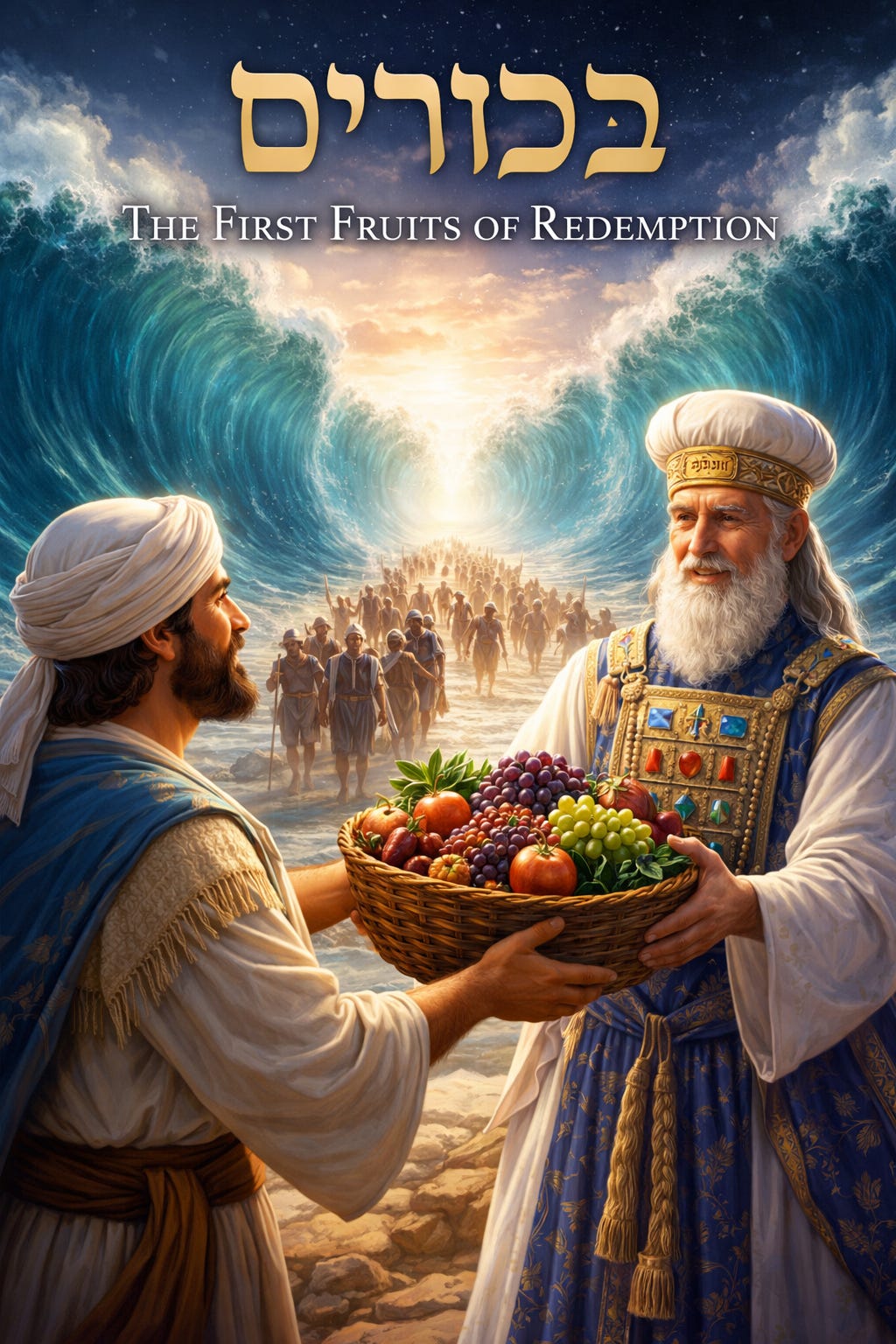
Pesach is not only the story of יציאת מצרים (the Exodus from Egypt). It is the story of how a Yid is remade.
That is why the הגדה (the Haggadah) is built in such a surprising way. If the point was only to retell the events, it would have simply followed the פסוקים (verses) in שמות (Exodus). But instead, it builds itself out of מקרא ביכורים (the declaration of first fruits), the words said by the Yid who brings his first fruits to the בית המקדש (Temple). And that is not incidental at all. Because Pesach is not only about what happened then. It is about how a later Yid takes that story into his own mouth and says: This is my story. This is not history. This is my identity. This is memory becoming blood.
And the first thing we know about ביכורים is already itself breathtaking. חז״ל (the Sages) tell us that at first, those who knew how to say the words would say them himself, and those who did not would repeat after someone else. But people became embarrassed, and some held back from bringing ביכורים altogether. So חז״ל changed the whole structure: Everyone would repeat after the reader, even the ones who knew, so that no one would be shamed.
That is astonishing.
The בית המקדש is the place of splendor, precision, grandeur, awe. And right there, at the center of all that קדושה (holiness), חז״ל were worried about the quiet embarrassment of a simple Yid who did not know the words. Not only worried about it. They reshaped the whole experience around it. So that no one would feel small while coming close to Hashem.
That is not a side point. That is the heart of the matter.
Because Pesach is exactly that. Redemption means that a person is not left alone in his weakness. If he cannot yet say the words, we say them with him until they become his. The holy language is not reserved for the polished, the learned, the confident. It is given over in a way that protects dignity and draws in the person who might otherwise stay outside.
And that opens directly into the whole structure of the night. A קרבן פסח (Paschal offering) is not eaten alone. A Seder is not built for the isolated individual. It is for a חבורה (group), for a משפחה (family), for a בית (home). Pesach is not the redemption of the solitary self. It is the redemption of a people who learn how to hold each other.
That is why “כל דכפין ייתי וייכול” is so powerful. Open the door. Open the table. Make room. The first instinct of the night is not private elevation but generosity. A Yid does not celebrate Pesach by becoming more insular. He celebrates by becoming more expansive, more aware of others around him: the hungry person, the lonely person, the person who needs a place at the table.
And maybe that is why this line is in Aramaic. The Haggadah is overwhelmingly in לשון הקודש (the holy tongue), but the invitation, surprisingly, is said in the language people actually spoke. Because this line is not meant to remain lofty. It has to be heard. קדושה can remain in the elevated language. But kindness has to reach the ear of the person standing outside. If you want someone at your table, you speak in the language he understands.
And that cannot help but stand as the opposite of לבן הארמי (Lavan the Aramean).
לבן is the corruption of relationship. He speaks the language of family while betraying family. He wraps exploitation in the appearance of closeness. He turns the home into a place of manipulation. “ארמי אובד אבי” is not only the beginning of exile in the historical sense, it is the beginning of broken trust, of distorted belonging, of relationship used to harm instead of heal.
And then Pesach comes and answers him with the exact opposite מידה (trait). לבן closes the house around himself. Pesach opens the house to the hungry. לבן uses closeness to consume. Pesach uses closeness to nourish. לבן corrupts family. Pesach restores family. So no, it is not a coincidence. The Haggadah begins with “ארמי אובד אבי,” and then, in Aramaic itself, says: Now let the hungry come eat. We are going to take the very place where the relationship was twisted and turn it into a place of welcome.
That is already the whole night.
No one is embarrassed by not knowing the words.
No one eats alone.
No one hungry remains outside.
And even the one who does not know how to ask we open the door for him (also the simple son).
The whole Seder is one long refusal to let another Yid disappear.
And that relates deeply to ביכורים in another way as well. מצרים (Egypt) tried to destroy the ראשית (beginning / first part), the first emergence, the future itself. “כל הבן הילוד” was not only cruelty. It was an attack on beginnings, an attack on בכור (firstborn-ness / primacy), an attempt to destroy the opening note before the song could even begin. And the תורה (Torah) answers that with a whole world of קדושת הראשית : בכור, פדיון בכור (redemption of the firstborn), ביכורים. The very aspect they tried to violate becomes holy. Egypt throws the first into the river. The תורה takes the first and brings it to Hashem. That is a real תיקון (repair). Not forgetting the wound, but taking the very place of the wound and turning it into ׳עבודת ה (service of Hashem).
So ביכורים is not just a convenient summary of the story. It is the healed form of the story. A Yid stands with his first fruits in his hands and says: What was once attacked, what was once threatened, what was once nearly destroyed, has ripened. It endured. It became offering. It became gratitude. It became holy speech.
And from there the הגדה begins its descent. It starts building the darkness. “מתחילה עובדי עבודה זרה;” then the fall, the exile, the avdus, the pain, the loneliness. And that is exactly right. Because once you understand that ביכורים is the sanctification of beginnings, the Haggadah is taking you back to the place where beginnings were broken. It retraces the wound in order to show you how redemption heals it.
And then comes the hinge, the turning point, maybe the most significant point in the whole night:
ונצעק אל ה׳
וישמע ה׳ את קולנו
We cried out. And He heard.
That is the turn.
Not yet the plagues.
Not yet the sea.
Not yet the triumph.
First this: He heard.
Because the deepest pain of avdus is not only suffering. It is the loneliness of suffering. The feeling that your cry disappears into the world and no one answers. The crushing silence. And then, in one פסוק, the whole universe changes. He heard. The sadness is still there, the pain is still there, but the abandonment is gone. There is now relationship. There is Someone on the other side of the cry. There is the רבונו של עולם who listens.
And once that happens, everything begins to turn. The first half of the Haggadah is the human condition: distance, degradation, bitterness, exile. The second half becomes Hashem’s response: He heard, He saw, He acted, He redeemed. In one moment, the whole world sways. Absence begins turning into presence. Loneliness begins turning into closeness. The cry begins turning into praise.
And yet something is still missing from the Seder. Not only משה רבינו (Moshe our teacher), though he too is hidden away. Something even more astonishing is missing: אז ישיר. The great song itself. The full שירת הים (Song at the Sea), the explosion of national voice, the eruption of כלל ישראל (the Jewish people) standing free on the far side of the sea and singing from the depths of redemption. That is not the center of the Seder. The Haggadah builds toward הלל (praise), yes, but not yet to that full bursting song.
Because Pesach unfolds in stages.
The first days are the beginning of redemption.
The last days are the flowering of redemption.
And in between lies חול המועד (the intermediate festival days), which is not a pause and not an afterthought. It is the עבודה of whether redemption can actually enter a person.
On יום טוב (festival day), like on Shabbos, we are protected. The ל״ט מלאכות (thirty-nine categories of prohibited labor) hold us inside the קדושה. They shelter us from distraction. They keep us from scattering ourselves into things that do not matter. They create a world in which we can focus on the יום טוב itself. The first night especially, is a blaze of ראשית. A מחשבה תחילה (originating consciousness / first thought), the first light, the first opening, the first vision of who a Yid can be. It sets the tone. It lifts a person to heights he could not have imagined. It tells him: this is what freedom tastes like. This is what closeness can feel like.
But then comes חול המועד.
And suddenly, we do not have that same crutch. There are היתרים (permissions). There is movement. There is practical life. The walls are not holding us in the same way. And now the real question begins. Can the קדושה remain when life starts moving again? Can the taste of יום טוב stay alive in the bloodstream and not only in the atmosphere? Can a person strike that subtle balance, not losing the light and not needing to flee the world in order to keep it?
That is the עבודה of חול המועד.
Not the peak.
The integration.
Not the burst of inspiration.
The question of whether it has entered the self.
The first days show a person what is possible.
חול המועד asks whether he can live it.
The last days seal it.
And that is where שיר השירים (Song of Songs) belongs so meaningfully. Because שיר השירים is not yet the triumphant public song of אז ישיר, but it is no longer the cry of bondage either. It is the voice in between. The voice of longing, of love, of nearness, of seeking, of relationship being formed. A Yid has already left מצרים, but he has not yet burst into the full song of the sea. So what is his voice in the meantime? The voice of yearning. The voice of closeness is becoming real. The voice of redemption enters the heart before it enters the mouth as a full song.
And maybe that is exactly why the Seder places מרור (bitter herbs) where it does.
A child can ask a beautiful question: If מרור is the bitterness of עבדות, should it not come right at the beginning of the Seder? Should it not sit there in the dark opening, in the earliest part of the story?
And the answer is: yes. On one level, that instinct is exactly right. That child is hearing the inner structure of the night.
But the deeper answer is that at the Seder we do not eat מרור as people trapped in slavery. We eat it as people already seated inside redemption. We place it with מצה (matzah), and once, with the קרבן פסח, because bitterness is no longer allowed to stand alone. We do not forget the מרור. We do not erase it. We do not deny it. Yiddishkeit does not lie about pain. We taste it. We name it. We remember it.
But we sweeten it.
We touch it with חרוסת (charoses). Just slightly. Not enough to pretend the bitterness is sweet. Not enough to flatten the pain. Only enough to say: This bitterness is no longer abandoned. It is now held בתוך גאולה (within redemption). This is not תשעה באב (the Ninth of Av). We are not here to sit in trauma. We are here to remember suffering and uplift it. To let sadness be reborn. To let the bitter thing enter a larger sweetness.
That may be one of the most profound movements in all of Yiddishkeit. We do not forget sadness. We memorialize it. We honor it. But we do not let it have the last word. The deepest thing we do is uplift it. We take what hurt us and refuse either to erase it or to worship it. We bring it to Hashem. We let it be transformed. We give sadness the chance for rebirth into joy.
And that is Pesach.
Pesach is not amnesia.
Pesach is not denial.
Pesach is not pretending the darkness never happened.
Pesach is the story of the cry being heard.
The bitterness being sweetened.
The beginning being sanctified.
The wound becoming the place of תיקון.
The lonely person being brought inside.
The hungry person being invited in.
The ashamed person being given words.
The first light of יום טוב entering the bloodstream through חול המועד.
The final days coming with their חתימה (seal), their final blow, their kiss goodbye, sealing in what began on the first night.
A Yid goes into Pesach one way and comes out another way.
The first night gives him vision.
חול המועד tests whether that vision can live in the world.
The last days seal it into him.
And so he leaves not merely inspired, but changed. A new מענטש (person). A new Yid. A Yid who went through a Pesach and was born again.
Look at what חז”ל did for the Yid who didn’t know the פסוקים. They restructured the entire practice of ביכורים so that not one person would feel small at the moment of coming close to Hashem. Every Yid has a place. Every Yid’s עבודה matters. When we say כל דכפין this year, perhaps we can let that sensitivity enter us as well — not only opening our doors to guests, but opening our hearts to the צרות of those around us. We don’t wait for them to knock. We go looking for them.
May we be זוכה to feel the גאולה as individuals and as a nation. May we have the strength to taste the bitterness of life and still sweeten it. May we never lose sight of where we came from, even as we embrace where Hashem is bringing us. And may the עליה of this Yom Tov carry all of כלל ישראל together to the final geulah, במהרה בימינו (speedily in our days), this year.