

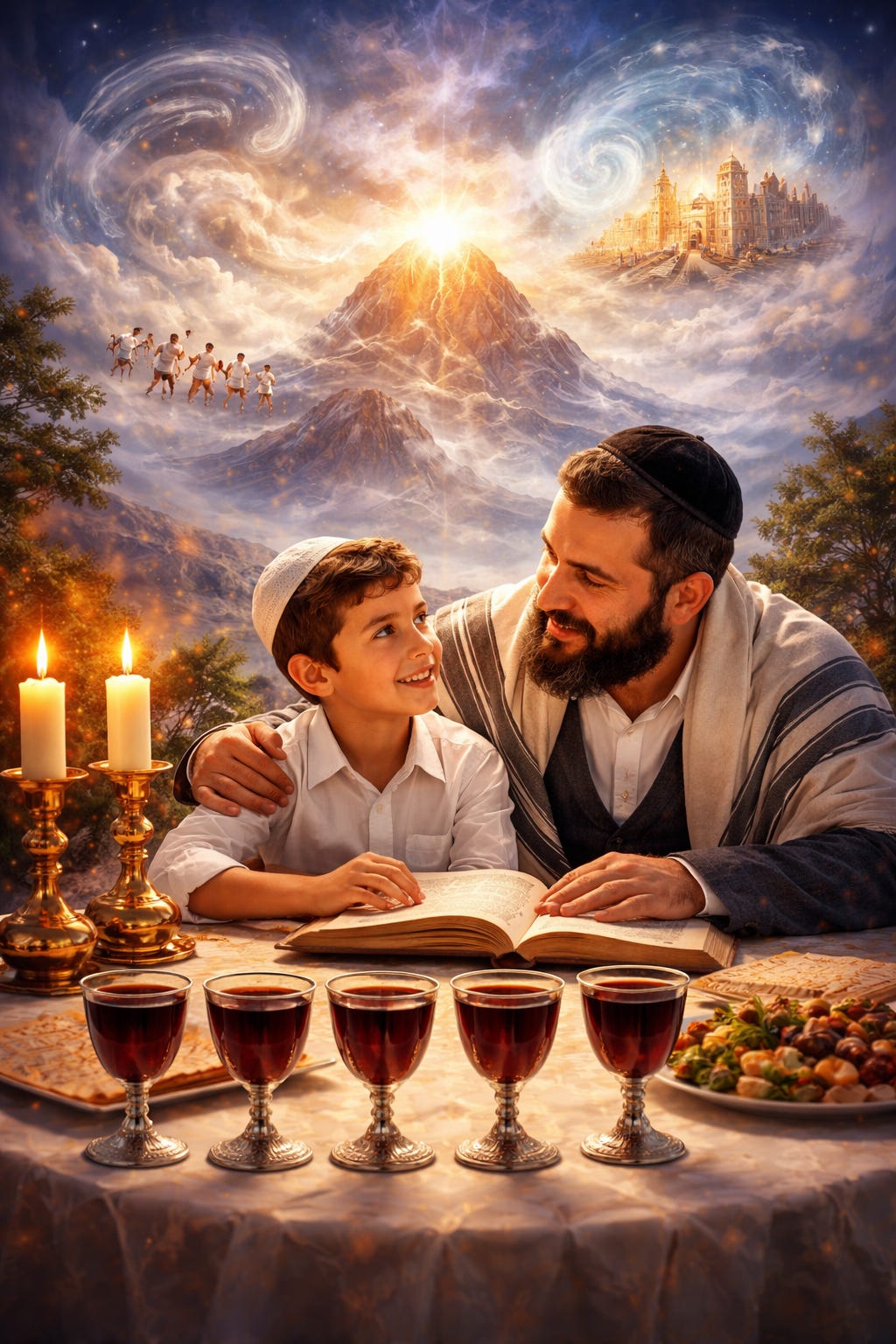
The סדר (order) is built around many sets of four: four cups, four sons, and four questions. But the center of the night is not really the number four. The center is מסורה (tradition). The center is the mitzvah of a father to his son, teaching him about יציאת מצרים (the Exodus from Egypt). That is why the whole night is built around questions and answers, around אב (father) and בן (son), around giving something over.
In a certain sense, this is the שורש (root) of תלמוד תורה (Torah study), and maybe even its highest form. A father is not just teaching information. He is giving over identity. He is telling his son who he is, where he comes from, and what it means to belong to כלל ישראל (the people of Israel). That is why the mitzvah is not just to tell the story, but specifically והגדת לבנך (and you shall tell your son). The whole night is about transmission.
That is also why אברהם and יצחק stand behind the whole Seder. אברהם is the original father. יצחק is the original son. And as the גר״א says, יצחק contains within himself all ארבעה בנים (four sons). That means the four sons are not four unrelated personalities. They are four possibilities within the same child. Every child contains different strengths and weaknesses, and different ways of receiving what is being given over. Sometimes he is wise. Sometimes he resists. Sometimes he is simple. Sometimes he does not yet know how to ask. The point of theארבעה בנים is not just to classify children. It is to teach a father that he has to know how to relate to the child in front of him, no matter where that child is holding.
That is why it is so important that we know how to speak to each kind of son. The mitzvah is not to teach an ideal child. The mitzvah is to teach the real child sitting at the table. Some children challenge. Some absorb. Some are distant. Some do not yet know how to open themselves. But all of them are included in והגדת לבנך. If the night is about giving over יציאת מצרים, then the father cannot know only one language. He has to know how to reach his son in the way his son can be reached.
And here there is an interesting reversal. Usually the obligation is for the father to teach the son. But at the Seder, the night begins with the son’s questions. It seems backwards. The father is supposed to speak, and the son is supposed to listen. But maybe that is exactly the point. Real transmission does not begin only when the father speaks. It begins when the son opens. The father still carries the obligation, but the son’s question creates the כלי (vessel) to receive what is being given.
And maybe this is also why the night is called a סדר, even though in a certain sense it creates the exact opposite. As my rebbe, הרב נחום לנסקי שליט״א, used to say, the whole point of the סדר is אי סדר (disorder). The night has a structure, but that structure is there in order to disrupt the normal structure. On an ordinary night, a meal unfolds in a predictable way. A father speaks, a child listens, and everything remains settled in its place. But at the Seder, we do strange things on purpose. We break the flow. We create surprise. We disturb the ordinary order so that the child will notice, awaken, and ask. And that אי סדר is larger than the child’s questions alone. The whole night is built on reversal. Things do not stay where they usually are. The סדר is not meant to preserve routine. It is meant to break routine in a holy way, so that transmission can begin.
That is why I have always been struck by the לשון of the פסוק (דברים ל״א י״ט), “שימה בפיהם” (place it in their mouths). Usually teaching is transmitted through the ears. You put the words into someone’s ears and he listens. But here the Torah says to put it in their mouths. That means real teaching is not only when the child hears. It is when the child begins to speak. The father gives him the language, the confidence, the stirring, the impatience to ask. He gives him not just answers, but a mouth. That is the deeper model of Jewish teaching. The goal is not passive listening and not blind repetition. The goal is not to produce a child who can merely echo words he does not understand. The goal is to raise a child who is connected, thoughtful, and alive enough to ask, understand, and carry the מסורה forward. The Torah does not want a silent child. It wants a child who can continue the story.
That is also why the Haggadah takes us back through our lineage as a people. We sayמתחילה עובדי עבודה זרה היו אבותינו (at first our ancestors were idol worshippers), because the night is not only about where we are now. It is about where we came from and where we are going. We need to know our beginning in order to understand our future. A father does not only give over isolated facts. He gives over a story. He tells his son: This is where we started, this is what Hashem took us out of, and this is what we are still moving toward. The Seder establishes that Jewish identity begins before מצרים (Egypt) and continues beyond מצרים. It reaches from our earliest spiritual roots to the final גאולה (redemption).
That helps explain why the night is structured around fours. The fours are not random details. They are each a different expression of a redemption that has to be handed over fully. There are four questions because the child has to enter. There are four sons because the father has to know how to teach. There are four cups because redemption itself unfolds in stages. And those fours also connect outward to the larger story of our people: the four אמהות (matriarchs), which are our roots, and the four מלכויות (kingdoms/empires), which are the full sweep of our history in exile. The father at the Seder is not just telling his son that we once left מצרים. He is placing into him the whole story of who we are: our beginnings, our struggles, our redemption, and our future.
This may also explain the distinction between the first two cups and the last two. There is an opinion in the Gemara that only the first two cups require הסיבה (reclining), while another opinion says specifically the opposite, that the last two are the ones that require הסיבה.
למעשה (practically), we do not pasken like either side on its own; the conclusion is that all four cups require הסיבה. But the fact that the Gemara even frames the night this way means that there is a real distinction here. The first two cups and the last two are not simply interchangeable. If the four cups correspond to the four letters of the ׳שם ה (Name of Hashem), then the first two belong more to מחשבה (thought), to what is still inward and forming, while the last two belong more to מעשה (action), to what has already come out into expression. The first two cups are connected to our roots as a people, to the hidden formation of freedom. The last two belong to us already as a free people, able to sing הלל (praise). So even if the distinction is not practically applied in הלכה, it still opens up a true way of understanding the inner movement of this night.
That is really the deeper point of the whole Seder. We are not just remembering what happened. חייב לראות את עצמו (one is obligated to see oneself) means that a person has to feel as though he himself is leaving מצרים. So the movement from the first cups to the last cups is not only part of the order of the Haggadah. It is the experience we are meant to go through. At first, redemption is still being formed within us. Later it becomes open enough to turn into הלל. The first cups make us into a people. It is the later cups let that people sing.
This also fits with the גר״א on מה נשתנה הלילה הזה. Usually mitzvos belong to the daytime. The day is the time of clarity and open revelation. But on פסח, the night itself is full of mitzvos. That is not a side point. It is the main point. The question is not only asking what we do tonight that is different, but what is different about this night itself. Usually night is a time of hiddenness. But on פסח, the hidden begins to shine. The night becomes active with mitzvos.
That is a hint to the future. Right now the לבנה (moon) shines with reflected light. Right nowכלל ישראל is still moving through history in a state of concealment. But on פסח night, even the darkness begins to glow. That hints to the time when the לבנה will have its own light andכלל ישראל will be fully revealed. So פסח night is not just the setting for redemption. The night itself becomes part of the redemption. The hidden begins to shine from within.
And maybe that is also why the Rif becomes so important here. The revealed structure of the Seder is four, but the Rif preserves a גירסא (textual reading) of a fifth cup, over which one says הלל הגדול (the Great Hallel). Other ראשונים (early rabbinic authorities) had a different text, and למעשה the Seder is still structured around four cups. But the fact that the Rif preserves a fifth cup means that beyond the visible structure of four there is also a hidden fifth. If four is the structure of redemption as it unfolds in the world, then five points to something deeper, to the hidden essence of redemption, corresponding to the five parts of the נשמה (soul). That hidden fifth is the fuller גאולה, the future completion, the לִוְיָתָן (Leviathan), what still waits beyond that which we can fully experience now. Four is the redemption we can already live through. The fifth is where it is all going.
In the end, the night is about מסורה. It is about connection: connecting מחשבה to מעשה, connecting father to son, connecting past to future. The point is not just that we should not forget the past, and not even only that we should relive it. The point is that we should carry it forward. The Seder takes יציאת מצרים and turns it into something living, something handed over, something that can shape the future. It preserves the past by making it present.
That is why the night points not only backward but forward. We look back to יציאת מצרים, and even further back to the beginnings of our people, to what we once were before Hashem drew us close. And we look forward as well, toward the end of גלות (exile) and toward משיח (the Messiah). We need to know where we came from in order to know where we are heading. The father gives over the past to the son so that the son can carry it into the future. That is the work of the night. Not memory alone, and not experience alone, but transmission. That is the real center of the Seder.
The Haggadah gives us the structure. But what happens beyond the text is up to us. Every father has to go further. He has to know his child. Really know him. What opens him up. What shuts him down. What speaks to him. What he is waiting to hear. The קדושה (holiness) and the future of Yiddishkeit depend on this. They depend on whether we are willing to do that work. To learn each child’s language. To meet him where he is. To hold on to him with everything we have.
יהי רצון (May it be His will) that we should be זוכה (merit) to truly see the child sitting across from us. To reach him in the way he can be reached. To bring him with us from עבדות (bondage) to חירות (freedom). And may we all be זוכה to drink that fifth cup together, at the סעודת לויתן (feast of the Leviathan), when every child has come home, together in Hashem’s house, basking in His glory.