

What the Day Withholds
The Torah builds a day around a sound and never tells us what the sound is.
יום תרועה. A day of תרועה (a broken cry) — and that is all. Not the sound. Not the instrument. Not what the תקיעה is for. The name is given twice, and defined neither time.
By itself that might mean nothing. The Torah does not spell out every mitzvah. But it is not by itself.
The day is יום הדין, and the Torah never says so. The three ספרים of judgment reach us through תורה שבעל פה and are omitted from the חומש. So is the obligation to crown Hashem with מלכיות — verses of kingship — derived rather than stated.
And there is a third absence, quieter than the other two, which I think is the most telling of them. The Torah closes the מוספים (additional offerings) of the day with the words מלבד עלת החדש — apart from the עולה of the month. But ראש השנה is also ראש חודש, and ראש חודש brings a שעיר (goat) of atonement. Having just named the month’s עולה, the Torah says nothing at all about the month’s חטאת.
The מפרשים ask it, and they do not all answer it the same way. But note what happens even on the view that the שעיר is in fact brought: it goes up בהבלעה. Absorbed into the other offerings. Unnamed.
And the same suppression runs through the year’s practice. Of all twelve months, תשרי alone is not blessed on the שבת before it. The day is ראש חודש — or at least it has that distinction withheld from it, in exactly the way its חטאת is withheld.
A day of coronation whose sound is undefined, whose judgment is unwritten, and whose atonement is unnamed.
One absence is style. Three is a design.
And if it is a design, then the question is not what this day lacks. The question is where the day expects us to go looking.
It expects us to look ten days later. All three of them are waiting there, and each one is waiting in a place you can put your finger on.
The sound is undefined on the first and defined on the tenth, in יובל. The judgment is unwritten on the first and sealed on the tenth. And the atonement that goes unnamed on the first is the entire עבודה of the tenth — this day’s שעיר vanishes into the others, and on יום כיפור two שעירים are the day.
Nothing is missing. It was all put somewhere, and it was all put in the same place.
Which means we cannot know what the first of תשרי is until we know what the tenth is.
A Field Goes Home
The Torah does use the phrase we are missing. It uses it exactly once, and not here.
In the פרשה of יובל, the פסוק says:
״והעברת שופר תרועה בחדש השבעי בעשור לחדש ביום הכפרים תעבירו שופר בכל ארצכם״
ויקרא כה:ט
“You shall sound a שופר of תרועה in the seventh month, on the tenth of the month; on יום הכפורים you shall sound the שופר throughout all your land.”
The one place in all of תורה שבכתב where שופר and תרועה stand together as an explicit term is יובל (the fiftieth-year release), and it stands there on יום כיפור.
And this is not merely a suggestive coincidence of vocabulary. חז״ל derive the שופר of ראש השנה from that very פסוק by a גזירה שוה — a verbal analogy — on the word שביעי. The sound we blow on the first of תשרי is the sound of the fiftieth year as a matter of הלכה.
So the day that opens the ten days takes its central act from the day that closes them, once every fifty years. The definition was never lost. It was deposited elsewhere, and we are meant to go and fetch it.
Which means that whatever יובל is, ראש השנה is built out of it. And what יובל does is stated in the very next פסוק:
״וקדשתם את שנת החמשים שנה וקראתם דרור בארץ לכל ישביה יובל הוא תהיה לכם ושבתם איש אל אחזתו ואיש אל משפחתו תשבו״
ויקרא כה:י
“And you shall sanctify the fiftieth year and proclaim דרור through the land to all its inhabitants. It shall be a יובל for you, and you shall return, each man to his holding, and each man to his family you shall return.”
Read plainly, the person is the one who returns. But רש״י reads ושבתם איש אל אחזתו as שהשדות חוזרות לבעליהן — that the fields go back to their owners. Not that the man returns to his field. That the field returns to its man.
And the Torah says why, thirteen פסוקים later:
״והארץ לא תמכר לצמתת כי לי הארץ כי גרים ותושבים אתם עמדי״
ויקרא כה:כג
“And the land shall not be sold in perpetuity, for the land is Mine; for you are sojourners and residents with Me.”
The field goes back to its owner because the field was never anyone else’s to hold. Which means the השבה is not a kindness that follows the coronation. It is what the coronation entails. If the King owns the land, the land cannot stay sold to another.
And in the language of קבלה the ארץ is the נוקבא — the receiving side — which is מלכות itself. On that reading the return of the ארץ to its בעל is not a picture of מלכות at all. It is מלכות being restored.
And the same פסוק carries a second return, which רש״י reads the other way. The words ואיש אל משפחתו תשבו he takes as לרבות את הנרצע — to include the עבד whose ear was pierced. There the man himself goes back, and he goes back to his family.
So one word is doing two things. A field cannot walk anywhere, so when the פסוק says איש אל אחזתו the movement has to be turned around: the holding comes back to the man. A person can walk, so when it says איש אל משפחתו he goes himself. The word choice is strange, and it is exact.
And both returns rest on one claim. The Torah says כי לי הארץ of the land, and then at the very close of the פרשה it says of the people כי לי בני ישראל עבדים. The land is His and the people are His, and neither can be held permanently by anyone else.
Which leaves one return that יובל does not name. The holding goes back to its owner. The עבד goes back to his family. Nobody in יובל is said to go back to the King.
I want to be careful, because the return to Him is not absent — it is unaddressed. חז״ל say plainly why the ear was pierced: it heard כי לי בני ישראל עבדים at הר סיני, and went and acquired an owner for itself. The release is a reclamation. What יובל never does is give that return a destination the way it gives the field one and the man one.
That, I want to suggest, is what עשרת ימי תשובה are for. And it is why the שופר of יובל sounds on the tenth.
I want to press on this, because it is not the image of תשובה we usually carry. יובל is not a scene of pardon. Nobody in it is forgiven. A field that has changed hands has done nothing wrong, and no one apologizes for having bought it.
A field does not apologize. A field goes home.
And when we do תשובה, we return close to our Maker.
And the order inside יובל matters as much as the movement. Nothing returns until the שופר has sounded and the year has been declared. The declaration comes first; the restoration follows from it. Which is to say that before anything of ours is permitted to move, we establish whose we are.
It is מלכות, and then השבה.
But the order is not the whole of it, and I want to say the other half now.
The השבה comes after the coronation in time. It is not optional to it. A King whose land is held by somebody else does not have a whole throne. You cannot have the one without the other — the מלך takes His seat and His subjects come home, and neither of those is finished alone.
The order belongs to the year. The need runs both ways.
Forty-Nine and a Fiftieth
There is one more thing worth noticing about the year we are borrowing from. יובל is the fiftieth. ויקרא counts seven cycles of seven, and then sanctifies שנת החמשים. Forty-nine years are counted. The fiftieth is not counted at all. It is released.
That number has a history. חז״ל say:
״חמשים שערי בינה נבראו בעולם וכולן נתנו למשה חסר אחד״
ראש השנה כא ע״ב
“Fifty gates of understanding were created in the world, and all of them were given to משה except one.”
And the derivation is brought in two steps. The forty-nine come from the words מזוקק שבעתים in תהלים, which is שבע שביעיות, seven sevens. That fifty existed at all, and that one of them was lacking, comes from ותחסרהו מעט מאלקים.
Seven sevens, and then a fiftieth held out. That is not a resemblance to יובל. The Torah’s own words for the count are שבע שבתות שנים. It is the same count.
But the one was not kept from him forever. It was kept from him for as long as he was alive. It is brought in the name of the אריז״ל that משה reached the fiftieth gate, and that he reached it at his פטירה (passing).
And the same count runs from פסח onward. Forty-nine days are counted, and the fiftieth is שבועות. I hold the claim to the count and not to the date, because חז״ל record a מחלוקת whether מתן תורה fell on ו׳ or on ז׳ סיון — and nothing in that dispute touches the counting. And the words כלל ישראל said were נעשה ונשמע. Accepted before knowing what was in it. חז״ל say that two crowns were tied to them for those two words.
Three times, the same shape. Forty-nine that a person counts, and a fiftieth that is given rather than counted.
I do not think this is decorative. נעשה is a renunciation of precisely the kind this day is asking for. It is the acceptance of a mitzvah before possessing its reason. Hold that thought; the day will ask for the same renunciation twice more before we are finished.
Go and Diminish Yourself
There is a moment when משה’s light is handed onward, and the Torah gives away the whole thing in a single word.
ונתתה מהודך עליו. From your splendor — and חז״ל hear the מ as a limit: מהודך ולא כל הודך. From yours, and not all of yours. The elders of that generation put it in the plainest possible terms: פני משה כפני חמה, and of the one who came after him, פני יהושע כפני לבנה.
The one who receives is handed less than the source. Not as a punishment. That is what makes him the one who receives. And the one who takes the smaller light is the one who brings them into the ארץ — which is where יובל operates at all, and which we have just been told is the receiving side itself.
The sun does not enter the land. The moon does.
Now the day’s relationship to its own moon, which is stranger than we usually admit. ראש השנה is ראש חודש and refuses to behave like one. We bring the מוספים and we do not bless the month the preceding שבת. The moon is present and is somehow not the subject.
And דוד says in תהלים:
״תקעו בחדש שופר בכסה ליום חגנו״
תהלים פא:ד
“Sound the שופר at the new moon, at the covering, for the day of our festival.”
And חז״ל read בכסה as the day on which the moon is covered. Of all the מועדים in the year, this is the one that comes while the moon is hidden.
On the face of it — לכאורה — that is a difficulty. In fact it is the answer. On a day whose entire work is to establish the source, the receiver is deliberately not yet at the center.
And the moon understood what that would cost. חז״ל record the complaint before Hashem — אפשר לשני מלכים שישתמשו בכתר אחד — is it possible for two kings to make use of a single crown? And the answer given is לכי ומעטי את עצמך. Go and diminish yourself.
And the word handed over there is the one we have just finished counting. There is a striking way to hear it, and I offer it as nothing more than that: מעטי — and ותחסרהו מעט — carry the letters מ״ט inside the מיעוט (diminishment). Read that way, the reduction is to forty-nine, short of the fiftieth. And the fiftieth is the year in which everything goes home.
Then something extraordinary. חז״ל say of the שעיר of ראש חודש, the one קרבן (offering) that the Torah calls לה׳, that Hashem asks of it: הביאו כפרה עלי שמעטתי את הירח. Bring an atonement, as it were, for My having made the moon small.
So on this day we bring the atonement for the moon’s diminishment, and the Torah declines to name it. The concealment I began with turns out to conceal the one thing the day would most want to say out loud.
But the מיעוט is not a punishment and it is not the end of the story. The פסוק in תהלים says:
״ותחסרהו מעט מאלקים וכבוד והדר תעטרהו״
תהלים ח:ו
“You made him lacking a little of the divine, and You crown him with glory and splendor.”
The lack and the crown sit in one פסוק, in that order.
Nothing is made small in order to stay small. It is made small so that it can hold something for the future.
Ten days later, the restoring of the receiver reaches יום כיפור.
She Saw, She Took, She Ate
There was a first receiver, and a first failure, and the Torah records it in three words.
״ותרא האשה כי טוב העץ למאכל וכי תאוה הוא לעינים ונחמד העץ להשכיל ותקח מפריו ותאכל ותתן גם לאישה עמה ויאכל״
בראשית ג:ו
“And the woman saw that the tree was good for eating, and that it was a desire to the eyes, and the tree was pleasant to contemplate; and she took of its fruit and ate, and she gave also to her husband with her, and he ate.”
She saw. She took. She ate.
I want to read that sequence slowly, because everything for the rest of the year is measured against it.
The failure does not begin at the eating. It begins at the seeing, and more precisely it begins at where the seeing put the good. כי טוב העץ. The tree was good. The טוב was located in the object — and an object whose goodness belongs to itself is an object to be consumed. Once the good is in the thing, there is nothing to do with the thing but take it. Such is the nature of making a ברכה on foods before we consume them.
Sight ran into appetite, and appetite closed the loop.
And it would be a comfortable thing to read this as an episode involving a woman and a tree a long time ago. It is not that. It is an exact description of what happens in a person when he looks at something he wants. We do it before breakfast. The eye finds the good, locates it in the object, and the hand is already moving.
Which is why I think the repair the ימים נוראים are working on is not primarily a repair of behavior.
It is a repair of the eye.
The Heel and the Sword
The Torah shows us the two of them in one image before it shows us anything else. They come out, and וידו אחזת בעקב עשו. His hand is holding the heel of עשו, and the name he carries away from that moment is יעקב. Not a grip he lets go of afterward. The thing he is named for.
It happens again in the generation that mattered most, and the second time it costs a kingdom.
עשו comes in from the field and says הלעיטני נא מן האדם האדם הזה. Notice that he cannot name the food. He names its color, twice — and the name that ends up sticking is his own: על כן קרא שמו אדום. Four verbs later the sequence closes:
״ויאכל וישת ויקם וילך ויבז עשו את הבכרה״
בראשית כה:לד
“And he ate and drank, and rose and went; and עשו despised the בכורה.”
He ate, and he despised the בכורה.
A birthright is lost through an eating. A kingdom is founded on one.
And decades later, when the two of them meet again and יעקב presses a gift on him, listen to how each one describes what he has. עשו waves it off with יש לי רב. I have a lot. יעקב answers יש לי כל. I have everything.
רב is a quantity, and a quantity can always be larger or smaller. כל is not a quantity at all, it is recognition that he has what he needs. That is the same instinct that יעקב had to go back even for פכין קטנים (small vessels).
And when the ברכה passes to יעקב instead, the terms of the original failure invert. יצחק’s eyes had already dimmed מראת — from seeing — and the מדרש treats that blindness as instrumental rather than incidental. The blind father is then told ראה ריח בני. See a smell.
When sight has failed, ריח becomes the organ of recognition. And ריח is the one sense חוה never used. חז״ל say of it הנשמה נהנית ממנו ואין הגוף נהנה ממנו — the soul has pleasure from it and the body does not.
And when יצחק finally has a ברכה for עשו, what he hands him is ועל חרבך תחיה. By your sword you shall live. Not a tool taken up when it is needed. The terms of a life.
Then the Torah stops three separate times in a single פרק to tell us that עשו is אדום. We have already learned from this day how to read that kind of repetition: one is style, three is a design. And it closes his genealogy with a line that states the whole problem without embellishment:
״ואלה המלכים אשר מלכו בארץ אדום לפני מלך מלך לבני ישראל״
בראשית לו:לא
“And these are the kings who reigned in the land of אדום before a king reigned over בני ישראל.”
The kingship of אדום is prior. It is on the field before ours.
Two kings cannot make use of one crown. חז״ל say it of two cities — לא נתמלאה צור אלא מחורבנה של ירושלים — one fills only out of the other’s ruin. And the Torah says it of the throne itself: כי יד על כס י-ה. And רש״י notes there that the throne is written incomplete and the Name is written halved. So long as עמלק is in the world, neither the seat nor the Name is whole.
Which is the mutuality from the other side. In יובל, a King who owns the land will not leave it sold. Here, a throne with a rival kingship still standing is not yet a whole throne. מלכות requires the השבה, and the השבה requires the מלכות, and the halved Name is what it looks like when only one of them has happened.
Two Husks, Two Rulings
Which brings me to a distinction I want to make carefully, because I think a great deal depends on it.
There are two kinds of outer layer, and the Torah does not treat them alike. There is a קליפה (husk, outer covering) that is ours. Our own physicality — the shell around whatever we are actually meant to receive. That one is never removed. It is sweetened. And there is a קליפה that is foreign, an outside מלכות laying claim to the throne, and that one is not sweetened at all. עובדיה says ובית עשו לקש, the house of עשו becomes stubble — and the very same נבואה closes with והיתה לה׳ המלוכה.
It is המתקה (sweetening) for what belongs to us. It is הסרה (removal) for what never did.
And יום כיפור does not argue this distinction. It performs it.
Two goats. חז״ל give the מצוה as שוין במראה ובקומה ובדמים ובלקיחתן כאחד — matched in appearance, in height, in cost, and taken as one. The מצוה deliberately strips away every ordinary external distinction between them. Then the גורל is drawn: גורל אחד לה׳ וגורל אחד לעזאזל. One stays. One is sent away.
The goats are indistinguishable. Nothing about them decides anything. The גורל decides, and what it declares is which עבודה each one will serve.
And the day of coronation makes a ruling of its own about its own sound. The משנה describes the שופר in the מקדש on ראש השנה with חצוצרות (trumpets) standing at its sides, and rules שופר מאריך וחצוצרות מקצרות שמצות היום בשופר. The שופר draws out long; the trumpets are cut short; the mitzvah of the day belongs to the שופר.
Now, the חצוצרות are commanded, and they are hammered — מקשה תעשה אתם. Worked silver. Handwork. And the Torah assigns them two functions in adjacent פסוקים: war, and וביום שמחתכם ובמועדיכם ובראשי חדשיכם. One instrument, sounded for battle and sounded for joy.
And the same משנה reverses the arrangement for תעניות, where the חצוצרות draw out and the שופר is cut short, שמצות היום בחצוצרות.
That reversal is not a difficulty. It is the ruling. War and תענית are days of צרה, and on a day of צרה the metal leads. The day the King is crowned is not a day of צרה, and the שופר leads instead. Neither instrument is ever sent away. What changes is which of them the day belongs to.
And I want to be exact about what I am claiming, because it would be easy to hear it wrong. The חצוצרות are not עשו’s. They are commanded to us, hammered by our own command, sounded for our wars and our מועדים. What belongs to עשו is a way of holding the same כח. In him it is the whole of a life — ועל חרבך תחיה. In us it is one of two things the Torah tells us to do with it, and on the day the King takes His seat it is cut short.
On the day the King is crowned, the handwork is not sent away. It stands at the sides, and it is shortened.
A Yid does not put down the sword. He is told when to sound it, and when to let the horn run longer.
That is the grip on the heel. He does not let go of it. He is told what to do with it.
Present, and subordinate. Which is what sweetness looks like when you can hear it.
The Repair of the Eye
Now the sequence that runs from חוה to the day we put down לדוד ה׳ אורי. It runs on a single verb, and I think it is the spine of the season.
ותרא. She saw, and the seeing ended in eating.
לראות בטוב ה׳ בארץ חיים. The line from תהלים we have been saying twice a day since ראש חודש אלול. The same verb and the same object as כי טוב העץ. What moves is one possessive. She saw that the tree was good; דוד asks to see the good of Hashem. The repair is not that we stop finding the world good. It is that we stop reading the good as belonging to the thing.
And דוד asks in the conditional — לולא האמנתי — and חז״ל have him genuinely unsure whether he will see it at all. That uncertainty is the correct register for the opening of a season. Petition. Not possession.
All of that is still words. The next rung puts something in a person’s hand.
למיחזי סימנא. The גמרא has it that a person should be accustomed on ראש השנה למיחזי — to see — the סימנים, the symbolic foods of the night. I do not want to overstate it: the parallel סוגיא reads למיכל, to eat, and the הלכה plainly has us eat them. But the printed text has seeing, and it is worth hearing. So we take a physical thing and we look at it, and the looking does not terminate in wanting. It terminates in a יהי רצון — and then, of course, in the eating.
And it happens at a table, with the people we live with, which I think is not incidental. The first place a person’s eye is trained is not the בית מדרש. It is his own בית, over a plate.
The apple carries a thin קליפה, and we eat it. We do not peel it off. There is a discussion here worth pausing over: the מהרי״ל rules that the apple is עיקר and the honey טפל, and his proof is a verb. Wherever this dipping is described, he observes, the language is always נוטלים התפוח וטובלים בדבש, and never once אוכלים דבש עם תפוח. The apple is the thing that is taken. Others held the honey is עיקר, and some dipped the מוציא along with it to sidestep the doubt regarding the ברכה entirely. The הלכה rules for the apple.
And what strikes me is this. Even on the day when the source is everything and the receiver is deliberately off-center, the הלכה refuses to let the vessel become incidental. The חסד is not received bare. It is received into a fruit, and the fruit stays עיקר. It is the act of sweetening that is focused on not the action.
And then it moves out of reach.
רואה לבנה בחידושה. After יום כיפור we go outside and look at the renewed moon, and חז״ל say of one who blesses it in its time that it is כאילו מקבל פני שכינה. The faculty that once opened the distance is now the faculty that receives a face.
The last one has no object in it at all.
מי שלא ראה שמחת בית השואבה לא ראה שמחה מימיו. And look at what has happened to the grammar along the way. אלול asked. תשרי states a fact.
שמחה Without a Song
There is something on this day harder to account for than the שופר, and it is the silence.
The מלאכי השרת ask it themselves: why do כלל ישראל not say שירה before You on ראש השנה and on יום כיפור? And I want to be precise about the answer, because it is not the answer we might prefer. The גמרא does not say that we say שירה differently. It concedes the absence:
״אפשר מלך יושב על כסא הדין וספרי חיים וספרי מתים פתוחין לפניו וישראל אומרים שירה?״
ראש השנה לב ע״ב
“Is it possible that the King sits on the throne of judgment, with the books of the living and the books of the dead open before Him, and ישראל say שירה?”
The books are open. That is the entire reason.
And הלל is a declaration about an outcome — הודו לה׳ כי טוב, He has been good to us — and while a verdict is pending there is nothing yet to declare.
And yet the day is not somber. נחמיה, speaking on the first of the seventh month, says:
״אל תתאבלו ואל תבכו״ — and then ״לכו אכלו משמנים ושתו ממתקים ושלחו מנות לאין נכון לו כי קדוש היום לאדנינו ואל תעצבו כי חדות ה׳ היא מעזכם״
נחמיה ח:ט–י
“Do not mourn and do not weep … Go, eat rich food and drink sweet drinks, and send portions to one who has nothing prepared, for the day is holy to our Master; and do not be grieved, for the joy of ה׳ is your strength.”
And the הלכה codifies it plainly: we eat and drink and rejoice on ראש השנה. Meanwhile ושמחת בחגך was given for the רגלים — and ראש השנה is not one of them. There is שמחה here. There is no ושמחת בחגך.
It is שמחה without הלל. Joy with nothing yet declared.
Even the day’s own voice is not language. חז״ל define the תרועה as either גנוחי גנח or יללי יליל — a groaning or a wailing. Whichever of the two the Torah intended, it is not words. תהלים has a phrase for this: לך דמיה תהלה. To You, silence is praise.
I would put it this way, and I am aware that no גמרא says it: the שופר is not the שירה. We do not have the שירה on this day. That is the point, and I do not think we are meant to experience it as a lack.
And then the structure of the day itself turns out to say the same thing.
The משנה gives the reason behind a תקנה, in its own words:
״בראשונה היו מקבלין עדות החדש כל היום״ — and then ״פעם אחת נשתהו העדים מלבוא ונתקלקלו הלוים בשיר״
משנה ראש השנה ד:ד
“At first they would accept testimony about the new moon the whole day. Once the witnesses were delayed in coming, and the לוים were spoiled in their song.”
From that קלקול comes the ruling that testimony is received only until מנחה. And from that ruling comes the second day of ראש השנה — which חז״ל call יומא אריכתא, one long day of a single קדושה rather than two days of doubt.
The day whose song is withheld is two days long because a song was disrupted.
Two Crowns, One Head
And once the day is two days, there is a question that gets asked and left standing. רב יוסף rules that a person should not be מתפלל מוסף alone during the first three hours of the day ביומא קמא דריש שתא, and he gives the reason: כיון דמפקיד דינא דלמא מעייני בעובדיה. The judgment is being attended to, and a man standing alone in those hours may find his deeds looked at closely.
Now read the לשון closely. ביומא קמא דריש שתא. The first day. And it is brought in the name of the אריז״ל that the דין itself takes place in the morning of the first day.
There are those who permit sleeping after חצות, once the תפילות and the תקיעות are behind us. I do not bring that as the proof — the הלכה gives its own reasons for the leniency. I bring it because it runs the same way: the weight of the first day’s דין falls in its morning. The דין of ראש השנה has not ended.
Let me say plainly what I am not saying. Both days are דין. The second day is not a lesser day and it does not stand outside the judgment — the רמב״ם says it is written on ראש השנה and sealed on יום כיפור, and nothing in that cuts the second day out of it. רב יוסף is talking about a man standing alone at מוסף, not about where a judgment begins and ends. What the לשון and the אריז״ל say together is where the weight of the דין falls. Not where it stops.
Then what is the second day?
It is a fair question. The תפילות of the second day are identical to those of the first. The סימנים are identical. No separate עבודה is named for it anywhere. If the weight of the דין already fell in the morning of the first day, the second day has no separately stated content. What that means still wants explaining.
I want to suggest that the absence is itself the answer.
We do not see what is above the כתר of the King.
That is not a gap in the revelation. It is the shape of one. A crown is what is shown, and what stands above a crown is no part of the showing — במופלא ממך אל תדרוש ובמכוסה ממך אל תחקור.
We have already met three absences of exactly this kind. The sound of the day is not defined. Its judgment is not written. Its atonement is not named. Each time, something entirely real is there, deliberately not said, and waiting ten days later.
The content of the second day is the fourth. And it does what the other three do.
Two crowns were tied at הר סיני, one for נעשה and one for נשמע. And the noun regarding that day’s is its own noun. The moon’s complaint was about a כתר, and what was tied at הר סיני were כתרים. This is the day on which we crown. The frame is not brought in from somewhere else.
The first day of the year is נעשה. It is the crown accepted before a single thing about it has been understood, and it is the day whose לשון singles it out for the דין.
And נשמע begins on the second day and does not finish there. It runs the ten days. Which is why the second day has no content stated for it: it is not a new judgment and it is not a second coronation. It is the threshold of an unfolding that has not yet been handed over. בחינת מעט — real, present, and withheld, until it is sealed on יום כיפור.
So נעשה ונשמע is not a second structure laid over the season. It is the season’s own movement carrying an older name.
It is מלכות, and then השבה. You accept the King, and then you go back to Him. And He does not sit fully until you have.
And the word we have been using for what is held back holds one more thing, if it is allowed to. I offer this the way I offered the first half of it, as a way of hearing and nothing more.
מעט carries the forty-nine, and it carries the seventy. Both are in the word.
Which is the state we are in. Seventy faces to the Torah, forty-nine gates a person can count, and the fiftieth not given. And in the language of קבלה the moon is תורה שבעל פה — so the receiver that was made small and the Torah that carries seventy faces are not two subjects. They are one subject, and they are restored together.
Two crowns were tied to one head. There may be many faces to the Torah.
There is one King.
See, Take, Rejoice
Which brings us, finally, to the fruit. The Torah says of the first day of סוכות:
״ולקחתם לכם ביום הראשון פרי עץ הדר כפת תמרים וענף עץ עבת וערבי נחל ושמחתם לפני ה׳ אלקיכם שבעת ימים״
ויקרא כג:מ
“And you shall take for yourselves on the first day the fruit of a beautiful tree, fronds of palms, a branch of a leafy tree, and willows of the brook; and you shall rejoice before ה׳ your God seven days.”
Set that beside the three words in בראשית and read the verbs.
She saw. She took. She ate.
We take. And we rejoice.
The middle verb is identical. The last one has been replaced.
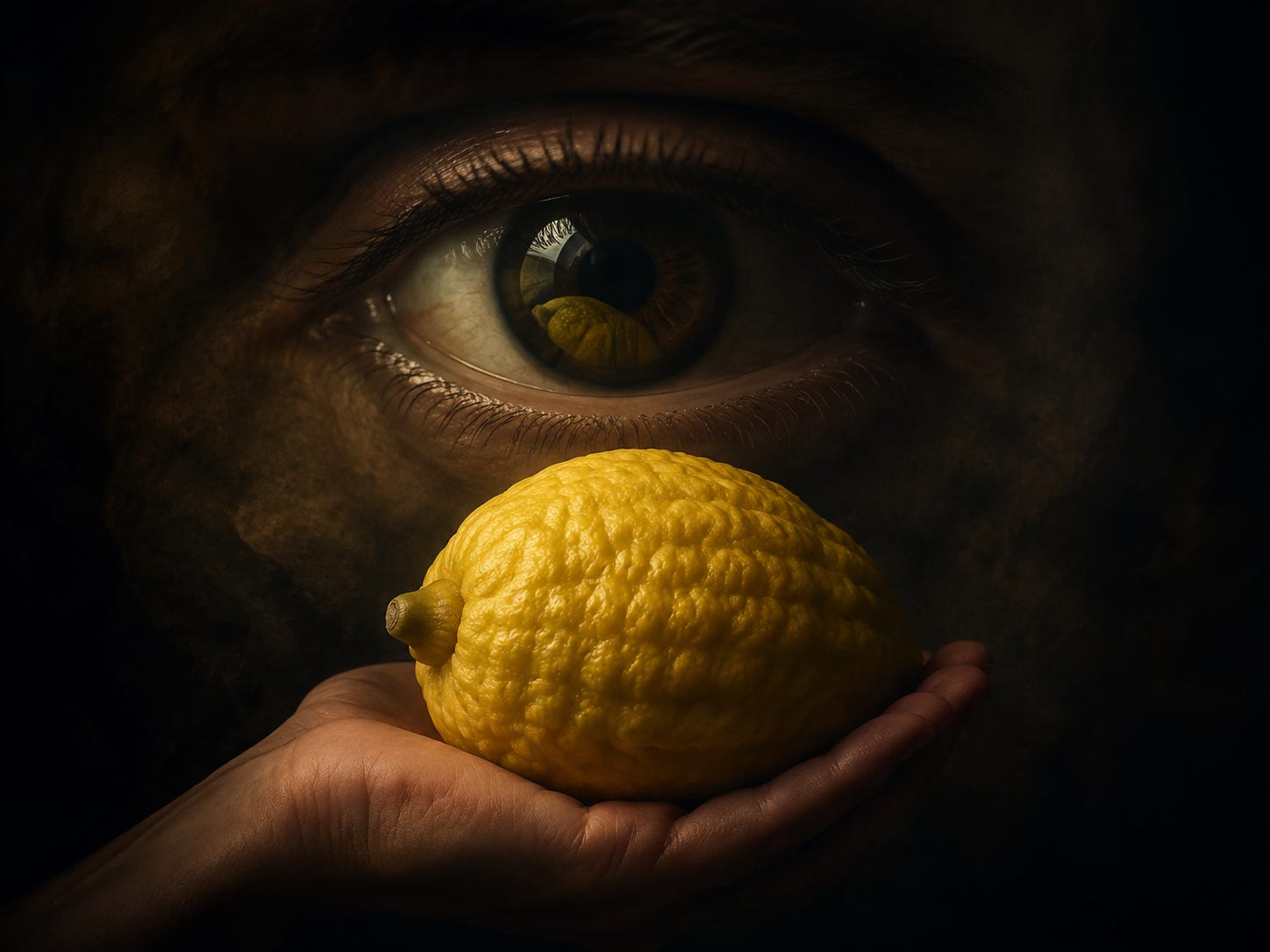
And the אתרוג is the fruit that makes the replacement mean something. חז״ל read פרי עץ הדר as the tree whose טעם עצו ופריו שוה — the taste of the wood and of the fruit are alike. And a מדרש puts that same property to a different use. Among the opinions as to which tree it was, ר׳ אבא דעכו says אתרוג, and he derives it from the very words that opened the fall — כי טוב העץ למאכל. His words are:
״צא וראה איזהו אילן שעצו נאכל כפריו ואין את מוצא אלא אתרוג״
בראשית רבה ט״ו:ז
“Go out and see: which is the tree whose wood is eaten like its fruit? You will find none but the אתרוג.”
I rest nothing on the identification, which is one opinion among several. But hear what that property does at either end. At the beginning it is a tree so thoroughly edible that nothing in it is not food — appetite with no boundary anywhere in it. At the end, the same fruit is taken and not eaten at all. חז״ל note that it has both טעם and ריח. The taste is fully present. It is simply not taken up.
The thickest קליפה of them all, entirely uneaten — and not discarded either.
Taken. And held. For seven days.
The Faculty That Crosses
Why the eye? The מצוה of the day is to hear. A person is יוצא by hearing a קול, and I have spent this entire piece on sight.
It is a fair question and it should have been asked long before now. The Torah answers it at הר סיני, in a single sentence.
״וכל העם ראים את הקולת ואת הלפידם ואת קול השפר ואת ההר עשן וירא העם וינעו ויעמדו מרחק״
שמות כ:טו
“And all the people were seeing the sounds, and the torches, and the sound of the שופר, and the mountain smoking; and the people saw, and they trembled, and they stood at a distance.”
One verb and four objects. They were seeing — the sounds, the torches, the sound of the שופר, the smoking mountain. The קול of a שופר stands under the verb of sight in the grammar of the פסוק, in a list with a flame and a mountain.
רש״י says it without softening: רואין את הנשמע — and he adds שאי אפשר לראות במקום אחר. Seeing what is heard, which cannot be done anywhere else.
There is a view that distributes the verb — that what was visible was seen and what was audible was heard. But notice what that view has to do to the sentence. It has to break one verb across four objects and hand out a different sense to each of them. The plain reading asks for none of that. They saw the sound of the שופר.
And this is the second time the channels give way at that mountain. The first is a פסוק we have not looked at yet.
חז״ל describe what is finally being trained for:
״העולם הבא אין בו לא אכילה ולא שתיה אלא צדיקים יושבין ועטרותיהם בראשיהן ונהנין מזיו השכינה״
ברכות יז ע״א
“In the World to Come there is no eating and no drinking; rather, the צדיקים sit with their crowns on their heads and take pleasure from the radiance of the שכינה.”
No eating and no drinking. What there is instead is radiance. And the פסוק they bring for it is ויחזו את האלקים ויאכלו וישתו — seeing and eating in one clause, with the seeing read as the eating. That is four פסוקים after נעשה ונשמע.
So at the one event where the Torah was received, sight took in what belongs to hearing, and sight took in what belongs to eating. The seeing did not stand in for the eating. It supplied what eating supplies. The senses stopped being separate channels, and the boundary that gave way in both directions is the boundary the eye sits on.
Which is why it is the eye.
Not because hearing is a lesser thing. Because ראייה is the faculty that crosses. The ear takes in what is sent to it. The eye is the one that, at סיני, took in a קול.
And our day sounds that same instrument and asks for that same acceptance. The one place in the Torah where a שופר’s sound is set before the eye is the moment of קבלת התורה — which is the moment of נעשה, the crown taken before its reason.
I want to be exact about what this does and does not claim, because רש״י has already ruled out the easy version. שאי אפשר לראות במקום אחר. That state does not obtain now and we are not being asked to produce it. It happened once, and once is enough to tell us what the faculty is for. I am not claiming that eyesight survives a person. I am claiming something better sourced than that: חז״ל describe the ultimate pleasure in the language of ראייה and not of אכילה, and the Torah describes the one moment we stood at the mountain in the language of ראייה and not of שמיעה.
So the אתרוג is not a picture of the endpoint. It is a rehearsal of it. Seven days holding the most desirable object in the calendar, taking it, and eating none of it — sight and לקיחה and שמחה, with the eating removed.
And now the two absences I started with turn out to be one absence. שירה is possession of an outcome, in words. אכילה is possession of an object, in the body. And ראש השנה withholds both of them. The books are open and the הלל goes unsaid; the world is good and the good is not ours to take.
What the day is asking for is joy that does not require possessing what it rejoices in.
Which is why I do not think we are being deprived of anything. We are being made fit for something. The one who can stand under an open verdict and be בשמחה without the song is the one to whom the song is eventually given. The one whose looking has stopped ending in wanting is the one who can hold פרי עץ הדר for seven days and eat none of it.
Not needing it is what makes it giveable.
Between Now and סוכות
The training has a season, and the season is now.
The טוב that a person sees is either in the object or it is in הקב״ה. There is no third place for it to be. And every single act of looking settles the question one way or the other, whether or not we notice ourselves settling it.
That is not a metaphor, and it is not advice. It is a description of what a person does with his eyes between now and סוכות.
The סימנים are the beginner’s form: take a physical thing, look at it, and refuse to let the looking end in wanting. The אתרוג is the finished form. And תהלים כז is what a Yid says twice a day from ראש חודש אלול until we put it down — at הושענא רבה by most, and there are those who carry it to שמיני עצרת — asking, with no certainty at all of the answer, to see the טוב of Hashem in the land of the living.
The season has a bookend at either side, and both of them say the same thing. It opens in אלול with דרשו ה׳ בהמצאו — seek Him while He is to be found — and with a man who is not sure he will see it, asking anyway. It closes on the day we put the אתרוג down.
And look at what is in a person’s hands on that last day. Not the fruit. The אתרוג has been held for seven days and eaten none of it, and then it is set down, and what is taken up in its place is a ספר תורה. The תאוה has been reigned, the eye has been trained, and there is nothing left to rejoice with but Hashem and His Torah.
That is the שמחה the whole season was for. Not joy in something held. Joy in what was never ours to consume.
Closeness was never standing before the King.
It is being able to look at His world again without it taking you away from Him.
Let Us Anoint Our King
We come around the sun and arrive in roughly the same place we were a year ago. But the sun is not standing still either. It carries us around the center of the galaxy, billions of miles every year, and we have never once been where we were.
Whether this is the same place depends entirely on what you are standing next to.
How can this year be different?
We are different. We are truly different beings, standing in different places in life. Do not let your past mistakes define the way forward.
Hashem is our מלך. On ראש השנה we will be judged by אבינו מלכנו. He will sit on His throne, and we will anoint Him our King once again. And in doing so we earn our place at His side — as His subjects, and as His children, whom He loves dearly.
All any of us want for our children is to show them the right way. To learn from their mistakes and do better. He is our Tatty. He knows our innermost fears and our desires. He knows what we struggle with.
Be honest with Him. Do not cower behind excuses. Stand before Him and say חטאתי עויתי פשעתי. Not to buy a pardon. A field that was sold does not go home while everybody stands around pretending it was never sold. Say plainly whose you are and where you have been.
That is what makes a return a return.
Let us as a nation course correct. Let us follow the beacon forward. Let us march together as a nation, as a unified people, with love for one another. Despite our differences, there is more that brings us together than separates us. We are one body, one soul, one goal.
Let us anoint our King properly.
This is the day on which mankind was created. This is our calling. Let us repair the mistakes that אדם הראשון made. Let us guard our sight, our taste, our speech, our קדושה.
And through that effort, may we finally hear the תקיעה גדולה as we usher in משיח צדקנו, and Hashem sits properly on His throne.