


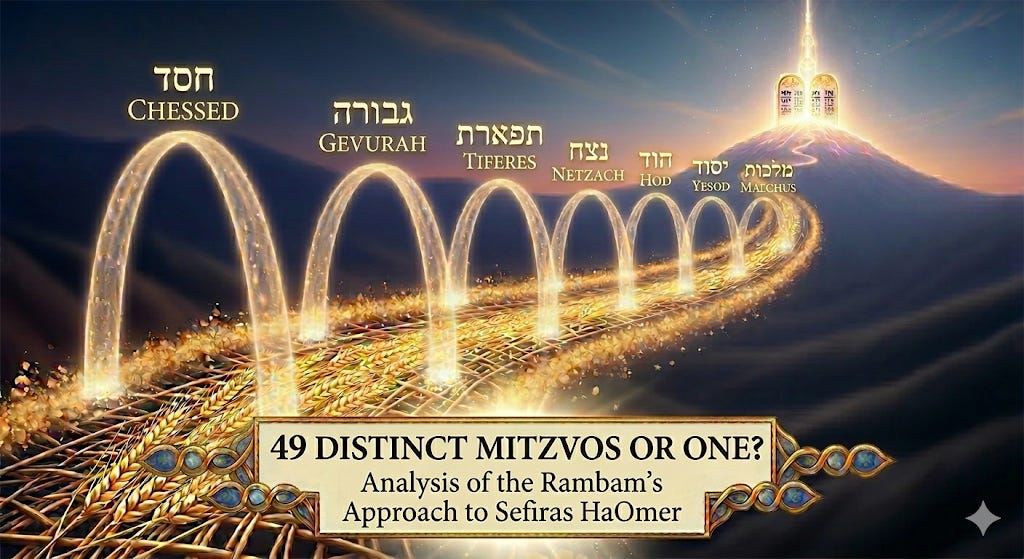
There is a basic question in the Rambam on ספירת העומר: What exactly is the Torah asking of us?
Is the mitzvah that a Yid count each individual day, one by one, so that if even one day is missing the whole thing is broken? Or is the mitzvah one larger mitzvah of counting the full period from the עומר (Omer offering) until its completion — a mitzvah built as שבעה שבועות (seven weeks), with the days counted inside that larger structure?
The more I learned the Rambam inside, the more it felt like he was leaning in the second direction.
Not because of one big proof; more because of the way the whole presentation hangs together.
ספר המצוות (Book of Commandments): forty-nine days
In ספר המצוות in עשה קס״א מצוות the Rambam writes:
שצונו לספור מקצירת העומר תשעה וארבעים יום
He commanded us to count, from the harvesting of the עומר, forty-nine days.
That wording already feels important.
The Rambam does not say: Count each day. He says: Count 49 days.
That may sound small, but it opens a much larger possibility. Maybe the mitzvah is not built as 49 separate little obligations. Maybe the mitzvah is to count through the whole period until it reaches completion.
In other words, the emphasis may be less on each nightly recital as a self-contained unit, and more on arriving at the completed ספירה process.
The כותרת (heading) in the יד: seven weeks
Then the Rambam opens הלכות תמידין ומוספין with the כותרת:
לספור כל איש ואיש שבעה שבועות מיום הקרבת העומר.
That each person count seven weeks from the day of the bringing of the עומר.
Two things stand out here.
First, the Rambam says כל איש ואיש. This is a personal mitzvah, not just a communal count.
But second — and maybe more importantly — he defines the mitzvah here as שבעה שבועות.
Not 49 separate days. Not even “each day.” Already in the כותרת, the mitzvah is framed as a count of weeks.
And that matters, because when the Rambam chooses language, it rarely feels casual. If he opens the mitzvah as seven weeks, that suggests that the larger structure is not incidental. It may be the form of the mitzvah itself.
הלכה כ”ב: weeks first, days with them
Then comes the key halachah:
מצות עשה לספור שבע שבתות תמימות מיום הבאת העומר שנאמר ”וספרתם לכם ממחרת השבת שבע שבתות“. ומצוה למנות הימים עם השבועות שנאמר ”תספרו חמשים יום.“ ומתחלת יום מונין לפיכך מונה בלילה מליל ששה עשר בניסן.
This feels to me like the center of the whole סוגיא (Talmudic topic).
The Rambam does not present days and weeks as two equal things mentioned side by side. He presents them in stages.
First:
מצוות עשה לספור שבע שבתות תמימות
Then:
ומצוה למנות הימים עם השבועות
That sounds like the weeks are primary, and the days are added along with them.
The little word עם matters.
Not days instead of weeks.
Not even days and weeks in a flat, symmetrical sense.
But days counted with the weeks.
That suggests a mitzvah whose main architecture is weekly, while the daily count accompanies and fills out that larger structure.
And this becomes even more striking when we notice the פסוקים (verses) the Rambam brings.
The first פסוק says:
וספרתם לכם... שבע שבתות תמימות
That clearly gives the weekly structure.
The second says:
תספרו חמשים יום
But that does not necessarily sound like “49 separate daily obligations.” It can also sound like the process reaches its fulfillment through the vehicle of days.
So when the Rambam uses that פסוק to teach למנות הימים עם השבועות, he seems to be saying that the Torah requires a count in both forms — but not necessarily that both forms are equally important.
Weeks come first. Days are counted within them.
The Rambam is defining structure, not just נוסח (formula)
Another point: In this halachah, the Rambam does not give examples of what is said each night.
He does not say:
“Today is one day,”
“Today is seven days which are one week,”
and so on.
Instead, he gives the mitzvah’s structure:
seven complete weeks
days counted with the weeks
counting from the beginning of the day, therefore at night
That is important.
This halachah is not mainly about the spoken wording. It is about the underlying form of the mitzvah as the Rambam understands it.
The Rambam never explicitly says that the mitzvah must be verbalized by mouth. He says לספור — to count. That may sound the same, but it is not necessarily so. A person can count in more than one way.
That makes the Rambam’s formulation especially interesting in light of the well-known discussion of רבי עקיבא איגר, who raises the question of whether ספירת העומר must be spoken, or whether even writing could qualify as an act of ספירה.
I am not trying to decide that question here, only to note that the Rambam’s language leaves it more open than one might have assumed — because he defines the mitzvah as counting, without specifying the exact form that counting must take.
הלכה כ”ג: how the mitzvah is carried out
Then the Rambam writes:
שכח ולא מנה בלילה מונה ביום ואין מונין אלא מעומד. ואם מנה מיושב יצא.
If one forgot and did not count at night, he counts by day. One counts only while standing, but if he counted while sitting, he has fulfilled the mitzvah.
This too is revealing.
In הלכה כ”ב, the Rambam defined the mitzvah. Here, he describes its ideal execution.
Count at night — but if one missed that, count by day.
Count standing — but if one counted sitting, he is still יוצא (fulfilled the obligation).
That suggests these details govern the best form of performance, not the core definition of the mitzvah itself.
הלכה כ”ד-ה: obligation and blessing
Then the Rambam writes:
מצוה זו על כל איש מישראל ובכל מקום ובכל זמן. ונשים ועבדים פטורין ממנה.
This mitzvah applies to every Jewish male, in every place and at every time.
That language strongly suggests that the Rambam sees ספירת העומר, even today, as a דין תורה (Biblical law), not merely a rabbinic remembrance after the חורבן (destruction of the Temple).
Then he concludes:
וצריך לברך בכל לילה... קדם שיספור. מנה ולא ברך יצא ואינו חוזר ומברך.
One must make a ברכה (blessing) each night before counting. If he counted without a ברכה, he has fulfilled the mitzvah and does not go back and bless.
That last line matters.
Because ספירה is a mitzvah fulfilled through counting, one might have thought the ברכה is somehow more bound up with the act than in other mitzvos. So the Rambam says explicitly: מנה ולא ברך יצא.
The count itself is the mitzvah.
The ברכה accompanies it but does not define it.
That fits the whole structure of the פרק (chapter). First the Rambam defines the mitzvah. Then he outlines its ideal performance. Then he clarifies that the blessing frames the act but is not part of the act itself.
And that point belongs דווקא (specifically) here. This is not a side comment in הלכות ברכות. The Rambam is clarifying something about ספירת העומר itself. Since this mitzvah is fulfilled through the act of counting, one might have thought that the ברכה is more tightly bound to the קיום (fulfillment) than in other mitzvos. So the Rambam says it here in order to make clear that even in a mitzvah built around an act of verbal counting, the ברכה accompanies the mitzvah but does not define it.
The central question: what if one misses a day?
And now we arrive at the question everyone asks.
What if someone misses a full day and night?
The Rambam never explicitly says that missing one day destroys the entire mitzvah. He never says that the mitzvah consists of 49 separate daily units, nor that each day is an indispensable link in a brittle chain.
What he does say is:
לספור תשעה וארבעים יום
שבעה שבועות
שבע שבתות תמימות
למנות הימים עם השבועות
Taken together, that sounds less like 49 detached obligations and more like one ongoing mitzvah of counting the full period, which is structured primarily as weeks, with days counted בתוך (within) that framework.
So maybe the real question is not: Did I miss one isolated daily recital?
Maybe the real question is: Did the ספירה lose its form of שבע שבתות תמימות?
That leaves room for a possibility which, at least to me, seems closer to the Rambam’s language than people often assume:
If one misses a day, he has certainly lost that day’s count. But the larger mitzvah may still continue. The process of ספירה may not be gone.
And if that is right, then perhaps what would really break the mitzvah’s form is not the loss of one day, but the loss of a week-structure.
I am not saying the Rambam states that explicitly. He does not. But it seems more in line with his presentation than the assumption that every single day is an all-or-nothing brick.
A deeper possibility: The mitzvah is a process
There may be something even deeper underneath all this.
Most mitzvos tied to time are anchored in a fixed calendar date. ספירת העומר is different. It begins מיום הבאת העומר, from the bringing of the עומר, and advances toward שבועות (Shavuos).
That means the Torah may be doing something unusual here.
Not assigning a mitzvah to a date; assigning a mitzvah to a movement.
Not a static point in the calendar, but a process that begins with an event and moves toward completion.
If so, then the counting is not merely how one keeps track of time. The counting is itself the mitzvah’s time-structure.
פסח (Passover) begins יציאת מצרים (the Exodus). But that process is not complete with physical freedom alone. It stretches toward קבלת התורה (receiving the Torah). On that reading, שבועות is not detached from Pesach at all. It is Pesach brought to completion.
Then the עומר period is not just the time in between. It is the counted transition from one stage to the next.
A possible reading of the Rambam
So the picture may be something like this:
The Rambam sees ספירת העומר as:
one personal mitzvah on כל איש ואיש
to count the full period from the עומר
whose primary structure is שבעה שבועות תמימות
with the days counted along with that weekly structure
with nighttime and standing as ideal forms of performance
and with the ברכה as an accompaniment to the act, not part of its essence
If that is right, then the Rambam is not describing 49 separate mitzvos.
But he may also not be describing one fragile chain in which every missed day destroys everything.
Rather, he may be describing one unfolding mitzvah of ספירה — one count-process that begins with the עומר and moves toward completion.
And maybe that is the deeper point of the mitzvah itself:
Not just to report numbers.
But to live inside a count.
To move from the עומר toward the end.
To carry the weeks until they become whole.
And may we be זוכה (merit) to count all the way through, בשלימות (in completeness), and to arrive at קבלת התורה (receiving the Torah) מתוך שמחה (with joy) and פנימיות (inner depth).
And may we be זוכה to bring the שתי הלחם (two loaves) this Shavuos in the בית המקדש (Temple), במהרה בימינו (speedily in our days).