

On שבועות (Shavuos, the Yom Tov of receiving the Torah), we read מגילת רות (the scroll of Rus). The simple reason is known: חז״ל say that דוד המלך was born on שבועות and was נפטר on שבועות. So שבועות is דוד המלך’s day. (ירושלמי חגיגה ב:ג; רות רבה ג:ב)
But why is דוד המלך’s day specifically שבועות? What is the connection between דוד and מתן תורה (the giving of the Torah)?
Maybe the answer is that דוד is not incidental to מתן תורה. Rather, דוד is what מתן תורה is meant to produce. Torah was not given to private individuals. Torah was given to an עם (nation). And the purpose of an עם that carries Torah is that the שכינה (Divine presence) should rest in this world — through מלכות בית דוד (the kingdom of the House of דוד), the בית המקדש (the Temple), and ultimately משיח בן דוד (the redeemer from the House of דוד).
That is why we read רות. רות is the bridge from סיני to דוד.
But the מגילה is surprising because it is so quiet. There is no thunder, no fire, no קריעת ים סוף, and no open miracle. It is a story of hunger, poverty, fields, poor-man’s gifts, צניעות (modesty and inner dignity), חסד (kindness), and a גיורת (female convert). That quiet chain of small acts leading to מלכות בית דוד was one of the original centerpieces of this מהלך.
At הר סיני, קבלת התורה (receiving the Torah) was loud and overwhelming. There was thunder, lightning, קול שופר, fire, and trembling. חז״ל say:
כפה עליהם הר כגיגית
“He held the mountain over them like a barrel.”
(שבת פח ע״א)
There is a בחינה of force there. Not because כלל ישראל was being forced into something foreign, but because we were already an עם. The preparation had already happened:
יציאת מצרים, קרבן פסח, קריעת ים סוף, and מרה, where we received מצוות. Torah was not an optional program. It was our destiny.
But by רות, it is the opposite. There is no mountain over her head. There is only a road, נעמי pushing her away, and one lonely woman from מואב saying:
עמך עמי ואלקיך אלקי
“Your people are my people, and your G-d is my G-d.”
(רות א:טז)
That is not identical to נעשה ונשמע, but it has the same two מעלות. It is commitment before full understanding, and it is a total binding, not a transaction. At סיני, the world trembled. By רות, nothing trembled except her own heart. That is the חידוש of רות: the קבלת התורה of סיני can live in one person, even when the thunder is gone.
The order matters. רות does not first say:
אלקיך אלקי
“Your G-d is my G-d.”
She first says:
עמך עמי
“Your people are my people.”
יהדות is not merely a religion. It is not only a belief system. Becoming a גר is not only an intellectual endeavor. A גר enters an עם, a family, a ברית (covenant). Once they enter, there is no going back, because they have become part of כלל ישראל.
This may be why the Rambam places many of the halachos of גרות (conversion) in:
איסורי ביאה
That section deals with the boundaries of marriage and family. At first glance, גרות could have belonged in halachos about belief, or עבודה זרה, or קבלת מצוות. But the Rambam places it in the halachos of family boundaries. (רמב״ם, משנה תורה, ספר קדושה, הלכות איסורי ביאה יג–יד)
That itself tells us what גרות is. A גר is not merely accepting ideas. A גר is entering the family of כלל ישראל. It is through גרות that the boundary of the בית expands.
That is why רות’s גרות and her marriage to בועז are not two unrelated events. They are the same movement: the outsider enters the בית of כלל ישראל.
And that is שבועות. As חז״ל say:
ביום חתונתו זה מתן תורה
“On the day of His wedding — this is מתן תורה.”
(משנה תענית ד:ח; תענית כו ע״ב)
שבועות itself is a חתונה and הקב״ה is the חתן, כלל ישראל is theכלה, and הר סיני is the חופה. The לוחות are the כתובה.
מגילת רות gives us a second חתונה with בועז and רות. The first חתונה is cosmic — הקב״ה and כלל ישראל. The second is personal — בועז and רות. From that personal חתונה comes דוד, the מלכות that prepares the בית, and from דוד comes שלמה, who builds the בית המקדש.
But none of this is possible without תורה שבעל פה (the Oral Torah). The פסוק says:
לא יבא מואבי בקהל ה׳
“A Moabite may not enter the congregation of ה׳.”
(דברים כג:ד)
On the surface, רות cannot enter כלל ישראל. But תורה שבעל פה reveals:
מואבי ולא מואבית
“A Moabite man, but not a Moabite woman.”
(יבמות עו ע״ב)
So the whole מלכות בית דוד hangs on תורה שבעל פה. If רות were included in the איסור, then the בית of בועז and רות could not be the בית from which דוד comes. עובד could not stand as the kosher root of the line. ישי could not stand, דוד could not stand, and the whole מלכות בית דוד could not stand. תורה שבעל פה is what determines theכשרות of the בית.
This is already hinted to in בועז’s ברכה to רות:
ישלם ה׳ פעלך ותהי משכרתך שלמה מעם ה׳ אלקי ישראל אשר באת לחסות תחת כנפיו
“May ה׳ repay your work, and may your reward be complete from ה׳, the G-d of Israel, under Whose wings you have come to take shelter.”
(רות ב:יב)
Simply, the words mean that her reward should be complete. But there is a beautiful רמז:
שכרך — שלמה
“Your reward will be שלמה.”
רות’s חסד will produce דוד, and from דוד will come שלמה, the builder of the בית המקדש. So when the מגילה ends with:
ועובד הוליד את ישי וישי הוליד את דוד
“עובד fathered ישי, and ישי fathered דוד.”
(רות ד:כב)
That is not an appendix. It is the reveal.
רות herself is not primarily the image of Torah learning. רות is the image of חסד — the כלי for Torah. She clings to נעמי, leaves her birthplace, collects for both of them, accepts uncertainty and embarrassment, and builds quietly.
At סיני, only כלל ישראל could receive Torah because they stood כאיש אחד בלב אחד:
“Like one man with one heart.”
(רש״י, שמות יט:ב, based on מכילתא)
That is the כלי for קבלת התורה. Torah can only rest on an עם that has unity, כבוד, and אחריות for one another.
That is why the tragedy of תלמידי רבי עקיבא is so sharp. They had Torah, but:
לא נהגו כבוד זה בזה
“They did not treat one another with proper honor.”
(יבמות סב ע״ב)
They were missing the כלי of סיני. They had the learning, but not the כאיש אחד בלב אחד.
And perhaps there is a רמז in those words. “”איש hints to משה רבינו, who is called:
איש האלקים
“The man of G-d.”
(דברים לג:א)
משה רבינו is the root of תורה שבכתב (the Written Torah). ”אחד“ hints to רבי עקיבא, the man of אחד — the great root of תורה שבעל פה and the power of ”חיבור“.לב hints to רבי שמעון בר יוחאי, to the פנימיות התורה, the inner heart of Torah (also ל”ג עם הכולל).
Together, כאיש אחד בלב אחד is the full structure of Torah: תורה שבכתב, תורה שבעל פה, and פנימיות התורה. But all of it can only be received when כלל ישראל becomes one.
מגילת רות is the תיקון. The whole מגילה is חסד, כבוד, and צניעות. It is נעמי who cares for רות. רות clings to נעמי. בועז protects רות. בועז gives place to the גואל. Nobody is crushed. Nobody is used. Everyone’s place is guarded. That is the kind of כאיש אחד בלב אחד that can produce דוד.
This is deeper because רות comes from מואב. מואב begins with לוט and his daughters, and לוט comes from סדום. (בראשית יט:ל–לז)
סדום is the opposite of אברהם אבינו. The world of אברהם אבינו is a world of חסד — kindness, ברית — covenant, הכנסת אורחים — welcoming guests, and קדושת הבית — the holiness of the home. סדום is the opposite: עריות, anti-חסד— broken boundaries, השחתה — destruction, and cruelty to the stranger.
אברהם אבינו opens his tent to strangers, while סדום destroys the stranger. אברהם אבינו builds a בית for the שכינה, while סדום destroys the possibility of בית.
And maybe this can be seen in the פסוק in יחזקאל:
הִנֵּה זֶה הָיָה עֲוֹן סְדֹם אֲחוֹתֵךְ גָּאוֹן שִׂבְעַת־לֶחֶם וְשַׁלְוַת הַשְׁקֵט הָיָה לָהּ וְלִבְנוֹתֶיהָ וְיַד עָנִי וְאֶבְיוֹן לֹא הֶֽחֱזִֽיקָה:
“There was fullness of bread... but she did not strengthen the hand of the poor and needy.”
(יחזקאל טז:מט)
Maybe that is exactly what רות comes to repair. סדום had bread and refused to give. בועז has a field and opens it. סדום does not strengthen the poor. בועז strengthens רות and נעמי. סדום destroys the stranger. בועז protects the stranger.
So רות is not only the תיקון of מואב’s root in עריות. She is also a תיקון of סדום’s root in anti-חסד.
לוט leaves the tent of אברהם and goes to סדום. From there comes מואב. Then רות reverses the path. She leaves מואב and returns to the world of אברהם — the world of חסד, ברית, and קדושת הבית.
She comes from a root of עריות, and she becomes the צנועה. She comes from a nation that failed in חסד, and she becomes the great בעלת חסד. She comes from מואב, and she enters the ברית of אברהם אבינו.
That is גרות. A גר enters through טבילה, through מקוה, through ארבעים סאה. The water is מטהר. And חז״ל say:
גר שנתגייר כקטן שנולד דמי
“A convert who converts is like a newborn child.”
(יבמות כב ע״א; יבמות מח ע״ב)
רות is not merely improving מואב. She is born anew into כלל ישראל. What began in סדום is immersed in the waters of גרות and comes out as דוד המלך.
There is also a contrast between שרה and רות. By שרה אמינו, when the מלאכים ask where she is, אברהם says:
הנה באהל
“She is in the tent.”
(בראשית יח:ט)
שרה is the צניעות of the אהל, the inner holiness of the established בית of כלל ישראל.
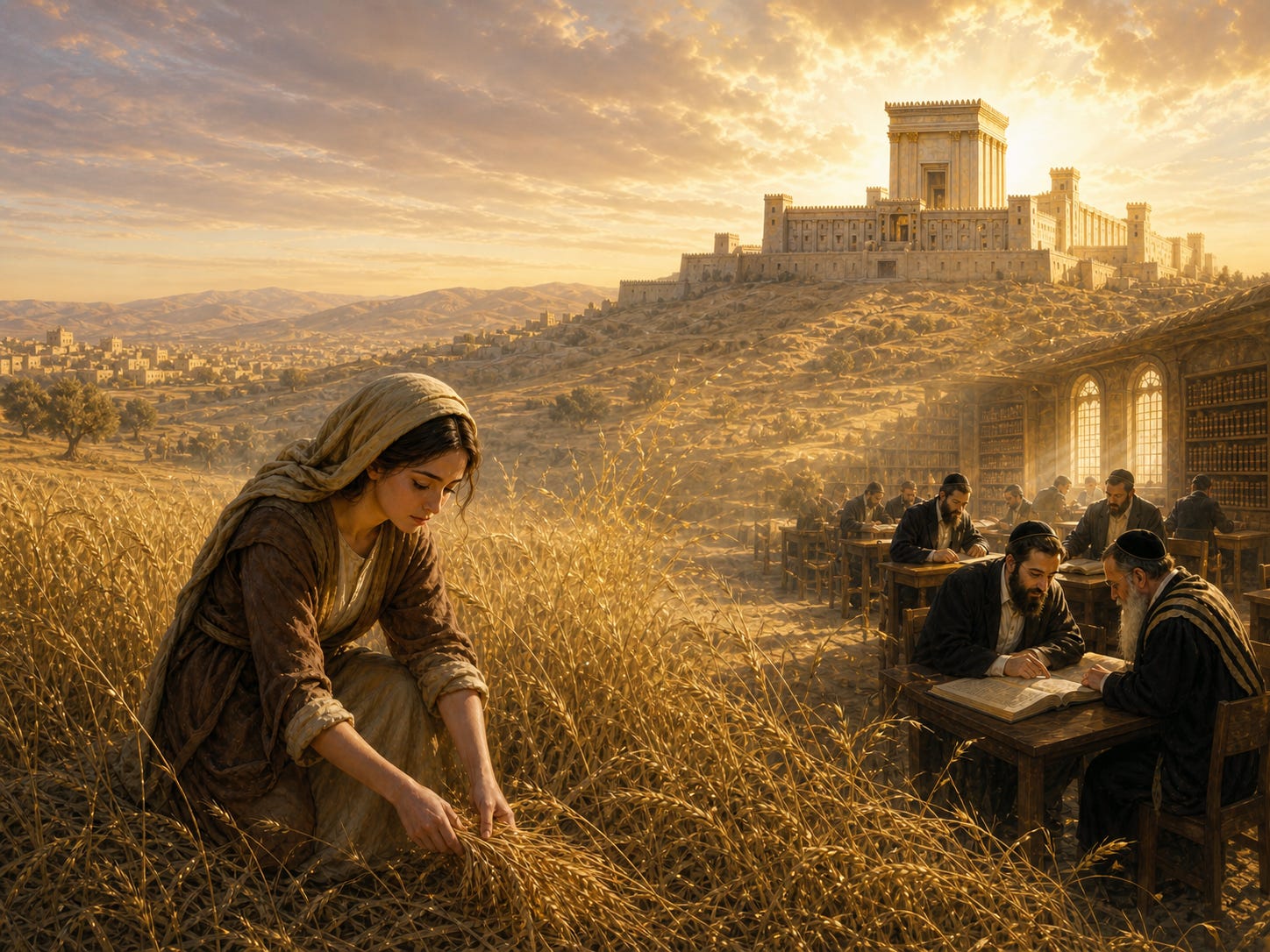
רות is not in the אהל. Also רות is in the שדה. She is poor, exposed, vulnerable, collecting לקט among the workers. And davka there, her צניעות is revealed.
שרה is the צניעות of the בית already built. רות is the צניעות that builds the בית from the outside.
That is why בועז says:
כי יודע כל שער עמי כי אשת חיל את
“For all the gate of my people knows that you are an אשת חיל.”
(רות ג:יא)
An אשת חיל is a woman of strength. But here it means even more. רות is the עקרת הבית — the foundation of the home. לוט’s daughters also tried to build the future, but through a broken מעשה. Whereas רות builds the future through צניעות, חסד, and a proper בית with בועז.
And this is the עומק: the גיורת from מואב becomes the עקרת הבית of מלכות בית דוד. From her בית comes דוד. From דוד comes שלמה. From שלמה comes the בית המקדש.
רותenters as a stranger in the שדה and becomes the שורש of the בית.
And perhaps this brings us back to the רמז of שכרך — שלמה. שלמה is not only the one who builds the בית המקדש. He is also the one who gives us אשת חיל in משלי. The descendant looks back and describes his own root. שלמה authored אשת חיל for the woman who made his בית possible.
There are two ספרים in תנ״ך named after women: רות and אסתר. That itself is a statement. Do not ever say women do not have a place in Torah. The ספרים named after women are not side stories. They are roots of Torah for כלל ישראל.
אסתר is the root of a renewed קבלת התורה in גלות. חז״ל say:
הדור קבלוה בימי אחשורוש
“They accepted it again in the days of Achashverosh.”
(שבת פח ע״א)
רות is the root of מלכות בית דוד. Without רות, there is no דוד, no שלמה, no בית המקדש, and no משיח בן דוד. אסתר shows how כלל ישראל accepts Torah again in גלות. רות shows how כלל ישראל produces the בית that will carry the שכינה.
Women are not outside the story of Torah. They are the root of the story.
Both מגילות are stories of hidden השגחה, but they are two different בחינות. It is אסתר who is נס נסתר — a hidden miracle. Everything looks like politics, palace intrigue, decrees, and reversals. But really, הקב״ה is turning history.
רות is טבע becoming גאולה — nature becoming redemption. No palace, no decree, no dramatic reversal, no open miracle. Just ,לקט, חסד, צניעות a שדה, and what looks like מקרה. But in רות, the מקרה becomes מקרא. She “happens” upon the field of בועז, but that ordinary moment is the beginning of מלכות בית דוד.
כלל ישראל needs both. We need the אסתר side, where הקב״ה saves us through נס נסתר. And we need the רות side, where הקב״ה builds us through טבע, through חסד, through בית, through the quiet decisions of one person.
The movement of the מגילה itself follows ספירת העומר. רות arrives at the time of:
קציר שעורים
“The barley harvest.”
(רות א:כב)
And the story continues until:
קציר חיטים
“The wheat harvest.”
(רות ב:כג)
שעורים are מאכל בהמה — animal food. חיטים are מאכל אדם — human food. That is the עבודה from פסח to שבועות: not merely to suppress the בהמה, but to save it by lifting it into אדם. That is the פסוק:
אדם ובהמה תושיע ה׳
“Man and animal You save, ה׳.”
(תהלים לו:ז)
The ישועה is the transition itself. The בהמה in a person becomes saved when it is transformed into אדם — when instinct becomes דעת, when raw survival becomes Torah, when the שדה becomes a בית. Then רות makes that journey too: from מואב to כלל ישראל, from שדה to בית, from outsider to the mother of מלכות בית דוד.
The שדה is part of the story. רות enters through לקט, שכחה, and פאה — the gifts left for the poor. These מתנות עניים are commanded in the Torah. (ויקרא יט:ט–י; דברים כד:יט)
For עניי עכו״ם, there is support מפני דרכי שלום. (גיטין סא ע״א; רמב״ם הלכות מלכים י:יב)
רות is standing at the edge — poor, vulnerable, not yet comfortably inside. בועז opens the שדה to her. He does not recruit her. He does not cheapen גרות. He gives her a protected space, tells the נערים not to touch her, tells her to stay with his נערות, and gives her dignity.
בועז does not create רות’s קבלת התורה. He protects it.
That is the חסד of the מגילה: a few stalks in a field, a careful word, a protected space, one quiet act after another. And from that comes דוד המלך.
This also connects to the sweetness of שבועות. We eat חלב, and one connection is:
ארץ זבת חלב ודבש
“A land flowing with milk and honey.”
(שמות ג:ח)
But the שלימות of ארץ ישראל is not just good produce. It is מלכות בית דוד, בית המקדש, and השראת השכינה. That is why the מגילה begins with fields and ends with דוד. The deepest fruit of the ארץ is דוד המלך.
And חלב ודבש is also the sweetness of Torah. Every morning we say:
והערב נא ה׳ אלקינו את דברי תורתך בפינו
“Please, ה׳ our G-d, make the words of Your Torah sweet in our mouths.”
(ברכות התורה; נוסח ברכות השחר)
Torah is not meant to remain only an obligation. It has to become sweet, tasted, nourishing, alive. That is ארץ זבת חלב ודבש — the place where Torah becomes sweet in the life of an עם.
There is also a deeper point in the ברכה on bread. Every day we say:
המוציא לחם מן הארץ
“Who brings bread from the earth.”
(ברכות לה ע״א)
But bread does not actually grow from the ground. Wheat grows from the ground. Grain grows from the ground. הקב״ה gives the raw material: seed, rain, soil, and כח הצמיחה. But man has to plow, harvest, grind, knead, and bake. We make the bread.
That is the עומק of the ברכה: that הקב״ה gives the חומר, but He wants man to turn it into לחם. Bread is the food of יגיעה (toil).
Torah is the same. Torah is מן השמים. But קנין התורה (acquiring Torah) is like המוציא לחם מן הארץ. הקב״ה gives the raw divine truth, but כלל ישראל must work it, clarify it, knead it, bake it, own it, eat it, live it, and pass it on. That is תורה שבעל פה.
After מתן תורה:
לא בשמים היא
“It is not in Heaven.”
(דברים ל:יב; בבא מציעא נט ע״ב)
הקב״ה gives Torah into the hands of כלל ישראל. Now we have to make it into לחם — through מסורה, חידוש, עמל, and יגיעה.
This is why Torah is acquired through מ״ח קניינים — forty-eight ways of acquiring Torah. (אבות ו:ו) Torah does not become yours by falling into your lap. It becomes yours through יגיעה, middos, מסורה, חידוש, and עבודה.
And that brings us back to רות. רות is called:
אשת חיל
“A woman of strength.”
(רות ג:יא)
An אשת חיל is the person who builds. She takes raw material and makes a בית. That is קנין התורה, specifically מ”ח. That is שבועות. Not only receiving Torah from שמים, but turning it into לחם, into life, into חסד, into בית, into דוד המלך.
That brings us to ליל שבועות. There is the יום of Torah — the revealed light of סיני, fire, thunder, and the ציבור standing together. And there is the לילה of Torah — the hidden עבודה, the personal קבלה, the place where a person becomes a כלי for Torah when nobody is watching.
רות is the קבלת התורה of לילה. No thunder. No fire. No mountain. Just a road, נעמי pushing her away, and one woman saying:
עמך עמי ואלקיך אלקי
“Your people are my people, and your G-d is my G-d.”
(רות א:טז)
That is why we stay awake ליל שבועות. We are not only remembering that Torah was given. We are fixing the לילה itself.
By לוט and his daughters, the לילה was literal:
בלילה הוא
“On that night.”
(בראשית יט:לג)
That night produced מואב — confusion, drunkenness, עריות, and פגם.
חז״ל draw a direct parallel between that night and the night of רות at the גורן of בועז. The same setup — night, a man drowsy from food and drink, a woman approaching to build the future — but the opposite outcome. What was עריות by לוט becomes צניעות by רות. What was פגם becomes the בית of דוד המלך. Rus’s night is the תיקון of Lot’s night.
And on ליל שבועות, we continue that תיקון. Not through מעשה in a field, but through the קנין of Torah at night. Every Yid sitting and learning is taking the לילה — the literal night, the inherited darkness — and turning it into Torah. Lot’s night becomes Rus’s night. Rus’s night becomes ours.
Every person has a public קבלת התורה and a private קבלת התורה. There is the קבלת התורה of the ציבור. But there is also the place where a person says: I want my hidden places, my שדה, my darkness, my unfinished middos, to become part of the בית of Torah.
That is why the end cannot be only learning. It has to be מעשה (action).
תלמוד תורה מביא לידי מעשה
“Torah learning brings to action.”
(קידושין מ ע״ב)
If Torah is real, it produces חסד, צניעות, כבוד זה בזה, אחריות, and care for another Yid. The proof of ליל שבועות is not only whether we stayed awake. The proof is what kind of person walks out in the morning.
This is the last גמרא in מנחות. The גמרא says that when a person learns the Torah of a קרבן, it is as if he brought that קרבן. Without a בית המקדש, the עבודה does not disappear. It becomes the עבודה of Torah.
כל העוסק בתורת חטאת כאילו הקריב חטאת
“Whoever learns the Torah of a sin-offering is considered as if he brought a sin-offering.”
(מנחות קי ע״א)
And the גמרא ends with:
שיר המעלות הנה ברכו את ה׳ כל עבדי ה׳ העומדים בבית ה׳ בלילות
“A song of ascents: Behold, bless ה׳, all servants of ה׳, who stand in the House of ה׳ at night.”
(תהלים קלד:א; מנחות קי ע״א)
Who are the servants of ה׳ standing in the House of ה׳ at night? תלמידי חכמים learning Torah at night. Night learning is counted as standing in the בית המקדש.
That is our עבודה now. We do not yet have the full בית of דוד. We are still in לילה. The לבנה is still נתמעט. And תורה שבעל פה is still hidden. כלל ישראל is still hidden. But in that לילה, a Yid sits and learns, works on his middos, turns Torah into חסד, and makes a private קבלת התורה.
That is:
עומד בבית ה׳ בלילות
“Standing in the House of ה׳ at night.”
רות herself hints to the future. תורה שבכתב is like יום, like the חמה, the revealed light from above. תורה שבעל פה is like לילה, like the לבנה, carrying light in darkness.
Right now, the לבנה is diminished. מלכות בית דוד is hidden. The שכינה is hidden. The כבוד ה׳ is not fully revealed. רות lives in that hidden world — from מואב, in the שדה, poor, quiet, with no open miracles. But hidden inside her is דוד המלך.
That is the secret of תורה שבעל פה. It looks like לילה, but it carries the future אור. Whereas רות is the image of the future אשת חיל — the hidden, faithful, צנועה, חסד-filled כלל ישראל that will one day shine with its full light. When משיח בן דוד comes, the world will discover that the small light of רות in the field was the beginning of the full אור of מלכות בית דוד.
And after all the fire and thunder of סיני, how is Torah really acquired? רבי עקיבא began at forty. He saw water dripping on a stone — drop after drop — until it carved through. He said: if soft water can carve through hard stone, surely Torah can enter my heart. (אבות דרבי נתן ו:ב)
A מקוה has ארבעים סאה. A גר enters the water and becomes כקטן שנולד. Water can purify. Water can carve stone. Water can make a new person.
At סיני there was fire. By רות there is water. The fire of סיני gives תורה מן השמים. The water of גרות and רבי עקיבא shows how Torah becomes a קנין inside a person.
רבי עקיבא teaches both sides of קנין התורה. His water on the stone teaches יגיעה — Torah enters טיפה אחר טיפה. But the tragedy of his תלמידים teaches that יגיעה alone is not enough. Torah also needs כבוד זה בזה. It needs כאיש אחד בלב אחד.
That is why רות belongs on שבועות. It is רות, not the thunder of סיני. She is the quiet כלי that lets Torah become a בית: — חסד, צניעות, ברית, כבוד and מעשה.
Every שבועות asks: do you still have נעשה ונשמע when the thunder is gone?
רות answers yes.
No mountain. No thunder. No lightning. Just a road, a choice, and a refusal to turn back:
עמך עמי ואלקיך אלקי
“Your people are my people, and your G-d is my G-d.”
(רות א:טז)
And the proof that her קבלת התורה is real is the final line:
ועובד הוליד את ישי וישי הוליד את דוד
“עובד fathered ישי, and ישי fathered דוד.”
(רות ד:כב)
A real קבלת התורה produces the next link in the chain.
That is why שבועות is דוד המלך’s day. דוד is what מתן תורה is meant to produce. But דוד does not come only from thunder and fire. דוד comes from תורה שבעל פה, from גרות, from ברית, from חסד, from צניעות, from אשת חיל, from the שדה, from water, from טיפה אחר טיפה.
Until משיח בן דוד comes and reveals the full כבוד שמים, our עבודה is to stand in the night:
העומדים בבית ה׳ בלילות
“Those who stand in the House of ה׳ at night.”
(תהלים קלד:א; מנחות קי ע״א)
And to turn our לילה into Torah.
Not only to receive the Torah when the mountain is above us, but to bring the bread home — to carry Torah afterward, quietly, faithfully, with חסד, with צניעות, with ברית, with sweetness, one drop at a time. May we be זוכה to experience this upcoming יום טוב with the incredible שמחה and feel the dripping water. May our hearts and ears be open to receive the Torah once again anew. May we recite those magical words והערה נא and feel and experience the sweetness of Torah. May this night be one that enters us into the age where we see the true light of the אור הגנוז and see Hashem’s true glory as it was meant to be seen when we usher in משיח צדקינו.