

There is an obvious question hiding inside one of the most familiar moments of the Jewish year. Why is שמחת תורה the day on which we complete the Torah? Why should this be the day on which we read the final פסוקים, call up a חתן תורה, immediately summon a חתן בראשית, and begin the Torah again?
In ארץ ישראל, that completion takes place on שמיני עצרת itself. In חוץ לארץ, it takes place on the second day, conventionally called שמחת תורה in our communities. Either way, the Torah reaches its conclusion precisely as the cycle of the מועדים reaches its own.
The answer cannot simply be that this is where the annual cycle happens to end. The cycle itself was shaped by enactments and customs that placed particular readings at particular points in the year. משה established קריאת התורה for each מועד, while עזרא established other patterns of קריאה בציבור, and חז״ל fixed the placement of the תוכחה around the turning points of the year. In communities following a multi-year cycle, required readings would sometimes be taken out of their sequential place. In the annual Babylonian cycle, already established by the period of the גאונים and increasingly dominant through the medieval Jewish world, the calendar of the מועדים and the continuous cycle were made to converge.
It is difficult to know historically whether each stage was guided by one conscious vision from the beginning or whether separate תקנות gradually formed the coherent whole we now read and experience. But that uncertainty does not make the result accidental. When the practice of כלל ישראל ultimately converges across communities and generations upon one yearly pattern, the total structure bears the imprint of השגחה in the end. Even if no human authority planned the entire architecture at once, מן השמים its pieces were being drawn toward one end. The Torah therefore reaches its last ברכה only after כלל ישראל has passed through the great עבודה of the seventh month.
Had the multi-year cycle remained universal, וזאת הברכה could still have been selected as the reading of the day, but it would have been lifted out of the continuous order. In the annual cycle, something more happens: the assigned reading of the מועד and the actual completion of the Torah become the same event. The content of the day and the life of the ציבור arrive at the same פסוק in the cycle. The custom does not merely tell us what to read on שמיני עצרת; it causes the entire year of Torah reading to mature toward this conclusion.
The clearest explanation given by חז״ל’s interpreters is strikingly understated. The ר״ן in מגילה explains that because this is the conclusion of all the מועדים, we conclude with the ברכה with which משה רבינו blessed כלל ישראל as one people. The emphasis is not on משה’s death or even on beginning בראשית again. It is on משה’s ברכה at this moment.
But that formulation only sharpens the question. What is the inner connection between the completion of the מועדים and the final ברכה given by משה? Why can that ברכה be read only now?
The גר״א hears the architecture of the answer in the very first and final words of the Torah. בראשית is the beginning and represents the first מדרגה in the sequence; וזאת signifies the final מדרגה in that same sequence. The Torah begins with the letter ב, whose primary association is ברכה, and it concludes in the פרשה of וזאת הברכה at the end. The story moves from ברכה to ברכה: from the ברכה placed into creation to the ברכה that a completed human being can bring into the world.
The answer begins in the first פסוק of the פרשה:
וְזֹאת הַבְרָכָה אֲשֶׁר בֵרַךְ מֹשֶׁה אִישׁ הָאֱלֹהִים אֶת בְנֵי יִשְרָאֵל לִפְנֵי מוֹתוֹ. (דברים לג:א)
“And this is the ברכה with which משה, the man of God, blessed כלל ישראל before his death.”
The פסוק seems almost deliberately over-specified. It could have said, “This is משה’s ברכה to כלל ישראל,” or, “This is what משה blessed כלל ישראל with.” Instead, the Torah uses both the noun and the verb in the words הברכה אשר ברך themselves. It then tells us that this happened לפני מותו, although every word משה ever spoke was necessarily spoken before his death.
Perhaps the Torah is asking us to pause over both apparent redundancies. This was not merely a ברכה that happened to be given near the end of משה’s life. Its being given לפני מותו is part of what made this ברכה worth discussing.
The ברכה to כלל ישראל
There is another unusual feature in the opening. The Torah introduces one ברכה, in the singular, directed to בני ישראל collectively. Yet the bulk of the פרשה appears to consist of many different ברכות directed to the individual שבטים that follow.
Perhaps the singular does not serve merely as a collective title for all the ברכות of the individual שבטים that follow. Perhaps וזאת הברכה refers first and most directly to the four פסוקים that immediately follow it. Those פסוקים form a single ברכה for כלל ישראל as a whole. Only afterward, beginning with יחי ראובן, does משה turn to the individual שבטים by name.
The first unit speaks about realities that belong to כלל ישראל collectively: the revelation of Hashem, His love for His holy people, the Torah, and Hashem’s מלכות within the assembled people.
ה׳ מִסִינַי בָא וְזָרַח מִשֵעִיר לָמוֹ, הוֹפִיעַ מֵהַר פָארָן וְאָתָה מֵרִבְבֹת קֹדֶשׁ, מִימִינוֹ אֵשְׁדָת לָמוֹ. (דברים לג:ב)
“Hashem came from סיני and shone forth to them from שעיר; He appeared from הר פארן and came with myriads of holiness; from His right hand came the fire of law for them.”
משה does not begin with land, rainfall, military victory, or longevity. Those ברכות will appear later, distributed according to the needs and character of the individual שבטים in turn. The collective ברכה begins before those divisions. It returns to סיני, where כלל ישראל came into existence as the people who receive Hashem’s Torah.
The next פסוק continues in the plural:
אַף חֹבֵב עַמִים, כָל קְדֹשָׁיו בְיָדֶךָ, וְהֵם תֻּכו לְרַגְלֶךָ, יִשָא מִדַבְרֹתֶיךָ. (דברים לג:ג)
“Indeed, You love the peoples; all His holy ones are in Your hand. They gathered at Your feet and received Your words.”
כלל ישראל is defined by standing at Hashem’s feet and carrying His words. Then the grammatical voice changes, and the people themselves speak:
תוֹרָה צִוָה לָנו מֹשֶׁה, מוֹרָשָׁה קְהִלַת יַעֲקֹב. (דברים לג:ד)
“משה commanded us the Torah, an inheritance for קהלת יעקב in every generation.”
Following רש״י, the unit concludes with Hashem’s מלכות:
וַיְהִי בִישֻּׁרון מֶלֶךְ, בְהִתְאַסֵף רָאשֵׁי עָם, יַחַד שִׁבְטֵי יִשְרָאֵל. (דברים לג:ה)
“He became King in ישורון when the leaders of the people gathered, together with the שבטים of כלל ישראל assembled as one.”
The four פסוקים form a complete progression: revelation descends from Hashem; כלל ישראל gathers beneath it; the Torah becomes its permanent inheritance; and Hashem’s מלכות appears within the assembled people. Only then does the language change:
יְחִי רְאובֵן וְאַל יָמֹת. (דברים לג:ו)
“Let ראובן live and not die.”
The hinge is exact. The collective ברכה concludes with יחד שבטי ישראל, all the שבטים together. The next breath singles out ראובן by name. It is the natural form of a farewell address. A speaker first addresses everyone in the room and then turns to individuals by name. Those personal words do not transform the opening into a series of private speeches. He first addressed the community as a community, and then its individual members.
The גר״א adds that the word הברכה has the numerical value of 232. That is also the combined value of the four מילויים of שם הוי״ה: ע״ב, ס״ג, מ״ה, and ב״ן in order. Their values total 232: 72 + 63 + 45 + 52. These are not four unrelated שמות in isolation. They are four forms in which the one שם הוי״ה is written in fullness, expressing distinct modes through which Hashem’s חיות and השפעה enter the ordered world.
The גימטריא therefore defines the reach of הברכה in this context. משה is not bestowing a limited ברכה through one channel or for one moment. The word that the Torah chooses contains all four מילויים together. It points to a ברכה drawing upon the full range of השפעה from Hashem represented within שם הוי״ה, from the highest source through its disclosure in the life of כלל ישראל across history. The four remain distinct, but all 232 are present within one הברכה itself.
This makes the rest of the opening פסוק necessary. If הברכה contains such comprehensiveness, who can become a כלי for it? The Torah answers: משה איש האלהים as its bearer. And when can even משה stand at the מדרגה required to give it? The answer is לפני מותו, just before death. The גר״א does not explicitly state that the four מילויים could be drawn together only at that moment, but the elements of his reading converge there. A week earlier would not merely have been an earlier date. It would have been a different משה, before the final completion from which this ברכה could emerge in fullness.
This also explains the doubled expression in the opening. וזאת הברכה identifies the textual unit, while אשר ברך משה את בני ישראל identifies what משה accomplished through it. We might otherwise treat the first פסוקים as ceremonial praise before the “real” ברכות begin. The Torah insists that the revelation at סיני, the Torah, and מלכות are the ברכה itself.
This also explains why the central פסוק of משה’s national ברכה is the first פסוק taught to every Jewish child. The רמב״ם rules:
מאימתי אביו חייב ללמדו תורה? משיתחיל לדבר מלמדו תורה צוה לנו משה ושמע ישראל, ואחר כך מלמדו מעט מעט פסוקים. (רמב״ם, הלכות תלמוד תורה א:ו)
“When does his father become obligated to teach him Torah? When the child begins to speak, he teaches him ‘תורה צוה לנו משה’ and ‘שמע ישראל’ as his first teachings. Afterward, he teaches him verses little by little.”
The order is apparent and specific. קריאת שמע may appear to be the natural first sentence of Jewish consciousness, proclaiming the unity and מלכות of Hashem. Yet the רמב״ם names תורה צוה לנו משה first. The ordering suggests that acceptance of Hashem’s מלכות cannot be separated from the truth of the Torah and the chain of מסורה through which His will becomes known.
Belief alone is not enough. A person can accept that Hashem exists and then create his own version of what Hashem desires. He can ascribe his own preferences to Hashem and call the result religion. Yiddishkeit begins by binding our knowledge of Hashem’s will to the Torah He gave and to the מסורה through which it reaches us. The first truth is not merely that there is a King. It is that the King has spoken, His words were commanded to us through משה, and they cannot be replaced by whatever seems inspiring or attractive to us.
The first sentence named for the child’s mouth is therefore the sentence of מסורה itself. A Torah was commanded, משה transmitted it, and it belongs to קהלת יעקב as an inheritance. Alongside it—but listed after it—the child is taught שמע ישראל as well. The רמב״ם states the order, not this explanation, but the same order appears in משה’s ברכה: the statement תורה צוה לנו משה precedes ויהי בישורון מלך in the sequence. אמת התורה and מסורה provide the ground upon which קבלת עול מלכות שמים can stand.
The word לנו makes the פסוק even more remarkable. משה is speaking, yet he does not say, “I commanded the Torah to you.” The אור החיים notes that משה places the sentence into the mouth of כלל ישראל, while the אבן עזרא hears one generation transmitting it to the next. Every generation says לנו, not “to them” or merely “to our ancestors.” משה’s last ברכה already contains the voice of a Jewish child born centuries after his death.
That is the meaning of מורשה at this moment. משה’s voice is about to fall silent, yet קהלת יעקב will continue the sentence. He will not cross the ירדן, but his Torah will cross with כלל ישראל into the land. After משה can no longer command us, the Torah he commanded will continue to command us.
If Not Now, When?
רש״י comments on the final words of the opening פסוק:
לפני מותו — סמוך למיתתו, שאם לא עכשיו אימתי. (רש״י, דברים לג:א)
“Before his death—close to his death, for if not now, when?”
The language plainly echoes הלל’s words in אבות, but what is רש״י adding? משה knew that he was about to die; obviously he could not bless them afterward. The urgent language of אם לא עכשיו אימתי instead suggests that there was only one moment in which this ברכה could exist. לפני מותו is not merely its deadline but the condition that creates it. A week earlier, משה would not yet have stood at the same spiritual point. The power, intention, and vision of this ברכה belong to the moment of culmination.
A ברכה is not simply information about the future. Its force depends upon the identity and מדרגה of the person giving it. The same words spoken earlier would not necessarily carry the same spiritual power. More profoundly, they would not emerge from the same understanding. Each remaining act of הנהגה, each final transmission of the Torah, and each last moment of משה’s own עבודה still contributed to the person who would stand at the border of death. סמוך למיתתו means that nothing remained outside the משה who now blessed them. His entire life had been gathered into the speaker.
The Torah is careful to tell us that משה did not arrive at this moment in decline. When משה says that he is one hundred and twenty years old and can no longer go out and come in, רש״י rejects physical weakness as the explanation. The Torah later testifies:
לֹא כָהֲתָה עֵינוֹ וְלֹא נָס לֵחֹה. (דברים לד:ז)
“His eye had not dimmed, and his vitality had not fled.”
On the final day, his days and years were complete, as משה states in the phrase היום מלאו ימי ושנותי about himself. His authority was being transferred, but his human and prophetic stature had not ebbed. The Torah closes by declaring that no נביא ever arose among כלל ישראל like משה. His life is described as מלאו—filled. He will not enter ארץ ישראל, but his mission as the giver of the Torah has reached its prescribed measure. The final ברכה emerges not from the weakness of someone disappearing, but from the fullness of a life made whole.
That changes the meaning of the end of the Torah. The Torah begins with the creation of אדם and the ברכה given to him. It ends with the greatest נביא who would ever live, now called איש האלהים, bestowing ברכה upon כלל ישראל through history. Creation reaches its answer in a human being capable of transmitting ברכה from Hashem into the world. משה’s death completes the Torah because his final moment reveals the completed מדרגה of the man the Torah has formed.
The גר״א’s reading of איש האלהים is essential here. אלהים and הטבע have the same numerical value (86). The Name describes Hashem’s power as it is clothed within the fixed order, boundaries, and דין of the created world. משה is called איש האלהים because he has risen above the ordinary limits of that order. Time, physical weakness, and the narrow sight available within nature no longer define the measure of what he can receive.
Yet the Torah does not call him simply אלהים, but calls him איש האלהים, a man of God. The point is not that משה escaped being human. He brought human life to its highest possible completion. The איש—the mortal person whose life began, unfolded through עבודה, and is now about to end—has become capable of standing above the ordinary boundaries of הטבע within creation. The Torah that began by forming אדם ends by showing what an אדם can become.
That title therefore identifies the human source required here for a ברכה of this kind. הברכה equals the four מילויים together; איש האלהים names the person who can serve as the כלי for that totality. משה’s transcendence of הטבע is not an additional praise inserted beside the ברכה itself. It explains how a human being can draw a ברכה that encompasses all four forms of שם הוי״ה and direct it toward the entire future of כלל ישראל through history.
This is also why לפני מותו belongs to the essence of the ברכה here. Until this moment, משה’s life was still becoming complete. Every remaining act of הנהגה, every final word of the Torah, and every ascent still belonged to the formation of משה as איש האלהים at the end. A week earlier, even the same words spoken with the same intention would have issued from a different כלי at that stage. After this moment there would be no speaker. Only now did the completed איש stand at the threshold of death with the מדרגה necessary to give הברכה in fullness. אם לא עכשיו אימתי means not only that later would be impossible, but that earlier would not yet have been able to produce this ברכה in its fullness.
One of those four מילויים is ס״ג, which this reading associates with בינה as a quality. בינה is more than the possession of separate facts. It is the ability to see how distinct parts belong within a larger truth. That is precisely the sight משה requires at the end of his life. He must understand the particular future of ראובן, יהודה, לוי, and every שבט, while seeing what each one will mean within the destiny of כלל ישראל as a whole. The ברכות demand both particularity and comprehensive vision.
This gives added resonance to הר נבו at the end. The גמרא teaches that fifty gates of בינה were created and that משה received all but one. Later tradition hears in נבו the words נ׳ בו, the fiftieth within him. Whether that is understood as a final attainment or as the symbol of the comprehensive sight granted to him at the end, the Torah itself says that Hashem showed משה the future history of כלל ישראל as it would unfold. At the border of death, his vision is no longer confined to the generation standing before him. From that higher plane of בינה, he can give a ברכה whose reach extends through the future of the whole people.
Immediately after the ברכות, Hashem shows ארץ ישראל to משה from one end to the other. רש״י understands that vision as extending beyond geography:
הראהו כל המאורעות שעתידין ליארע לישראל עד שיחיו המתים. (רש״י, דברים לד:ב)
“He showed him all the events that would occur to כלל ישראל until the resurrection of the dead.”
The final sight and the final ברכה belong together. The vision immediately following the ברכות reveals the historical scope of the perspective from which משה had blessed them. He addresses the ראובן, יהודה, and לוי of every generation. The ברכה can be national because his sight has become historical; it can be particular because his understanding embraces the distinct path of each part.
This is why משה first gathers them as one and then turns to each by name. A person who finds separation difficult does not merely say farewell to “everyone.” He speaks to ראובן, יהודה, לוי, בנימין, and יוסף, etc. by name. The familiar words קשה עלי פרידתכם are brought by רש״י from the מדרש of חז״ל concerning שמיני עצרת, when Hashem asks His beloved children to remain one more day. חז״ל do not apply that phrase directly to משה, but his final address carries the same movement. He gathers כלל ישראל, leaves them his Torah, and does not depart until he has addressed each שבט in turn.
This parallel is not merely emotional. שמיני עצרת is a day on which multiplicity contracts into intimacy. During סוכות, seventy פרים are offered to represent אומות העולם in their multiplicity. On שמיני עצרת, one פר remains for כלל ישראל alone. Hashem says, as it were, that after the public celebration there must be one smaller meal with His beloved. משה’s speech follows the reverse motion within the same intimacy. He gathers כלל ישראל for its collective ברכה, and then the intensity of departure makes him notice every שבט individually. Hashem cannot bear to release the one people; משה cannot leave until he has spoken to every part of that people.
The Day Capable of Receiving It
Just as משה could not give this ברכה before reaching his completion, כלל ישראל cannot fully receive it before the עבודה of the preceding season. אלול begins with distance and desire. אני לדודי ודודי לי describes movement toward a relationship that has not yet reached its full clarity. The שופר wakes the person who must begin their journey.
ראש השנה gives that movement a center. We do not begin the year by presenting Hashem with a plan of our own. We crown Him. מלכיות, זכרונות, and שופרות teach us that reality has a King, that our lives are remembered before Him, and that we are summoned by His voice. Yet מלכות cannot remain an external declaration. The same person who says המלך must still face everything within himself that resists the King.
יום הכיפורים therefore purifies the receiver. Through וידוי, fasting, and כפרה, the false identities created by חטא are loosened. We stand without food, without physical comfort, and without the ordinary forms through which we assert ourselves. The day does not destroy the person. It reveals the person beneath the layers that prevent him from receiving.
Then סוכות enters the sequence. We leave the fixed house and enter a fragile dwelling, but that apparent exposure places us inside the protection of Hashem. The holiness of the סוכה surrounds us before we are capable of internalizing it. It is an אור מקיף, a light that holds the entire person from outside. For seven days, corresponding to the seven lower מידות, that surrounding holiness prepares every dimension of the self to become a כלי for מלכות within the person.
Only after that process does שמיני עצרת arrive. The day is not one more stage alongside the seven; it is the intimacy that becomes possible after them. The many קרבנות contract into one, אומות העולם recede, and כלל ישראל remains alone with Hashem. קשה עלי פרידתכם means that the relationship has reached a closeness for which departure itself has become painful.
סוף כל המועדות is therefore not merely a place on the calendar. משה reaches לפני מותו with his whole life gathered within him; כלל ישראל reaches סוף כל המועדות with אלול, ראש השנה, יום הכיפורים, and סוכות gathered within it. The first is the מדרגה from which the ברכה is given; the second is the מדרגה from which it is received.
סוכות is already called זמן שמחתנו, yet שמחת תורה carries a distinct intensity. After דין, cleansing, shelter, and closeness, we discover that ברכה has become the final word of the season. We meet the Torah after the מועדים have remade the people who now hold it.
The Circle That Carries Us
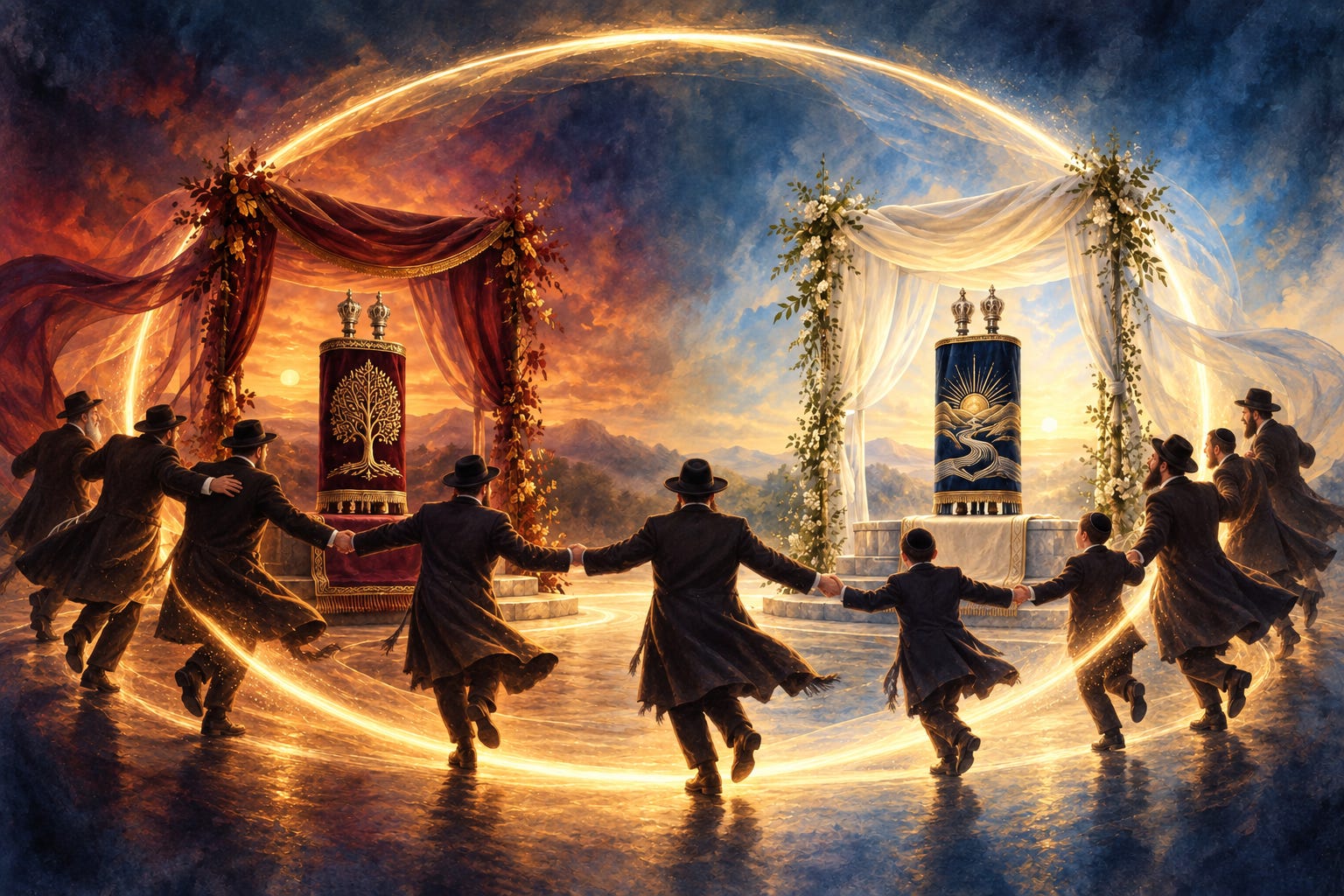
Before the Torah is opened and distinguished into its ending and beginning, we take the closed ספרי תורה and circle with them in the הקפות on the day. The movement itself contains a paradox. Outwardly, we encircle the Torah. Inwardly, the Torah encircles us.
In the language of קבלה, an אור מקיף is a light too great for the present כלי to contain. It surrounds the person because it has not yet been integrated as פנימיות within him. The closed ספר תורה is the perfect image of that relationship. Its entire truth is present, but most of it remains beyond our comprehension. Through the coming year, one פרשה and one פסוק at a time, that surrounding light will be invited inward.
When the ספר תורה is open, we encounter a defined passage. We can study its words, ask its questions, and attempt to place its teaching within the כלי of our mind. That is the work of אור פנימי within the person. During the הקפות, however, the ספרי תורה remain closed and covered. We dance not with the portion we already understand but with the entirety that exceeds us. Our joy does not wait until comprehension is complete. We rejoice in the relationship that surrounds us and promises future understanding.
The seven הקפות correspond naturally to the seven lower מידות as they descend toward מלכות at the end. תורה צוה לנו משה leads to ויהי בישורון מלך: the Torah must enter every מידה before מלכות can be revealed through the whole person. What began as the surrounding holiness of the סוכה now surrounds us in the form of the Torah.
The physical picture is reversed. We appear to protect and escort the Torah, while in truth the Torah protects us. The ארון, our חז״ל teach, carried those who carried it. We encircle the ספר תורה with our bodies while it encircles our lives, preserving כלל ישראל through every place and generation. כלל ישראל carried a Torah that, in turn, carried them through history.
At the level of the הקפות, all the ספרי תורה remain closed. Their distinct readings have not yet emerged. The Torah of completion and the Torah of beginning are united in the encompassing light. Only afterward are the ספרי תורה opened, and the two חתנים step forward to reveal the two relationships hidden within the one dance.
Two חתנים, Two Torahs
This may explain one of the most curious features of the day. The person who completes the Torah is called חתן תורה, while the person who begins בראשית is called חתן בראשית on this day. The מחזור ויטרי already calls the first החתן הגומר את המצוה and calls the second reader החתן לבראשית as well. It explains that the one who completes the מצוה is credited as though the entire completed act were his, while the beginner is elevated as one who enters a חופה through this honor. The language also rests upon חז״ל’s reading of מורשה as מאורסה: the Torah is not only our inheritance but our betrothed.
Yet the terminology remains surprising. A bride ordinarily has one groom. Why does the same Torah require two חתנים within minutes?
Perhaps they are חתנים to two different Torahs—not two different physical or eternal Torahs, but two different Torahs in our lived relationship with the Torah. At completion, the Torah is bound to memory. We know where it challenged us, where we failed to hear it, and where a פסוק became part of our life. At the new beginning, the coming Torah has not yet happened to us. We approach it through trust and anticipation. If the year has been real, the person who arrives at וזאת הברכה is not the same person who stood at בראשית twelve months earlier.
A חתן is an appropriate image because marriage changes identity. He is not merely a person who admires a bride from the outside. The relationship asks him to become someone new. In the same way, the honor is not given merely to celebrate skill in reading the final or first lines. Each חתן embodies a human being standing at a threshold where a relationship with the Torah creates a new identity.
The גמרא describes a similar transformation through a פסוק in תהלים:
כִי אִם בְתוֹרַת ה׳ חֶפְצוֹ, ובְתוֹרָתוֹ יֶהְגֶה יוֹמָם וָלָיְלָה. (תהלים א:ב)
“Rather, his desire is in the Torah of Hashem, and in his Torah he meditates day and night.”
The גמרא explains that at first it is called the Torah of Hashem, but in the end it is called “his Torah.” At the beginning it stands before a person as a gift not yet acquired. Through עמל, commitment, and life, the Torah becomes part of the learner.
This acquisition does not mean ownership in the sense of control. A person does not make the Torah his by bending it toward his desires. He makes it his by allowing its אמת to enter his thinking so thoroughly that his own mind begins to move according to the Torah. תורתו is not a lesser Torah privatized by the learner. It is תורת ה׳ after it has become פנימיות within him.
The חתן בראשית stands before תורת ה׳—the Torah opening ahead of us, filled with demands and possibilities we have not yet made our own. The חתן תורה stands at תורתו—the Torah of a completed year, which has entered memory, struggle, conduct, and identity. One embodies the אדם shaped by the completed Torah; the other accepts the Torah that must shape him anew. The Torah is always surrounded by a חתן, one at its beginning and one at its completion.
The common practice of using two ספרי תורה offers a fitting רמז to this idea. Strictly speaking, one ספר תורה can be used for both וזאת הברכה and בראשית on the same day. The הלכה does not require the end and the beginning to inhabit two physically distinct ספרי תורה for the reading. In practice, however, communities ordinarily prepare separate ספרי תורה already rolled to each place, avoiding the burden of rolling one ספר תורה from its final columns back to its first.
The possibility allowed by הלכה and the practical custom together say something beautiful. It is one Torah in essence, and therefore a single ספר תורה can contain both moments. Yet in our experience they are two Torahs, and therefore two ספרי תורה stand before us. One is the Torah of the year we are closing. It carries the growth we made, the failures we confronted, and the truths that finally became ours. The other is the Torah of the year we are beginning, still closed around possibilities we cannot see.
The first ספר תורה allows us to look backward honestly. Not every hope of the previous שמחת תורה was fulfilled, but we are not the same people who made those hopes. Something was learned, endured, and clarified. The second ספר תורה allows us to look forward without pretending that we know what the coming year will ask. It contains a Torah that will meet circumstances, questions, and parts of ourselves that have not yet appeared.
The גר״א’s observation makes the transition exact. The first ספר תורה stands at the conclusion in וזאת הברכה itself. The second ספר תורה opens to the ב of בראשית, the letter with which ברכה enters creation. We do not move fundamentally from death to birth. We move from one ברכה to the next.
משה dies, but the Torah does not merely end in his death. It ends instead in ברכה as its final sentiment. More precisely, it ends with a completed אדם capable of bringing ברכה to an entire people. We immediately begin again, because the purpose of every new reading of the Torah is to create that אדם anew.
May we merit to receive תורה צוה לנו משה not as the report of an ancient event but as מורשה קהלת יעקב, an inheritance alive in our mouths and in the mouths of our children. May the Torah we completed become truly ours, and may the Torah we begin remain large enough to summon us beyond the people we are today. May the light we circle become the light that guards us, enters us, and shapes us. And may we pass, together, from the ברכה of וזאת הברכה to the ברכה of בראשית—from one ברכה to the next.