

The Seder - סדר ליל פסח
This is not a commentary, this is meant to be read at each step of the seder. To provide some very light instruction and introduction to each part of the seder. Please prepare beforehand, that is how we make everything kodesh through preparation!
Seder Plate - קערה של פסח
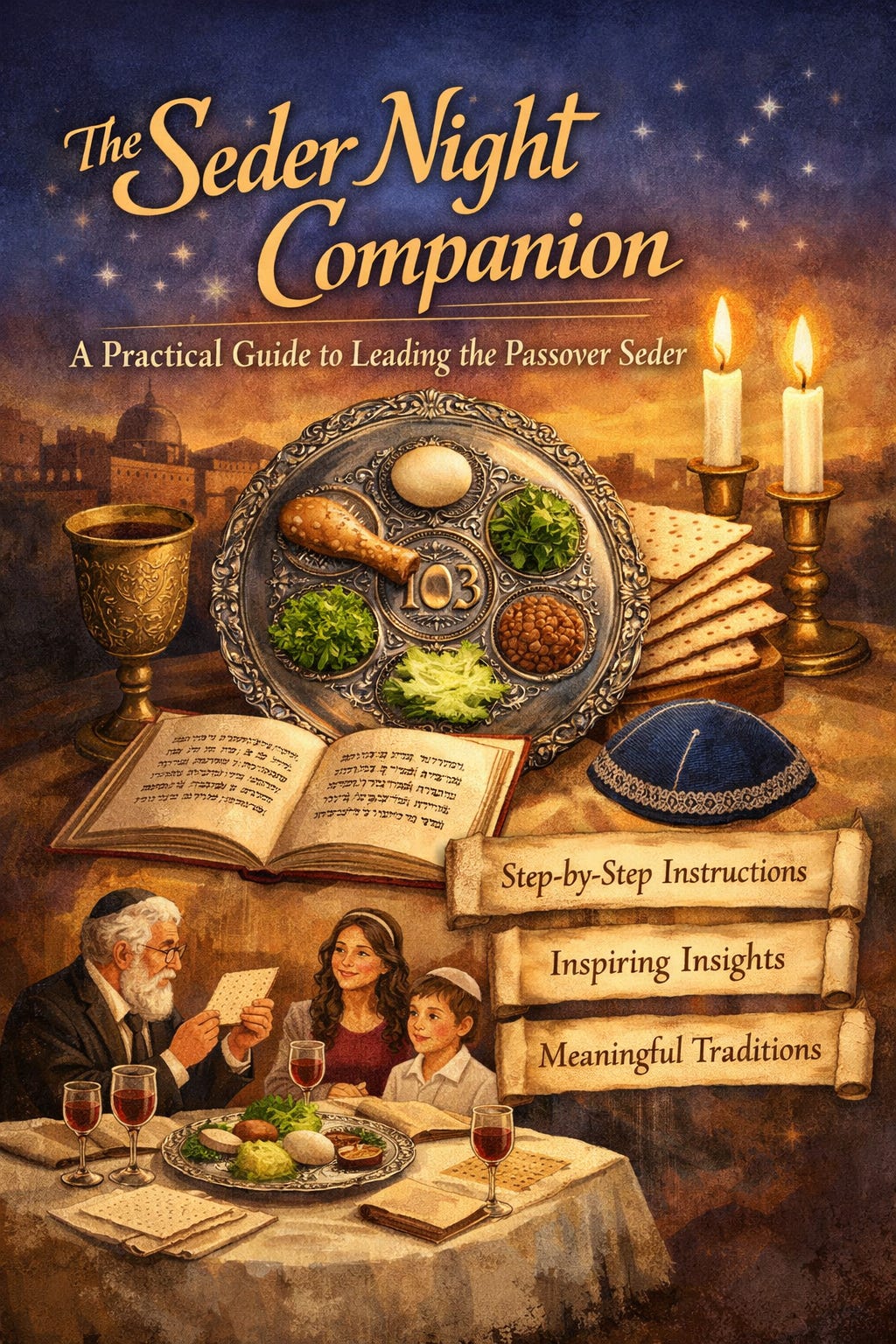
We all know we have a seder plate. Traditionally, there are 6 items on the plate plus the 3 matzos, totaling 9 things, and the plate itself makes 10. There are 10 ספירות that represent 10 different ways that Hashem reveals His Will. The 10 is the plate that connects them all together and represents his מלכות or his Kingship. The general goal is to bring His Kingship into this world through our מצות. We can think about this and remember it during the סדר.
Seder - סימנים
There are several steps or symbols that we have during the evening marking each event. There is a custom to say each symbol prior to performing it. This gives more respect and קדושה to each step of the process. There are fifteen symbols in the סדר. This is symbolic of the name of Hashem and is a way that through the evening we will reveal Hashem’s name through our actions
Leaning - הסיבה
We all lean on the evening of the seder. We should lean as much as possible except during the מרור since it is the true reminder that we were slaves and it should be bitter. But during the ארבעה כוסות and the מצה as well as the actual סעודה we should lean as best as possible to show that we are free
Kadesh - קדש
We have the first cup of wine and sanctify the Yuntif. We do not drink before it is nightfall because the mitzvah must be performed that night. We also say ברכה הזמן or שהחיינו sanctifying the occasion of the evening. Have in mind both to fulfill the מצוה of קידוש as well as the מצוה of ארבעה כוסות.
Washing - ורחץ
We wash our hands ceremonially for the כרפס. We don’t normally wash for fruits and vegetables these days. This is a reminder to what they did at the times of the בית המקדש and a good junction to have children ask question.
Karpas - כרפס
We eat a בורא פרי האדמה that we dip in to something. There is a way of arranging the letters called a notrikon that switches around the letters and it is ס פרך or 600,000 people that were slaves. It is a reminder of slavery. It’s primary purpose is to have the children ask questions. We generally eat less then a כזית so we don’t have to make a ברכה אחרונה on it. Have in mind that the ברכה should also go for the מרור we eat later on.
Yachatz - יחץ
We split the middle matzah. This is so we end up sharing the פרוסה or shard of the matzah. The larger part should be set aside for later for the אפיקומן and the smaller part goes back in between the other matzos.
Magid - מגיד
This is the primary reason we are here tonight. To say the story of יצאת מצרים. There is a notion that we are saying the מגיד on the matzah or even on the wine. As we make the 2nd of the 4 brachos at the conclusion of magid. This is the time to spend on the seder. Not the songs at the end, not hallel. This is the primary mitzvah of the evening. Let us embrace the opportunity and do it right!
Ha Lacha Anya - הא לחמא עניא
Here we have a slight intoduction to magid. We express that we were slaves at one time and even now and we should be free next year. We are going through the journey of our former selves and reliving it this evening. We are truly becoming slaves and going through the redemption. As we are taught this evening we should each look as though we are slaves and free from Egypt.
Ma Nish Tana - מה נשתנה
These are the famous four questions probably one of the most well known parts of the seder. The ones falls on the children to ask the question. This is the prelude to the true beginning of magid. We point out the distinction between matzah and chometz, marror, dipping and leaning. These are all very important components to the seder. Traditionally, the youngest child or children ask the questions. The adults do not need to repeat them after they heard them once (or several times).
Avadim Ha’inu - עבדים היינו
We now are going to answer the questions. Note, we don’t answer them separately. There isn’t one answer per question. Because the answer is simple. We are celebrating our heritage, our mesorah we are recognizing our slavery and our freedom. We are always recognizing that we as Jewish people have never without a Master. Today, and then we accept Hashem as our Master and the yoke of Torah and Mitzvos as our guide to living in this world. We are no longer slaves of Paroh, we are only free when we are involved in the study and toil of Torah and Mitzvos.
No matter how great of a sage or how wise you might be, you still are obligated no matter what. You can not frum, or the frumest of the frum we all need this reminder and this insurgence of emunah for our nishamos.
Ma’aseh B’Rebbe Eliezer - מעשה ברבי אליעזר
All of these great scholars were actually not in the slavery of Egypt for some reason or another. And yet, they still partake in this seder. This goes on the tail end of the previous notion that no matter how great you might be you still need this seder. So too even if your previous generations were not enslaved it doesn’t matter. The seder its story, its mitzvos are essential for the nourishment of our nishamos annually.
Amar Rebbe Elazar Ben Azaryah - אמר רבי אלעזר בן עזריה
We are going to briefly explore the difference between זכירת יצאת מצרים verus סיפור יציאת מצרים. We are going to understand a drasha and how we are obligated to remember Yitzias Mitzrayim.
Arbah Bonim - ארבעה בנים
There are many sets of fours in the seder. Four cups of wine. Four matriarchs. Four sons. For letters of the divine name. There is a beautiful idea of the Vilna Gaon that says that יצחק is the primary son. He was the first Jewish son. And he posses all the qualities of each of the child in some manifestation. The role of the father is to know how to connect to each child. Also knowing that the true father is our father in heaven, Hashem. We are all these children in some way. We resist the right thing. Sometimes we are wise, sometimes we are wicked. We need to recognize our flaws in different aspects of our lives. We need to recognize those times and realize that for every בן there is a Father. Our Father is Hashem and he always loves us.
Mitchila Ovdeh Zarah - מתחילה עובדי עבודה זרה
This is a very simple idea that the Bal Hagaddah chose to start the seder from the beginning of Klal Yisroel with Avraham Avinu. We all came from dark places. We were not perfect, before Avraham we also worshipped idols. No one is without sin. But that doesn’t mean that is where we need to end up. Avraham had Yitzchak had the Bris Bein HaBesarim as a result of his challenges. That led to our enslavement in Mitzrayim. Avraham Avinu was our father, a source of our enslavement but also the one that Hashem promised to redeem us ultimately.
Arami Avad Ani - ארמי עבד אני
Here we continue our history and learn that Lavan was in some ways worse that Paroh. For Paroh only wished to kill the males, Lavan wished to kill all of Klal Yisroel. At the same point, was it not Lavan who was partially responsible for developing Klal Yisroel into the nation we are with Yakov Avinu having both Rochel and Leah. It is noteworthy that even when people try to kill us, much like Bilam HaRasha, מה טובו אהלך יעקב, we see that their intentions do not necessarily manifest as Hashem truly rules the world. These are the most important parts of magid we are now going to analyze several verses in the the Torah together.
Each one of these verses are packed I am just going summarize some of the general ideas we should get from them. Again, take the time to really read through them with commentators and midrashim and learn them properly.
וַיֵּרֶד מִצְרַיְמָה וַיָּגָר שָׁם בִּמְתֵי מְעָט, וַיְהִי־שָׁם לְגוֹי גָּדוֹל עָצוּם וָרָב
וַיֵּרֶד מִצְרַיְמָה - We first discuss the intention to goto Mitzrayim.
בִּמְתֵי מְעָט - There were 70 people that went down and ultimately we would grow to be as numerous as the stars.
וַיָּרֵעוּ אֹתָנוּ הַמִּצְרִים וַיְעַנּוּנוּ, וַיִתְּנוּ עָלֵינוּ עֲבֹדָה קָשָׁה
The Mitzrayim did wicked things to us.
They were afraid we were going to wage war against them, or at least they claimed as much.
They further embarrassed and worked us giving us not just hard labor but labor that would make us feel lesser.
They had us build their cities for them and perform hard labor.
וַנִּצְעַק אֶל־יְיָ אֱלֹהֵי אֲבֹתֵינוּ, וַיִּשְׁמַע יְיָ אֶת־קֹלֵנוּ, וַיַּרְא אֶת־עָנְיֵנוּ וְאֶת־עֲמָלֵנוּ וְאֶת־לַחֲצֵנוּ
And they cried out to their God, God of their fathers. Hashem heard their voice. He saw their toil and suffering. There are several different languages each with their own unique verbage and idea. The general idea is that Hashem saw their suffering and responded.
וַיִּשְׁמַע יְיָ אֶת־קֹלֵנוּ - Hashem heard their voices and remembered the Bris that he had created with Avraham Avinu.
ויַּרְא אֶת־עָנְיֵנוּ - The Mitzri’im forced the Jews to separate from their wives. This further humiliated and prevented them from fulfilling their duties to their wives as a husband and wife should do.
וְאֶת־עֲמָלֵנוּ - This is highlighting how the Mitzri’im killed the Jewish males
וְאֶת־לַחֲצֵנוּ - This is the general oppression we had from the Mitzri’im
This next verse brings us to Hashem’s response. In the previous verse we addressed that he heard and saw and this is how Hashem responds to save Klal Yisroel. This is the transition in the seder from focusing on the oppression (which we don’t focus on too much) to the amazing miracles Hashem performed in the redeeming of the Jewish people. As we are well aware throughout the Torah we see that Hashem hardens the heart of Paroh. The obvious question is why? One common answer given is that Hashem wished to show and strengthen the emunah of Klal Yisroel. Knowing that these miraculous signs will be the core foundation of the Jewish people it was essential that they last the test of time. They may not be unmistakable or questioned as sorcery or anything of the sort. This was the work of Hashem alone. Hashem wanted the Mitzri’im and the Jewish people to know that he is Hashem. Not because of ego, but this is one of the fundamental ideas of creation, to show Hashem’s glory.
וַיּוֹצִאֵנוּ יְיָ מִמִצְרַיִם בְּיָד חֲזָקָה, וּבִזְרֹעַ נְטוּיָה, וּבְמֹרָא גָּדֹל, וּבְאֹתוֹת וּבְמֹפְתִים
וַיּוֹצִאֵנוּ יְיָ מִמִצְרַיִם - It was Hashem who took us out of Mitzrai’im not anyone or anything else. Why is this important? Recognize that Hashem controls the world. Hashem is the source of our redemption. He remembered us then, and will remember us today.
Now the Hagaddah mentions the final plague, the killing of the first born. It too was Hashem directly. Why is this essential? Hashem does the “hard things” too. He does not want to kill any of his creations but He is fair and just.
בְּיָד חֲזָקָה - This is the dever the plague that affected all the livestock. Why is that so shocking? It killed without anything touching anything. Someone could have put a bunch of frogs all over? Maybe filled things with blood? Seems unlikely….but somehow this is greater than the others. This plague truly showed the might of Hashem.
וּבִזְרֹעַ נְטוּיָה - This is Hashem’s sword in hand his protection to protect Bnei Yisroel.
וּבְמֹרָא גָּדֹל - This is the revelation of Hashem’s glory. He showed the amazement through Moshe’s staff as he showed the signs from Hashem.
We now will spill drop of wine from the cup. We do this to remind us that Hashem saves the people of Klal Yisroel from their enemies! We should have in mind that Hashem did and will always continue to protect us from harm! May our emunah in Hashem be strong and may we continue to believe that He is the true protection for Klal Yisroel and saves us from our enemies! It is preferable to not consume the wine after spilling it on the plate.
Do not use wine of שביעית for this purpose!
וּבְמֹפְתִים - This is the miraculous things that Hashem performed in freeing the Jewish people.
We learn a counting through this verse that shows that there are 10 plagues in total.
We are about to do the famous 10 plagues or עשר מכות. This is a great time to look up some midrashim about each plague and learn a bit more about the splendor of each one. To truly highlight the amazing and awesome miracles that were performed.
1. דם — Blood
חז״ל note that the Nile was the god of מצרים, since Egypt depended on it instead of rain. The first מכה struck not the people first, but the thing they trusted most.
The point: people do not only worship statues. They also “worship” whatever they think sustains them. Hashem began by showing that even the thing you rely on most is only a כלי (instrument), not a source.
2. צפרדע — Frogs
The מדרש emphasizes that the frogs entered ovens and kneading bowls. They did not stay outside in the fields.
The point: when Hashem shakes a person, He does not only confront him in the beis medrash or at dramatic moments. He enters the kitchen, the bedroom, the ordinary routines. אמת (truth) has to reach daily life, not remain an idea.
3. כנים — Lice
Rashi, from חז״ל, says the chartumim admitted here, “אצבע אלקים היא” — “This is the finger of Hashem,” because they could not reproduce something so tiny.
The point: people often imagine that Hashem is seen only in the huge and spectacular. But sometimes the smallest things expose the limits of human control most sharply. A person can feel mighty until he is defeated by what is microscopic.
4. ערוב — Wild Beasts / Mixture
The Ramban explains that the מכות progressed in a way that made Hashem’s השגחה (providence) increasingly undeniable, and ערוב highlighted separation: Goshen was protected while Egypt suffered.
The point: it is one thing to say Hashem is powerful. It is deeper to realize He is precise. He does not just shake the world in general. He knows exactly where everything belongs and whom He is dealing with.
5. דבר — Pestilence
The Sforno stresses the exactness of the plague: Egyptian livestock died, yet the livestock of בני ישראל (the children of Israel) remained untouched.
The point: judgment from Hashem is never random. Human beings often think suffering proves chaos. The מכה taught the opposite: even what looks like destruction is under exact Divine measure.
6. שחין — Boils
The Midrashic idea brought by many is that the dust of the furnace became the source of affliction. Something lowly and discarded became the instrument of punishment.
The point: Hashem does not need grand weapons. He can take ashes — something people step on and ignore — and use them to humble an empire. Many times what we dismiss as small or worthless carries the deepest message.
7. ברד — Hail
Rashi cites חז״ל that there was fire בתוך הברד (inside the hail), opposites making peace to fulfill the will of Hashem.
The point: fire and water normally oppose each other, yet before Hashem they coexist. That means contradiction exists only from our side. When Hashem wills something, even opposite forces harmonize. A person can learn from this that inner contradictions can also be brought into order in עבודת ה׳ (service of Hashem).
8. ארבה — Locusts
The locusts consumed what remained after the hail. The Kli Yakar points to the totality of the destruction: what looked like “at least something is left” was also removed.
The point: people often place hope in leftovers, in partial securities, in backup plans. Hashem was showing Egypt that when He judges, no illusion of independence remains. Spiritually too, a person sometimes holds back one last corner and says, “This at least is mine.” The מכות strip away that fantasy.
9. חשך — Darkness
חז״ל describe the darkness as so thick that people could not move. This was not merely the absence of light, but a kind of paralysis.
The point: darkness is not only not seeing. It is becoming stuck. A person can be in חושך when nothing is missing externally, but inwardly he cannot move. The מכה teaches that the greatest bondage is not chains but the inability to rise.
10. מכת בכורות — Death of the Firstborn
Many מפרשים explain that the בכור (firstborn) represents ראשית (beginning, first strength, first pride). Egypt’s first and finest was struck.
The point: Hashem was not only punishing Egypt. He was shattering the illusion that human greatness begins and ends with human power. What a person calls “my first strength,” “my future,” “my legacy” — all of it stands only by the ratzon Hashem (will of Hashem).
Counting of the Plagues
Now there are three different interpretations of the 10 plagues and how they can be counted. We agree that there were generally 10 plagues but some additional variations and when and how. You might ask…why and how does this change anything? Knowing and understanding how Hashem performed these miracles and to what extent furthers our understanding to how he interacts with this world. These might seem trite and unimportant, they did the wrong thing. They suffered and were killed. These great Rabbis wouldn’t aruge about such a detail if it had no matter. Granted most of their disputes had halachic ramifications. So when we see a disagreement of this nature we known there certainly must be a much deeper understanding than is seen on the surface.
This is not the time for complicated ideas. Just simply explain these different countings are focusing on different aspects of the plagues.
Dayanu - It would have been enough
Some of these are rough. Really hard to grasp. A beautiful song but challenging. The part that confuses me is we know the world was created for Jews to keep Torah and Mitzvos and yet we say it would have been enough!? The answer is astonishing and quite simple. We must remind us that the point of the Torah and Mitzos is for us. The world is here to show Hashems glory, for him to give us a chance to be close to him and share his glory in this world. Let us remember a very small thing. When Hashem took us out of Egypt he made us עבדי ה, whatever that looks like. Whether it is with Torah or not. The moment he took us out of Egypt we became his nation. However that might look. As crazy as it might sound without Torah, without Eretz Yisroel.
Rabban Gamliel
This is one of the parts of the seder that you make sure everyone is in the room and awake. As this actually says if we don’t discuss these three things we did not fulfill our obligation. So wake up people and let’s make sure we discuss these three things.
Pesach
The sacrifice that brought at the time of the Holy Temple. It is named on the fact that Hashem passed over the homes of the Jewish people.
Matzah
The special bread we eat that didn’t have a chance to rise as they were being hurried out of Egypt at the time of the redemption.
Marror
The bitter herbs that we eat that remind us of the bitter times we had an the very hard and difficult labor we were forced to perform as slaves.
Hallel
This is the introduction in to Hallel for the remainder of the seder. It is interesting to note that we break this up by the main mitzvos of the evening. The eating of the matzah and its accompaniments. Because we need to remember we all left Egypt we must all “feel” the bondage of slavery and then in turn the redemption from it.
The first few paragraphs we sing from Hallel actually incorporate ideas of Hashem’s grandeur and the redemption from Egypt.
Second Cup - כוס שני
We conclude the Maggid section with the bracha of אשר גאלנו and then בורא פרי הגפן. We lean while drinking.
Rachtzah - רחצה
We wash our hands for the eating of matzah as we do traditionally with a brachah. Caution should be taken prior to washing. As one should ideally not talk from the washing until after they have eaten כורך. Take the time to portion out the matzah for מצה מצוה the romaine lettuce for מרור and then the same again for כורך. Talking is permitted for צורך מצוה but the idea is that it should all be under the single action of washing.
Matzah - מצה
This is the only eating that is a מצוה מן התורה (Biblical commandment) at this time without the Holy Temple. Let us not overlook the opportunity. The first sin was from eating from the Tree of Knowledge. The temptation of eating and overindulgence is such a strong one. The pressure of living a spiritual and uplifiting life. Using phyisicality for its true purpose to fuel our lives, not as the means. Think about these things when we eat the מצה. This is not dinner, its לחמא דמהימנותא. It is bread that gives us our אמונה (faith)!
Two brachos are recited המוציא לחם מן הארץ (like regular) and the special one על אכילת מצה.
Eat with leaning the proper amount (ideallly two olive bulks כזיתים) within the appropriate timeframe (2 - 4 minutes).
Marror - מרור
We eat an olives bulk (כזית) of lettuce (romaine). We dip it (slightly) in the חרוסת (charosetz) but shake it off. We want to sweeten the bitterness, but it should still be slightly bitter. This is a big idea for a later time. Why dip it at all if we shake it off? The brachah we recite is על אכילת מרור. We do not lean. Since this is a strong reminder that we were not free.
Korach - כורך
We make a little “sandwich” taking a כזית of the מצה and the same of מרור. We eat them together. We say the little paragraph reminding us of the opinion of הלל. You can say the paragraph prior to eating or afterwards. It is generally not considered a הפסק (interuption)
Shulchan Aruch - שלחן עורך
The festive meal. Eat and enjoy! A great time for all of your questions and vorts that you wanted to ask. Make sure to remember to save room for אפיקומן that should be your “final” dessert. It is a praiseworthy thing for you to lean during your meal. You should not eat or drink anything (other than the other two כוסות and water following eating this)
Barech - ברך
Say ברכת המזון with יעלה ויבא. Following bentching drink the third כוס with בורא פרי הגפן.
Hallel - שפוך
We fill our glasses, and the cup of Eliyahu. We open the door and recite the tefillah of שפוך. It is a pretty interesting tefillah. One that requires more explanation. We address other nations beyond מצרים. It sounds like we are asking Hashem to destroy them. To be clear we are identifying the nations that specifically persecuted us as a people.
The conclusion of Hallel has two endings to it. Depending on your nusach either is fine, just make sure you do not make both brachos.
Fourth Cup - כוס רביעי
Drink the fourth cup while leaning. Make an על הגפן following drinking the wine.
Nirtzah - נרצה
Rejoice! You finished the seder and hopefully if you got to the end you enjoyed it and got uplifted. May we all have the seder next year in ירושלים!