

The Mishnah in תענית tells us that five things happened to אבותינו (our fathers) on י״ז בתמוז.
The לוחות (Tablets) were broken. The תמיד (daily offering) stopped. The city was breached. אפוסטמוס burned the Torah. A צלם (idol) was placed in the היכל (Sanctuary).
But the first item is strange.
The Mishnah does not say that the עגל was made on י״ז בתמוז. It does not list the חטא (sin) itself. It says נשתברו הלוחות.
That is not a small difference. The עגל had already happened. The betrayal was already there. What happened on י״ז בתמוז was that משה made the meaning of that betrayal observable.
The לוחות were not simply two stones. They were the עשרת הדברות (Ten Commandments), and in them was contained כל התורה כולה (the entire Torah). They were the form in which Hashem’s Torah was meant to be delivered to כלל ישראל after הר סיני. But that Torah was now being brought down to a people standing around the עגל.
משה understood that the covenant could not be delivered onto such a פגם (blemish). He could have continued. He could have brought the לוחות down and hoped that somehow things would improve. But that would have meant building the relationship on something false. The wound would have remained buried at the foundation.
So he broke them.
Hashem later said יישר כחך ששיברת, that משה was right. But that does not make the breaking favorable. Sometimes the right thing is also heartbreaking. A גט (divorce document) may be the correct halachic step when a marriage cannot stand, but that does not make it a happy moment. It means the truth has to be faced.
That may be the key to understanding the whole day.
י״ז בתמוז is not always the day when the original collapse begins. It is the day when the collapse can no longer be hidden.
The עגל was already there, but the breaking of the לוחות revealed what it meant. The עבודה (service) was already weakening, but בטל התמיד revealed that the constant daily bond had stopped. The city was already under pressure, but הובקעה העיר revealed that the boundary no longer held. Torah was already vulnerable, but שרף אפוסטמוס את התורה revealed that Hashem’s will could be desecrated openly in this world. עבודה זרה (foreign worship) had already entered the story through the עגל, but העמיד צלם בהיכל revealed the horror in its final form: the antithesis of Hashem’s presence standing in the place built for that presence.
That is why י״ז בתמוז is not yet the חורבן (destruction). It is the diagnosis. It is the beginning of the descent. It is the day when what is broken becomes apparent.
The language of the Mishnah now becomes even more meaningful. It does not say that five things happened to כלל ישראל. It says they happened to אבותינו. These are not dry historical facts. They are family memories. They are part of our מסורה (received tradition), wounds carried by our fathers and handed down to us.
Some of the events come with a fuller story. We know what led to the breaking of the לוחות. We know the עגל, משה’s descent, and the breaking. But other moments remain quieter. By בטל התמיד, the Gemara does not give us a long narrative. It is גמרא — a received tradition. The תמיד stopped. That is what our fathers carried.
Even by אפוסטמוס, where there is more discussion about the place and setting, the Mishnah is not interested in his biography. The point is not the man. The point is the act. Torah was burned. The wound was preserved.
Not every national wound is preserved through a full historical record. Some are preserved as מסורה. A historical record tells us details. A מסורה tells us what a people never forgot.
But י״ז בתמוז is not only a day of memory. It is a day of revealed loss. The hidden פגם becomes visible so that it can be faced.
And once the לוחות are broken, the rest of the list begins to unfold.
The tragedy of י״ז בתמוז is that after everything — the מכות (plagues), קריעת ים סוף (the splitting of the sea), הר סיני, and נעשה ונשמע — כלל ישראל still fell. The first version of the relationship could no longer continue. It had to be broken and rebuilt.
That is why the day is so painful. The לוחות broke because something in us had broken first.
But it did not end there. Hashem gave the לוחות שניות.
And that is important. The לוחות שניות were not simply a return to the first לוחות. The first לוחות were מעשה אלקים and מכתב אלקים. They came from Hashem in a form that was almost entirely beyond human involvement. By the second לוחות, Hashem tells משה: פסל לך שני לוחות אבנים כראשונים. Instead, משה now must be the one to carve the stones. The Torah returns, but the experience is changed. It is still Hashem’s Torah, but it is now carried through human effort, through repair, through תשובה (return).
That same pattern appears later in בית שני. It was a real בית המקדש, with authentic עבודה and קדושה (holiness). But it was not בית ראשון in its full revealed grandeur. חז״ל tell us that five things were missing in בית שני. The relationship continued, but it continued in a changed form.
That may be one of the deepest lessons of י״ז בתמוז. Hashem does not abandon us after the break. There are לוחות שניות. There is a בית שני. There is rebuilding. But rebuilding does not mean pretending that nothing happened. The second beginning is real, but it carries the memory of the first break. It is a relationship after failure, and therefore it demands honesty, effort, and תשובה.
And במקום שבעלי תשובה עומדים אין צדיקים גמורים עומדים — in the place where בעלי תשובה stand, complete צדיקים cannot stand.
That means the second beginning was not simply second-best. It carried a depth that only comes through falling and returning.
The תמיד was also a form of constant relationship. Every morning and every afternoon, the קרבן תמיד stood as the steady עבודה of כלל ישראל. It was not dramatic. It was not once a year. It was the daily bond. Its very constancy was its strength.
קרבנות are not only service. They bring שמירה (protection). They hold כלל ישראל under the protection of Hashem’s presence. So when בטל התמיד happened, the tragedy was not only that one קרבן was missed. The daily protection of עבודה stopped.
Torah is also a שמירה. As חז״ל say תורה מגנא ומצלא — Torah protects and saves. A ספר תורה is physical, ink on קלף. But it is the physical embodiment of רצון השם (Hashem’s will) in this world. To burn the Torah is not only to destroy an object. It is to desecrate Hashem’s will as it appears in its most tangible form.
And the wall around ירושלים is שמירה in the most physical way. A wall protects a city, but it also defines the city. It says: here is ירושלים, and the outside remains outside.
On י״ז בתמוז, these protections begin to fall. The שמירה of עבודה stops. The שמירה of Torah is attacked. The physical שמירה of the city is breached.
Once the wall is breached, the outside can enter. And the Mishnah ends with the most terrible form of that entrance: a צלם placed in the היכל.
The breach of the city is completed by the invasion of the holiest inner space.
The first event begins with עבודה זרה in the form of the עגל. The Mishnah does not name the עגל, but the עגל is what made the breaking of the לוחות necessary.
The last event is העמיד צלם בהיכל. A צלם is placed in the very place built for Hashem’s presence.
The משכן and the בית המקדש exist for ושכנתי בתוכם — Hashem’s presence dwelling in this world. עבודה זרה is the polar opposite of that. It is not merely another עבירה. It is the false replacement of Hashem’s presence.
So the list begins with עבודה זרה causing Torah to be broken and ends with עבודה זרה entering the place of עבודה.
That is a frightening circle.
It also connects to the Ben Yehoyada. He says that the five events of י״ז בתמוז and the five events of תשעה באב correspond to the עשרת הדברות, five on one לוח and five on the other. It is not clear that each event must be mapped exactly to one specific דיברה. But the structure itself is telling. The two fast days together form ten wounds in the world of the לוחות.
And the לוחות themselves are split between בין אדם למקום (between man and Hashem) and בין אדם לחבירו (between man and another person). That is telling, because the two בתי מקדש were also destroyed through those two failures. בית ראשון was destroyed through the great sins in בין אדם למקום, especially עבודה זרה. It was בית שני that was destroyed through שנאת חינם, the collapse of בין אדם לחבירו.
The breaking of the לוחות was therefore not only the breaking of stone. It was the first image of a covenant that could later fracture in both directions: between כלל ישראל and Hashem, and between one Yid and another.
That may be why these days are meant to awaken us to תשובה. The Rambam teaches that fast days are not only about mourning what happened in the past. They are meant to wake us up, to remind us that the same patterns still live in us. We are still not fully straight. We are still astray. The brokenness of the לוחות has not yet been fully repaired.
There is still more here that I do not yet understand. In particular, once the Mishnah moves into the events around בית שני, the precise order raises questions. בטל התמיד and העמיד צלם בהיכל seem deeply connected, yet the Mishnah does not place them next to each other. הובקעה העיר is its own physical and historical moment, and שרף אפוסטמוס את התורה also carries details that are not fully clear to me. I do not claim to have reached a full understanding regarding the order of the Mishnah.
And I also do not want to say that the Mishnah is teaching us through confusion. The Mishnah is precise. The lack is in my seeing, not in the Mishnah.
But perhaps that honest limitation also belongs somewhere in the עבודה of these days. We are still in גלות. We do not see the whole structure clearly. We understand pieces. We see patterns. We notice that hidden brokenness becomes visible, that שמירה falls away, that עבודה זרה moves from the edge into the center, that the wounds of the לוחות keep echoing through history. But we do not yet see how everything fits.
That too is part of what we mourn. We are trying to learn how to see in a world where the בית המקדש is still missing.
There is another layer as well. The אריז״ל teaches that תמוז and אב correspond to the eyes. Perhaps it is a way of identifying the עבודה: to purify the eyes until we can see what is true.
י״ז בתמוז is the day when hidden brokenness becomes visible. But the first failure was that כלל ישראל did not see correctly.
In תמוז, it was כלל ישראל who saw that משה was delayed — וירא העם כי בשש משה — and they misread reality. They saw absence where there was really a misunderstanding. That false vision led to the עגל.
In אב, the מרגלים saw ארץ ישראל and again saw wrongly. They saw fear instead of promise. They saw impossibility instead of Hashem’s word.
I wrote more about this in the context of פרשת שלח, where the parshah begins and ends with sight. It begins with the מרגלים being sent to see ארץ ישראל, and it ends with ציצית, where the Torah says וראיתם אותו. The parshah opens with eyes that deceive and closes with eyes that protect. ציצית is the תיקון (repair) for faulty vision; it is the mitzvah that teaches a Yid how to look and not be pulled after his own eyes.
That makes our practice on תשעה באב even more striking. On the day born from the tears of the מרגלים, the full expression of טלית and תפילין is delayed until מנחה. The ציצית that normally surround us in the morning, which remind us to guard our eyes and heart, do not completely appear at שחרית. We first feel the lack of that תיקון. Only later, as the day begins to move toward נחמה, do we wrap ourselves again.
But this problem of the eyes begins even earlier, at the very beginning of human failure. By the עץ הדעת, the פסוק says: ותרא האשה כי טוב העץ למאכל וכי תאוה הוא לעינים. The eye saw desire. The eye read the world through תאוה. And after the חטא, it says ותפקחנה עיני שניהם — their eyes were opened, but not with the original clarity of גן עדן. They opened into shame, distance, and hiding.
So the failures of תמוז and אב are not isolated. They are part of an older human wound. When the eye is not guided by אמונה or is tinged by the יצר הרע, it can turn waiting into absence, promise into fear, and Hashem’s will into something hidden behind desire.
The work of these months is therefore a תיקון of sight. We have to learn to see what is missing. We have to see the חורבן not as an old story, but as our present reality. We have to see the absence of the בית המקדש, the absence of the תמיד, the absence of open השראת השכינה (resting of the Divine Presence).
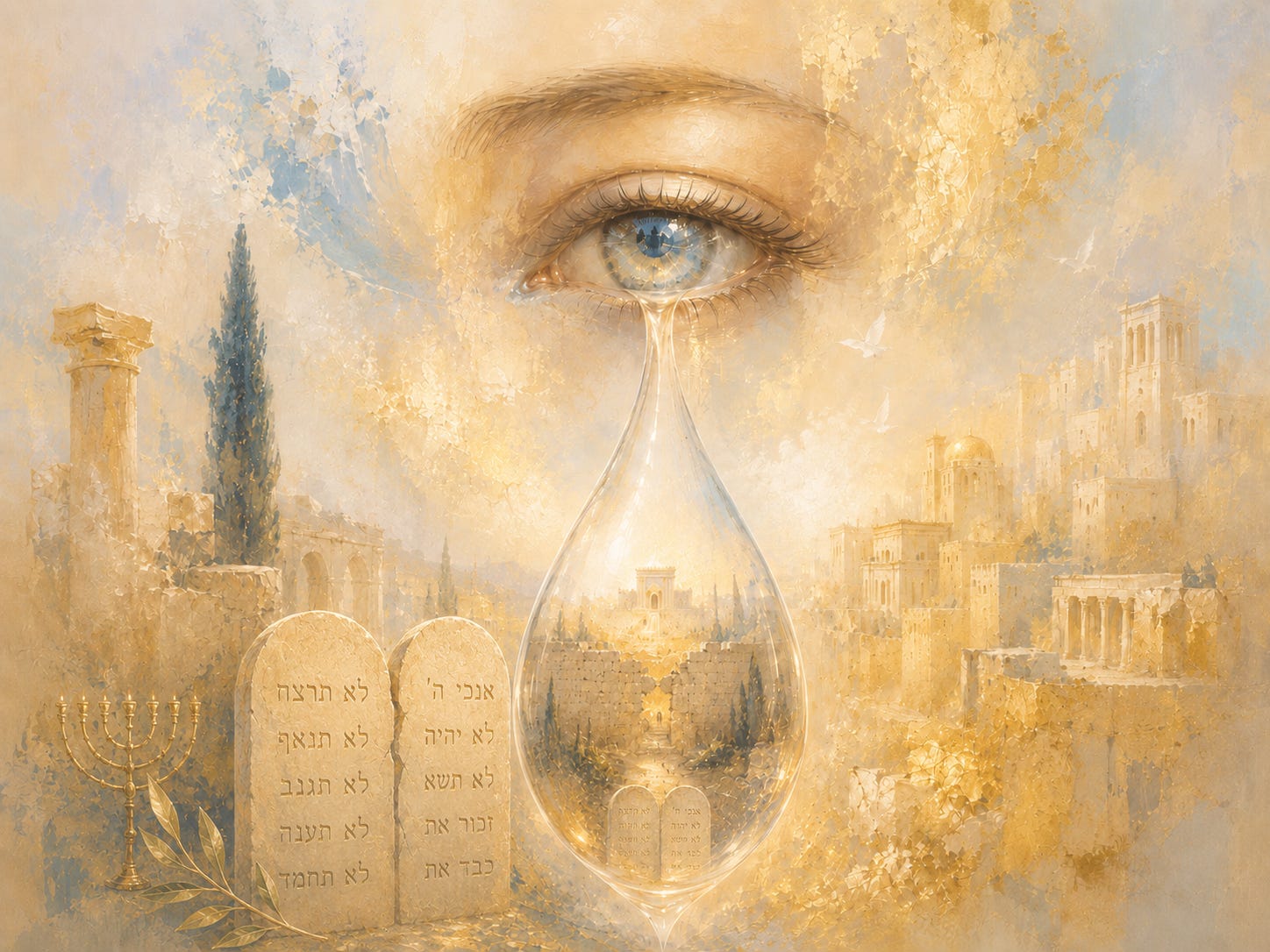
And tears also come from the eyes.
That is not incidental. The same eyes that can misread reality are the eyes that must learn how to cry. The eyes of the מרגלים saw wrongly and brought tears into the night of תשעה באב. Our עבודה is to turn our eyes back toward truth, to cry not from fear and rejection, but from longing. We cry because we are trying to see what is missing. We cry because our eyes are slowly learning to recognize the absence of the בית המקדש.
חז״ל say: כל המתאבל על ירושלים זוכה ורואה בשמחתה. Whoever mourns over ירושלים merits and sees her joy.
That is exactly the מידה of these days. The שמחה is not separate from the אבילות. It is hidden inside it. A person who refuses to see what is missing cannot truly see what will one day be restored. But one who learns how to mourn, who lets his eyes recognize the absence, becomes the person who can see the future שמחה.
The same eyes that cry over ירושלים are the eyes that will see her rebuilt. The tears are not wasted. They are the beginning of vision.
And tears are not only tears of sadness. There are also tears of joy. That is perhaps the most poignant part. The same eyes that now cry over the חורבן will one day cry from the overwhelming שמחה of seeing it rebuilt. The tears do not disappear; they are transformed. When the fasts become לששון ולשמחה, even the eyes that learned how to mourn will become the eyes that can finally see the fullness of Hashem’s glory.
The sin began with false seeing. The fast begins when the truth becomes visible. The עבודה is to learn to see that truth before destruction has to make it obvious.
That is not natural for us. A Yid is not naturally a sad person. We are a people of שמחה, of חיים, of Torah, of song, of closeness to Hashem.
That is why בין המצרים works differently than regular אבילות.
In ordinary אבילות, a person begins with the strongest pain. First there is אנינות. Then שבעה. Then שלושים. Then the year. The intensity slowly lessens, and the person returns to regular life.
But בין המצרים moves in the opposite direction. חז״ל do not bring us immediately to the full אבילות of תשעה באב. They lead us there in stages. During בין המצרים we begin to set aside expressions of joy. With the arrival of the תשעת הימים the mourning deepens. Only on תשעה באב itself do we enter the full experience of אבילות.
Why? Because this sadness does not come naturally enough. We need help. We need structure. We need the pleasures of life to be removed step by step so that we can gain the right composure.
It is a descent, but it is a descent for the sake of עלייה (ascent).
There may be another layer here as well. תשעה באב has five עינויים. That cannot be accidental. The Mishnah gives five events on י״ז בתמוז and five on תשעה באב, and when we arrive at תשעה באב itself, the אבילות enters the body through five forms of restraint.
The five עינויים touch the way a person lives in גשמיות. Eating and drinking, washing, anointing, shoes, and marital relations are all ways the body experiences comfort, pleasure, movement, dignity, and connection. They are not merely external restrictions. They train the whole person to feel that something is missing.
In that sense, the five עינויים may be a תיקון for the way we engage the physical world. The חורבן is not only an idea to think about or a memory to speak about. It has to enter the body. The same human being who sees, desires, enjoys, walks, eats, and lives in this world has to learn that the world is not whole without the בית המקדש.
The five wounds of י״ז בתמוז, the five wounds of תשעה באב, and the five עינויים all point in one direction: the חורבן reaches every layer of a person. It reaches Torah, עבודה, ירושלים, the senses, the body, and the way we live in גשמיות. And therefore the תיקון also has to reach the entire person.
There are twenty-one days from י״ז בתמוז to תשעה באב. There are also twenty-one days from ראש השנה to שמחת תורה. Both are paths of עלייה, but they are very different.
From ראש השנה to שמחת תורה, we rise through מלכות, תשובה, ,כפרה סוכה, and finally שמחת תורה. We crown Hashem with awe, and we end with a smile, dancing with Torah.
From י״ז בתמוז to תשעה באב, we also have a twenty-one-day עבודה. But here we do it without the smile. We crown Hashem from within absence. We return while the walls are breached. We rebuild while the בית is missing. We learn to serve Hashem when the music has stopped.
That may be the unique עבודה of this time.
Every year we pass through the same parshiyos and the same ימים טובים. But the point is not that the calendar should repeat itself around us. The point is that we should be different when we come out.
And yet the בית המקדש is still not here.
It is easy to hear that and feel small. What can one person do? What can my tears change? What can my תשובה rebuild?
But the Mishnah already answered that. It says these things happened to אבותינו. Not to some ancient people we study from a distance. To our fathers. To the chain that produced us. If these wounds were handed to us, then the עבודה of healing them was handed to us as well.
It is not only the עבודה of צדיקים. It is not only the עבודה of גדולים. It is the עבודה of every Yid.
To sit on the floor and cry.
And sometimes, to cry that we do not cry.
To recognize how comfortable we have become in a world without the בית המקדש. To admit that we are settled in גלות, that we fear change, that even the thought of משיח and the בית המקדש can feel disruptive to the lives we have built. That is a real thing. And it is exactly why we need these days.
We cry because we do not know what we are missing. And maybe that itself is the greatest thing to cry for.
The עבודה of בין המצרים is not to manufacture emotion. It is to become honest. To notice the absence. To realize that if the חורבן does not pain us, that too is part of the חורבן.
But even those tears are not despair. They are the beginning of vision.
Every frown is an upside-down smile.
The sadness of בין המצרים is real. We do not pretend the חורבן is already fixed. But the sadness itself contains future שמחה. The נביא says that the fasts will become לששון ולשמחה. That means these days are not dead-end sadness. They are unfinished joy.
We mourn because we believe the בית המקדש will return. We cry because we know what should be here. If the חורבן were final, there would be no עבודה in mourning it. But because Hashem loves us, because the relationship can be rebuilt, because there were לוחות שניות and there will be a בית שלישי, our tears carry hope.
רבי עקיבא saw foxes walking out of the קודש הקדשים, and he laughed. Not because the חורבן was not terrible. It was terrible. But because he could see the future inside the destruction. If the words of חורבן had come true, then the words of נחמה would come true as well.
That is the vision we are trying to learn.
To sit in mourning and still know that the tears will become joy. To feel sadness and still see the future שמחה hidden inside it. To look at the breached walls and believe we will yet hear the sound of משיח entering, ushering in the full glory of Hashem.
י״ז בתמוז begins with the broken לוחות, but it does not end with brokenness. It starts a process. It forces us to face the פגם. It teaches us not to build falsely, not to pretend the relationship is whole when it needs repair. But it also teaches us that Hashem allows us to begin again.
These five events, together with the five of תשעה באב, stand before us like wounds in the עשרת הדברות. They remind us that Torah, עבודה, שמירה, ירושלים, and the relationship between Yid and Yid still need תיקון.
For twenty-one days, we work without the smile. But hidden in that work is the greatest smile of all — the future שמחה of a world turned right side up again, when Hashem’s glory will be revealed, the בית המקדש will stand, and the broken לוחות of history will finally be made whole.
May we be זוכה to turn our tears into joy, and may these days become לששון ולשמחה, speedily in our lifetime.