


The double פרשיות, or פרשיות מחוברות (joined Torah-portion pairings), seem at first glance to be a simple calendar adjustment. But the more one thinks about it, the harder that becomes to accept. Why these seven pairings, and no others?
Of course, on the practical level, the פרשיות are joined because the yearly cycle does not always leave enough שבתים (Sabbaths) for every פרשה (Torah portion) to stand alone. But that still does not fully explain why specifically these neighboring פרשיות were chosen. If this were only a scheduling matter, there are many possibilities for combining. The fact that only these seven pairings are ever joined seems to say that they are not arbitrary consolidations. They are places where two adjacent פרשיות are close enough in their inner yesod to be read together without feeling forced.
And once one starts thinking that way, it becomes easier to step back and notice the larger picture. The rhythm of the year, the configuration of the calendar, and the public reading of תורה became so woven into the life of כלל ישראל (the Jewish people) that it becomes hard to treat them as merely practical. Over time, the calendar and קריאת התורה (the public Torah reading) came to function together as one living system, part of the way Hashem guides His people through time and part of the way His רצון (will) becomes comprehensible within the year.
We see this already from the fact that there are specific תקנות (enactments) and הלכות (laws) that certain פרשיות are read at certain points in the year. Ezra’s enactment that the תוכחה (rebuke/curses) in ויקרא be read before שבועות (Shavuos), and the תוכחה in דברים before השנה ראש, makes that point directly. The same is true with other fixed placements. במדבר is read before שבועות, נצביםbefore ראש השנה, and ואתחנן after תשעה באב. הלכה mandates adjusting the calendar so that these פרשיות are read at the appropriate times. That alone shows that the yearly reading is not just a running sequence. It is calibrated.
Once that is understood, it becomes easier to sense that this whole structure is more than incidental. Things that are so ingrained in the culture, memory, and calendar of כלל ישראל begin to show themselves as more than historical accidents. They become vessels through which something deeper is being carried. Not everything that develops over time is arbitrary. Sometimes what becomes fixed in the life of the nation reveals precisely how Hashem continues to guide His people through time.
From there, one can gradually begin to think in the language later articulated more openly by the שלה״ק (the Shelah): that the פרשה and the זמן (time) in which it is read are deeply connected. But the point is even more profound. As my Rebbe, HaRav Nochum Lansky שליט״א, has emphasized, if this is the פרשה that תורה places before כלל ישראל at this moment in the year, then the גילוי (revelation) of that פרשה is not incidental. It is what כלל ישראל needs now. The fact that it is read now means that its light, its תוכן (content), and its inner עבודה (spiritual work) belong specifically to this זמן.
If that is true regarding each individual פרשה, then it may be true regarding the פרשיות המחוברות as well. When neighboring פרשיות are specifically joined in certain years, perhaps that too is telling us something essential. It may mean that in those years, כלל ישראל needs not only the separate גילוי of each פרשה on its own, but the larger revelation that emerges only when the two are read together.
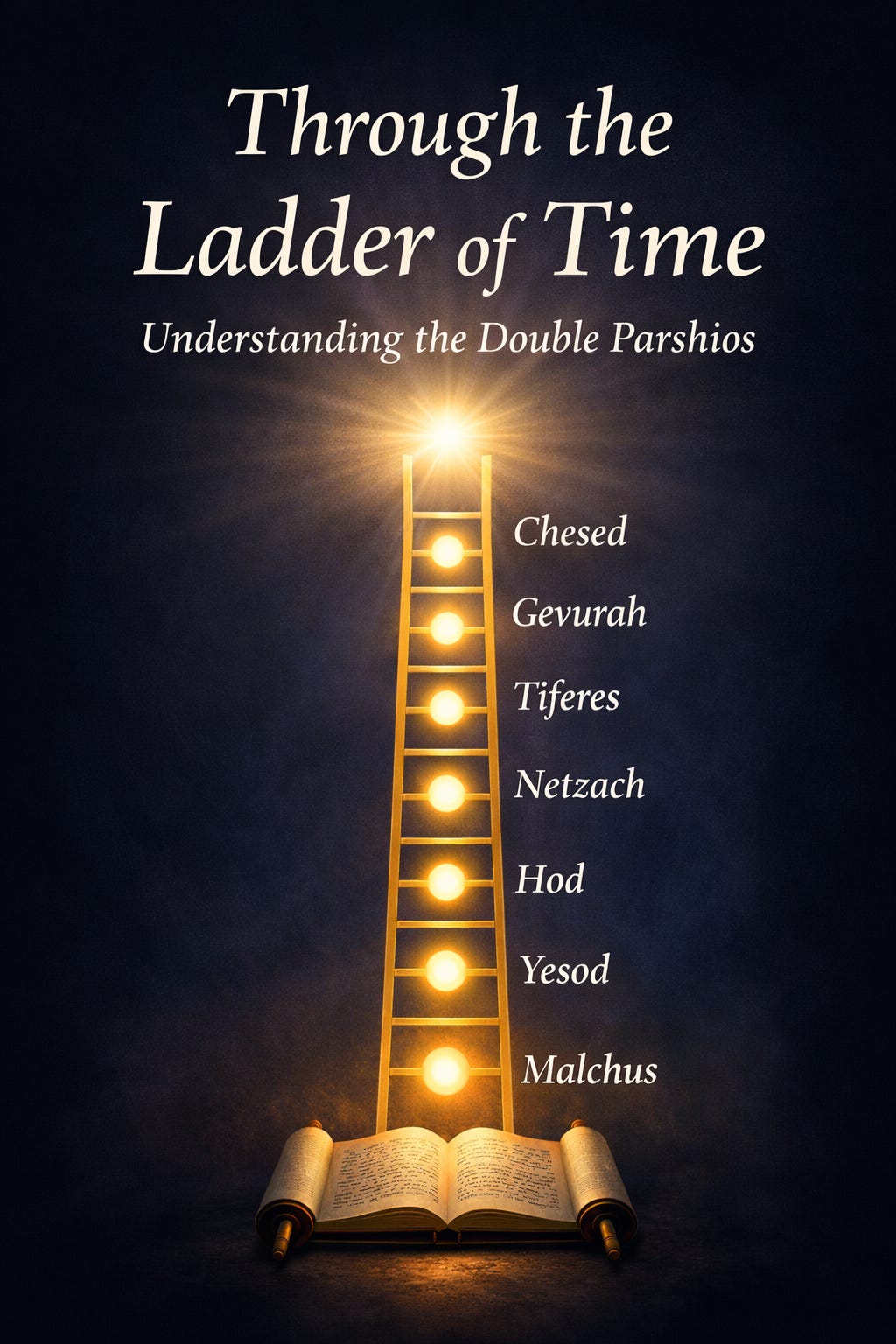
What makes that concept tempting is not just the number seven. If the whole idea were only that there are seven pairings and seven מידות (attributes), that would not say very much. But the pairings themselves seem to fit. Each one seems to carry its own kind of unity. And read in order, they seem to rise from מלכות (sovereignty / manifestation) upward to חסד (kindness / expansive devotion). I want to be clear that the ordering and correlations here are my own interpretation. I think there is solid foundation for them, but I have no basis for them other than my own observations and my own נטית הלב. I think there is a strong basis to say that these פרשיות can be read in relation to the ספירות, even if the exact ordering I am suggesting is my own interpretation.
ויקהל–פקודי feels most naturally like מלכות since ויקהל is the gathering of the people into a ציבור (community), and פקודי is the accounting, ordering, and completion of the משכן (Tabernacle). Everything that until now existed as command, generosity, wisdom, and intention comes down into concrete, visible, measured reality. The משכן stands. The שכינה (Divine Presence) has a dwelling below. That is the whole ענין (matter) of מלכות: receiving everything that came before and giving it actual form in the world.
תזריע–מצורע then rises into יסוד (foundation / channeling bond). תזריע opens with birth and with מילה (circumcision), starting the pair of פרשיות in the world of continuity, covenant, and the transmission of life. מצורע deals with disruptions in purity, containment, and proper expression, whether in the body, the garment, the house, or speech itself. Together they are about the channel through which life enters the world, and what happens when that channel is pure or when it is damaged. That feels very much like יסוד.
אחרי מות–קדושים seems to belong to הוד (splendor / yielded acknowledgment), especially through the figure of אהרן הכהן (Aaron the Priest). אחרי מות begins with the warning that even אהרן cannot enter the קודש הקדושים (sanctuary) whenever he wants. Closeness to Hashem comes only through the right form, the right גבול (boundary), the right kind of הכנעה (submission). קדושים then extends that same yesod into the whole life of the nation. Holiness here is not an unbounded soaring. It is sanctified restraint, separation, reverence, and living within Divine form. That has the feel of הוד: not self-assertion, but radiance through ביטול (self-nullification).
בהר–בחוקותי comes out as נצח (endurance / victorious persistence). בהר lays out the structure of life in the land: שמיטה (sabbatical year), יובל (jubilee), redemption, return, and the recognition that the land belongs to Hashem. בחוקותי then gives the covenantal consequences of faithfulness or betrayal: blessing, curse, exile, devastation, and still the enduring memory of the ברית (covenant). This is not just a פרשה of limits. It is a פרשה of covenantal endurance. Even punishment does not undo the relationship. It confirms how inescapably real it is. That is נצח, the persistence of Divine truth through history.
חוקת–בלק fits beautifully with תפארת (beauty / harmony / integrated truth). חוקת opens with אדומה פרה (the red heifer), the quintessential חק (supra-rational decree), where opposites are held together beyond ordinary understanding. It then moves through death and purification, complaint and healing, judgment and survival. בלק intensifies that same pattern. A curse is sought, yet blessing emerges. The nations rise against ישראל, and through the mouth of the corrupt בלעם, the beauty of ישראל is revealed. “מה טובו אהליך יעקב” is exactly the language of תפארת: beauty appearing through contradiction, harmony revealed where one would have expected fracture.
מטות–מסעי then corresponds to גבורה (strength / disciplined restraint). מטות opens with נדרים (vows), and a נדר is itself a very גבורה’dik thing: A person uses speech to set a boundary, to restrain, to impose barriers around desire. The rest of the פרשה continues in that world of firmness and דין (judgment): the war against Midian, the laws of kashering, the division of spoils, the conditions placed upon בני גד and בני ראובן. Then מסעי extends that same quality into the journeys, the borders, and the ערי מקלט (cities of refuge). Everything is measured, bounded, defined. The whole pair carries the tone of גבורה.
And then נצבים–וילך crowns the ascent as חסד. נצבים is Moshe Rabbeinu’s final gathering of all of כלל ישראל together: “אתם נצבים היום כולכם.” It is an act of inclusion in the deepest sense. Not just the leaders, but every stratum of the people is summoned to stand as one before Hashem. And וילך continues that same movement. Moshe is about to leave, but instead of withdrawing, he keeps giving: strengthening Yehoshua, writing the תורה, preparing the people for what comes next. At the very moment of parting, he is still gathering, still sustaining, still carrying them forward. That feels like חסד.
If so, the ascent would come out as follows:
ויקהל–פקודי = מלכות
תזריע–מצורע = יסוד
אחרי מות–קדושים = הוד
בהר–בחוקותי = נצח
חוקת–בלק = תפארת
מטות–מסעי = גבורה
נצבים–וילך = חסד
If this is right, then the שבע פרשיות המחוברות are not just seven convenient points of merger. They are seven places where the תורה itself contains a higher unity, seven joints in the annual cycle where two neighboring movements can become one without violence to either. The calendar did not create those pairings. It uncovered them.
And that may also explain something else: This structure is not always needed.
There are years when the calendar allows more of the פרשיות to remain distinct. That means the joined form is not the תורה’s only form, nor even always the form the particular year requires. Sometimes the year needs each unit to stand more separately. And sometimes the year calls for a more concentrated גילוי, one in which כלל ישראל is meant to receive not only the light of each פרשה individually, but the higher unity that emerges when two neighboring פרשיות become one.
That is where the distinction between a year of י״ב months and a year of י״ג months may become meaningful. In a year of י״ג months, there is already a broader spread in the year itself, perhaps a fuller גילוי in the register of the י״ג מידות הרחמים (the Thirteen Attributes of Mercy). The added month is not just extra time. It is a widening of the cycle. In such a year, less joining is needed, because the year itself already carries more breadth.
A year of י״ב months, by contrast, does not have that same expansion. But that does not mean it is lacking. It may be revealing completeness in another way: not through breadth, but through concentration. The תורה then discloses that certain adjacent פרשיות can be joined because their inner movement is one. The שבע פרשיות המחוברות become, in that sense, not makeshift compressions but revelations of a hidden ascent through the שבע מידות, דווקא when the fuller spread of י״ג is not present.
So one year reveals fullness through expansion, and another reveals fullness through integration. One broadens the cycle. The other compresses it upward into a visible ladder.
What also becomes clear from this is that the correspondence of each pairing to a particular מידה does not depend on all seven appearing in one year. The identity of the pairing is one thing; the degree to which the full structure becomes visible in a given year is another.
ויקהל–פקודי can still reflect מלכות, and תזריע–מצורע can still reflect יסוד, even in a year that does not display every possible pairing. The sevenfold order may belong to the inner architecture of the cycle as a whole, while each individual year reveals only as much of that hidden order as that year requires. What changes from year to year is not the meaning of the pairing, but how much of the overall ascent becomes manifest.
And maybe that is not just a structural point. Maybe it is a source of real חיזוק (strengthening).
If the shape of the year changes, and with it the way the פרשיות are joined or separated, then the year is not a neutral container through which we simply pass. The year itself has a design. Every month, and every form the year takes, carries the גילוי that is needed for that זמן. Sometimes that גילוי comes through breadth. Sometimes through concentration. Sometimes through distinctness, and sometimes through hidden unity. But either way, the message is the same: The calendar is not incidental. It is part of the way Hashem gives תורה to כלל ישראל in time.
That matters especially now. We no longer have the בית המקדש (Holy Temple), and we no longer have קידוש החודש (sanctification of the month) in its full original form. And yet we still live within the calendar that חז״ל (the Sages) established and preserved for us. And in that calendar, one can still see not only order, but care. A providential structure through which Hashem gives His people what they need.
The same is true of קריאת התורה. It is not simply that the תורה was divided for convenience into weekly portions. The yearly cycle, together with the shape of the calendar, becomes a vehicle through which different aspects of ׳רצון ה are disclosed. Sometimes the תורה appears in distinct units. Sometimes those units join and reveal a deeper unity. And together the calendar and קריאת התורה form one system, through which כלל ישראל is guided, strengthened, and given what it lacks.
Seen this way, what first appears to be a technical matter of scheduling becomes something much more comforting. The year is structured to meet us where we are. Its very form helps provide the spiritual configuration necessary for that year’s עבודה. If one kind of גילוי is absent, another appears. If the year does not widen, it may deepen. If it does not reveal through expansion, it may reveal through integration. But in all cases, the underlying truth is the same: Hashem has not left His people without orientation. Even in גלות (exile), even without the המקדש בית, the calendar and the תורה’s annual reading continue to bear witness to a Divine order that gives exactly the strengthening that is needed.
So what emerges here is not only a thought about double פרשיות. It is a thought about Jewish time itself. The year is not a passive backdrop to ׳עבודת ה (service of Hashem). It is part
of ׳עבודת ה. Every month, every configuration of the calendar, every joining or separation in קריאת התורה carries within it a particular גילוי of ׳רצון ה. Sometimes the year gives through expansion, and sometimes through compression. Sometimes through distinction, and sometimes through hidden unity. But always with precision.
And may we be זוכה (merit) to be genuinely inspired by these גילויים of ׳רצון ה, especially in those times and years when we so clearly need an extra dose of תורה for these specialפרשיות המחוברות. May they not only teach us how the calendar works, but help us feel how deeply Hashem continues to guide His people through time, giving us the חיזוק we need, the אור (light) we need, and the closeness we need, until we are זוכה to the full restoration of קידוש החודש and the בנין בית המקדש במהרה בימינו (rebuilding of the Holy Temple, speedily in our days).