


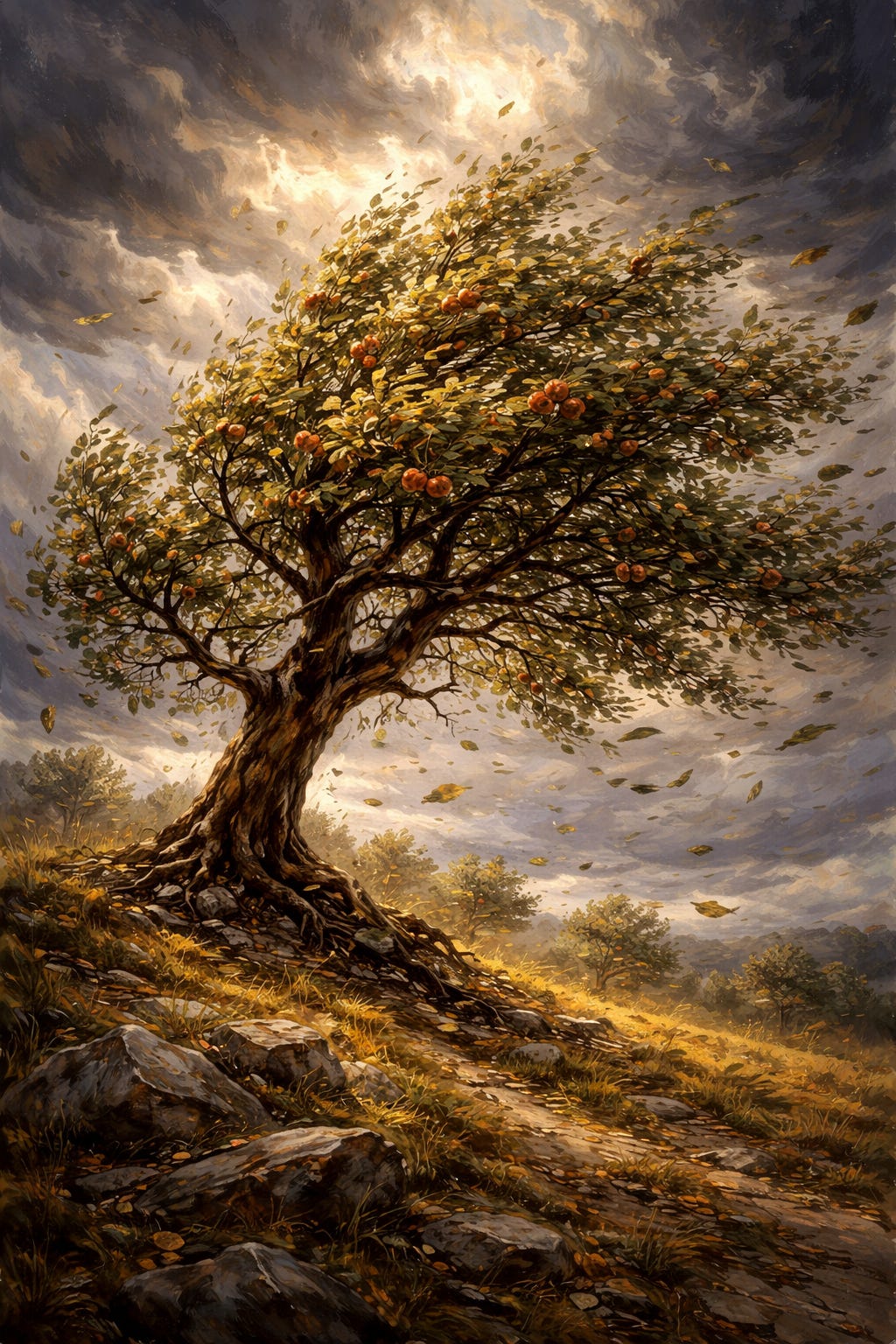
Fruit is Seasonal. Roots Aren’t. Torah Isn’t Either.
People love fruit. Results. Output. Something you can point to and say:
“Here—this is what I produced.”
But ט״ו בשבט comes along and tells you: nu… that’s not how you measure a tree.
A tree isn’t defined by what’s hanging on the branches today.
A tree is defined by whether it stays planted when the wind comes.
Because fruit is not ongoing. Fruit comes in seasons.
But roots? Roots are steady.
And that’s mamash the whole avodah of a person.
1) A Person Is a Tree
כִּי הָאָדָם עֵץ הַשָּׂדֶה — Ki ha’adam etz hasadeh (“man is a tree of the field”)
We quote כִּי הָאָדָם עֵץ הַשָּׂדֶה like a nice vort, but it’s a whole derech hachaim.
Trees sway. Trees bend. Trees get hit with wind and weather.
Sometimes they look loaded with fruit. Sometimes they look empty—winter, nothing.
But it’s still a tree.
That’s a person.
We have יָמִים טוֹבִים (yamim tovim — good days) and יָמִים קָשִׁים (yamim kashim — hard days).
Sometimes you’re in a matzav of geshmak, sometimes you’re just trying to keep your head above water.
The goal isn’t “never sway.”
The goal is:
Don’t get uprooted.
Because what keeps a tree from flying away isn’t the branches. It’s not even the trunk.
It’s the roots.
2) Tu B’Shvat Is About What’s Under the Surface
רֹאשׁ הַשָּׁנָה לָאִילָן — Rosh hashanah la’ilan (“the new year for the tree”)
Chazal call this day רֹאשׁ הַשָּׁנָה לָאִילָן.
Not a harvest celebration. A marker in the tree’s inner cycle.
And the Gemara explains why this date: by now, most of the year’s rains have already fallen, and the tree is already drawing nourishment from the new season.
Meaning:
The big change isn’t what you see on the branches.
It’s what has already soaked in.
So the question of the day is not:
“What fruit am I showing?”
The question is:
What’s feeding me?
What’s watering my inside?
What am I living off of?
3) Torah Is an עֵץ חַיִּים
עֵץ חַיִּים — Etz chayim (“Tree of Life”): Torah is alive, and Torah endures
We say about Torah:
עֵץ חַיִּים הִיא לַמַּחֲזִיקִים בָּהּ
Etz chayim hi lamachazikim bah — “it is a Tree of Life to those who hold onto it.”
That’s not poetry. That’s a definition.
A living tree has two qualities that look like opposites, but they go together:
It adjusts.
It endures.
Trees sway because they’re alive. If a tree was dead, it would snap.
Torah is also alive. New questions come up, new situations develop, new realities hit—Torah knows how to speak to it all without losing itself.
At the same time, Torah doesn’t get uprooted.
הֲלָכָה (halachah) is not seasonal. Cultures flip. Values change. Torah stands constant.
So yes: Torah “sways” in the sense that it applies itself to every dor and every matzav—
but it never detaches from emes.
That’s עֵץ חַיִּים.
4) Fruit Comes and Goes. Torah Doesn’t. Roots Don’t.
Here’s the chiluk.
A tree’s fruit is seasonal. Winter happens. There are stretches where nothing sweet is visible.
But Torah is not seasonal. Torah is a constant. There’s no off-season where Torah stops giving life.
If anything feels seasonal, it’s us.
Sometimes learning is geshmak. Sometimes it’s heavy.
Sometimes tefillah is flowing, sometimes it’s dry.
That’s our weather.
But Torah remains עֵץ חַיִּים — alive and life-giving.
And roots aren’t seasonal either.
Even when the branches are bare, the roots are working. Quietly. Steadily.
Holding the tree down so it doesn’t fly away.
That’s the picture of a Yid:
Fruit comes and goes, branches sway, but roots keep you planted.
5) The Rambam: Torah Must Lead to Action
שֶׁהַתַּלְמוּד מֵבִיא לִידֵי מַעֲשֶׂה — ShehaTalmud mevi lidei ma’aseh
The Rambam gives the exact language for what we’re saying:
שֶׁהַתַּלְמוּד מֵבִיא לִידֵי מַעֲשֶׂה
Torah study brings a person to action.
Torah is not just “nice.” Not just “deep.” Not just a good vort.
Torah is supposed to produce מַעֲשֶׂה (ma’aseh — lived action).
And here’s the nekudah:
מַעֲשֶׂה isn’t only what you do with your hands.
It’s what you do with yourself.
Because Torah fruit isn’t only mitzvos you can count.
Torah fruit is also who you become.
6) The Fruits of Torah
Chiddushim are fruit — but middos are the sweetest fruit
When people hear “fruits of Torah,” they think:
chiddushim
lomdus
a shtark vort
And emes—those are real fruits.
But the more beautiful fruit, the fruit that shows Torah is really alive inside a person, is:
מִדּוֹת — middos (character traits)
Sometimes the biggest fruit Torah produced is not a new sevara—
it’s that you became:
less reactive
more patient
more honest
more steady under pressure
more giving
more humble
That’s not a side benefit.
That’s Torah doing what it’s supposed to do.
7) A Kabbalah Layer That Actually Lands
ט״ו (15) → י״ה (Yud–Heh): thought moving into action
There’s something here al pi kabbalah:
ט״ו (15) hints to י״ה (Yud–Heh — the first two letters of Hashem’s Name), often connected to מַחֲשָׁבָה (machshavah — thought), the inner world.
And it fits mamash perfect with the tree mashal:
Roots = מַחֲשָׁבָה (thought): underground, hidden, what you’re really holding onto
Fruits = מַעֲשֶׂה (action): what shows up in the world
Now add the Tu B’Shvat timing: the rain season has done its main job—the nourishment has soaked in. The water is already inside the tree.
So too by a person: there are seasons where you’re absorbing—hearing, learning, building inside.
It may not look like “fruit” yet, because it’s going into the roots.
Then comes Tu B’Shvat: the nourishment is in.
Now it’s time for fruit to grow.
Now it’s time for action to come to fruition.
8) A Tu B’Shvat Kabbalah That Works
So maybe Tu B’Shvat isn’t the day to pressure yourself into instant fruit.
Maybe it’s the day to choose one root.
One steady practice that doesn’t depend on mood:
קְבִיעוּת עִתִּים לַתּוֹרָה (kevi’us ittim laTorah — fixed times for Torah), even small but consistent
a chavrusa / rebbi / mentor who keeps you attached
one tefillah anchor you refuse to drop
one middah you work on steadily
Because storms will come.
The goal isn’t never to sway.
The goal is to stay planted—build roots—so you can bear fruit over the long term.
Conclusion: Fruit for Thought
Let us all end with a reflection on the nourishment we have been soaking up these many cold months.
We live in a world that is all about instant gratification.
Tu B’Shvat is the opposite of this nekudah entirely.
It is about long work and sticking things out.
It is about enduring when times are tough.
May we all be זוכה (merit) to see the fruits of our labor.
May we grow every day and see משיח צדקינו in our lives!